Where you stay in Sicily determines what you see. The island is larger than most visitors expect approximately the size of Wales or the state of Vermont and driving from Palermo to Syracuse takes 3 hours on a good day. The decision about where to base yourself is therefore not a question of preference alone but a practical planning decision with significant consequences for your itinerary.
The good news is that Sicily has no bad bases. Every major town on the island has its own genuine quality, its own specific food culture, its own cluster of outstanding nearby attractions. The question is which combination of location, atmosphere and access to the destinations you prioritise fits your trip. This guide organises the options honestly by traveler type, by itinerary need and by the specific strengths and limitations of each area to help you make the right choice before you book.
In this guide
- Overview: how to choose your base
- Palermo the best base for first-timers
- Cefalù the best base for beach and culture combined
- Taormina the most scenic base on the eastern coast
- Catania the best base for the east coast without a car
- Ortigia/Syracuse the best base for the southeast
- Val di Noto the best base for the baroque circuit
- Agrigento the best base for the Valley of the Temples
- Trapani and the west the best base for western Sicily
- Agriturismo the Sicilian countryside alternative
- Practical tips for booking
- FAQ
Quick recommendation by traveler type
- First-time visitor: Palermo (2 nights) then move east
- Best for beach and culture: Cefalù or Taormina
- Best for history and archaeology: Ortigia/Syracuse or Agrigento
- Best for food and nightlife: Palermo or Catania
- Best without a car: Catania or Palermo (both have airports and train connections)
- Best for a quiet, slow pace: Ortigia, Noto, Marzamemi or an agriturismo in the countryside
- Best for Etna: Taormina or Catania
- Best for the Val di Noto baroque circuit: Noto, Ragusa Ibla or Syracuse/Ortigia
- Best for the Aeolian Islands: Milazzo (ferry base) or Taormina
Overview: How to Choose Your Base
The fundamental Sicily accommodation decision is east versus west. The island’s two international airports Palermo Falcone Borsellino (PMO) in the northwest and Catania Fontanarossa (CTA) in the east divide the island into two natural circuits. If you fly into Palermo, the natural base for the first part of your trip is Palermo itself, with Cefalù and the northern coast accessible to the north and the western circuit (Trapani, Marsala, Agrigento) accessible to the south and west. If you fly into Catania, the natural base for the eastern circuit is Catania or Taormina, with Etna, Syracuse, the Val di Noto and the Aeolian Islands all within reach.
For a full island circuit of 10 days or more, the most efficient approach is to fly into one airport and out of the other collecting a rental car at Palermo, driving the island clockwise (or counterclockwise), and returning the car at Catania for departure. This structure eliminates backtracking and allows you to change bases every 1 to 2 nights as the circuit progresses.
A rental car is essential for the full island itinerary. For those without a car, Palermo and Catania are the two cities with the best public transport connections to the rest of the island; Taormina and Syracuse are accessible by train; the smaller towns and archaeological sites (Agrigento, Selinunte, the Val di Noto outside the main towns) are difficult or impossible without independent transport. Read our complete Sicily road trip guide for the full driving advice.
👉Compare rental car prices at Palermo and Catania airports across all major companies. Book in advance for the best rates especially in July and August when cars sell out weeks ahead. Always select full coverage (zero excess).
👉 COMPARE THE BEST RENTAL CARS
Palermo the Best Base for First-Timers
Palermo is the best base in Sicily for a first visit. The combination of the Cappella Palatina, the three ancient markets, the baroque historic centre, the street food culture, the day trip options (Cefalù 70 kilometres east, Monreale 8 kilometres south, Segesta 60 kilometres west) and the genuine character of a working city of 700,000 people provides more depth per day than any other base on the island.
Two nights is the minimum for Palermo; three nights is more comfortable. Stay in the historic centre within walking distance of the Quattro Canti, the Cathedral and the Ballarò market for the most immersive experience. The ZTL (restricted traffic zone) covers most of the old city; park outside and walk in, or arrange hotel parking in advance.
Accommodation in Palermo ranges from boutique hotels in converted baroque palaces in the historic centre to international chain hotels near the Politeama district. The most atmospherically rewarding options are the smaller palazzo hotels and B&Bs in the streets around Piazza Bellini and Corso Vittorio Emanuele. For luxury, the Rocco Forte Villa Igiea a Liberty-style palace on the waterfront north of the historic centre, with views over the Gulf of Palermo is the finest hotel on this part of the island. Read our complete guides to things to do in Palermo and our Palermo in 2 days itinerary.
Cefalù the Best Base for Beach and Culture Combined
Cefalù is the finest base on the northern Sicilian coast for visitors who want the combination of a genuine Sicilian town, a Norman cathedral of the first rank and one of the best sandy beaches in northern Sicily immediately accessible on foot from their accommodation. No other town on the island combines these three elements historic architecture, beach and cultural depth at the same quality level and within the same 5-minute walking radius.
The town is small enough to be explored entirely on foot, which also means accommodation options are limited. Book well in advance for June through September; the best hotels and B&Bs in the historic centre fill months ahead. Cefalù is best as a 1 to 2-night stay within a broader itinerary rather than a week-long base it lacks the breadth of Palermo or Taormina for extended stays. The drive to Palermo is 70 kilometres (1 hour); to Taormina approximately 160 kilometres (2 hours). Read our complete Cefalù guide and Cefalù beach guide.
Taormina the Most Scenic Base on the Eastern Coast
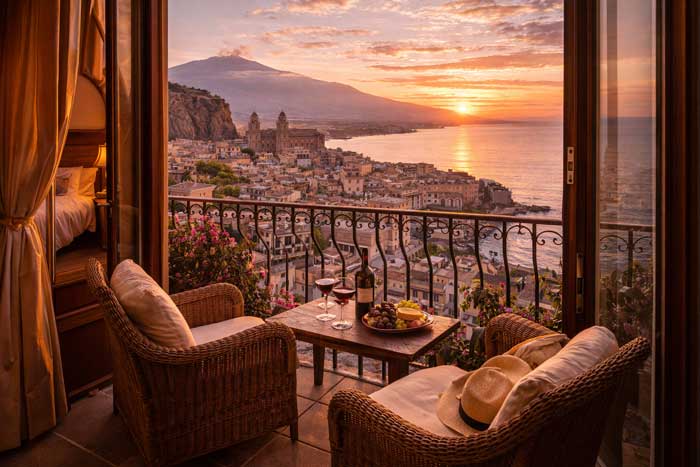
Taormina is the most immediately beautiful base in Sicily and the most expensive. The combination of the Greek theatre, the Ionian coastline view, Mount Etna on the northern horizon and the clifftop medieval town above the sea has made it a luxury and aspirational travel destination since the Grand Tour era, and the infrastructure of boutique hotels, high-end restaurants and refined services reflects this history.
The San Domenico Palace, now a Four Seasons hotel occupying a 15th-century Dominican convent above the Greek theatre, is the most celebrated hotel in Sicily and one of the finest in Italy. It was the filming location for HBO’s White Lotus second season, which gave it a new wave of international attention and a new price tier. The Grand Hotel Timeo, adjacent to the Greek theatre with a Michelin-starred restaurant, is the other landmark property. Both are extraordinary; both require advance planning and a budget to match.
Taormina’s practical limitations as a base: it is expensive compared to the rest of the island, the traffic and parking in the old town are complicated, and the driving distances to the western attractions (Agrigento, the Val di Noto) are significant. As an eastern coast base for Etna, the Alcantara Gorge and the Ionian coast, however, it is perfectly positioned. The cable car from the town down to Mazzarò beach is a specific practical pleasure. For families or budget travellers, Giardini Naxos 4 kilometres south along the coast, significantly less expensive and with direct beach access is the practical alternative with all the Taormina area attractions in reach. Read our complete Taormina guide and Taormina beach guide.
Catania the Best Base for the East Coast Without a Car
Catania is Sicily’s second city and the most underrated major base on the island. Its lava-stone baroque historic centre, its extraordinary morning fish market, its Etna-focused food culture and its position as the eastern transport hub (with direct train connections to Taormina, Syracuse, Messina and Palermo) make it the most practical single base for anyone exploring the eastern coast without a rental car.
The Catania Fontanarossa airport is 7 kilometres south of the city centre the shortest airport-to-centre journey of any Sicilian city and the train station connects directly to the Sicilian rail network. The city itself rewards exploration: the Piazza del Duomo and the lava-stone Baroque buildings, the fish market (one of the finest in Italy), the arancino culture of Via Etnea and the energy of a real working city that has not been refined for tourist consumption. Accommodation in Catania is significantly better value than in Taormina and the quality of mid-range options has improved substantially in the past decade. Read our complete Catania guide.
Ortigia/Syracuse the Best Base for the Southeast
For accommodation in the Syracuse area, always choose Ortigia over the mainland city. Ortigia is the island old town of Syracuse, connected to the mainland by bridge, car-free, 45 hectares in total area and home to approximately 5,000 permanent residents. It contains the Duomo (a Greek temple converted to a cathedral with the original Doric columns visible in the side walls), the Fonte Aretusa (a freshwater spring by the sea), the finest concentration of seafood restaurants in southeastern Sicily and the specific atmosphere of a baroque island town that has been continuously inhabited for 2,500 years. Staying on Ortigia rather than in the mainland city means walking everywhere, waking to the sound of the harbour and eating at the restaurants that the people who live there eat at every evening.
Ortigia accommodation fills quickly in July and August book early. The historic centro storico has several excellent boutique hotels and B&Bs in converted baroque palaces; the most atmospheric options are those with views over the harbour or the sea wall. The Syracuse Neapolis Archaeological Park (Greek theatre, Roman amphitheatre, Ear of Dionysius) is 20 minutes by car or taxi from Ortigia. From an Ortigia base, the Val di Noto baroque circuit Noto, Modica, Ragusa is 30 to 60 minutes by car. Read our complete Ortigia guide and Syracuse guide.
Val di Noto the Best Base for the Baroque Circuit
Visitors spending more than one night in the Val di Noto area face a choice between three excellent bases: Noto, Ragusa Ibla and Modica. Each has a different character, and the choice between them is partly a question of aesthetic preference.
Noto is the most architecturally coherent of the three the Corso Vittorio Emanuele is the finest single baroque street in Sicily, the golden limestone catches the late afternoon light with exceptional warmth, and the town has a visitor-focused infrastructure of good restaurants and accommodation options. It is the most convenient base for the Vendicari Nature Reserve (20 minutes) and Marzamemi (30 minutes).
Ragusa Ibla the lower baroque town on its limestone spur is the most atmospheric base, with the Giardino Ibleo viewpoint above the baroque skyline and the quieter evening atmosphere of a town that has not fully surrendered to tourism. The Inspector Montalbano television series was filmed extensively in Ragusa Ibla, giving it a specific cultural recognition among Italian television viewers internationally.
Modica sits between the two in character the chocolate tradition and the Bonajuto shop on Corso Umberto I are the primary visitor draws, alongside the baroque churches on the two hills. Read our complete guides to Noto, Ragusa and Modica.
Agrigento the Best Base for the Valley of the Temples
Agrigento as a base is essentially a question of whether the Valley of the Temples one of the most important archaeological sites in the world and the finest collection of Greek temples outside Greece itself is sufficient reason to stay. For most visitors on a full-island circuit, the answer is one night: enough for an early morning visit to the temples and an afternoon at the Scala dei Turchi before continuing west or north.
The most specific accommodation option in the Agrigento area is the Villa Athena a boutique hotel with a pool set inside the archaeological park itself, approximately 200 metres from the Temple of Concordia. The position is extraordinary; watching the illuminated temples from the hotel terrace at night, with no other buildings visible, is one of the most specific hotel experiences available in Sicily. The price is commensurate with the position.
For visitors without a car, Agrigento has a train station with connections to Palermo (2 hours) and Catania (3.5 hours), making it accessible but not ideally positioned for the broader western circuit. Read our complete Agrigento guide and Valley of the Temples guide.
Trapani and the West the Best Base for Western Sicily
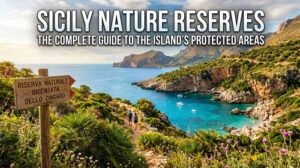
Trapani, on the northwestern tip of Sicily with views over the Egadi Islands, is the most convenient base for western Sicily’s specific combination of salt pans, Greek temples (Segesta, 30 minutes east), medieval hilltop towns (Erice, 15 minutes south), the Zingaro Nature Reserve (40 minutes northeast), the Egadi Islands (ferry from Trapani harbour) and the Marsala wine tradition (30 minutes south).
The city itself has a compact historic centre of some quality the Palazzo della Giudecca and the Cathedral are worth time and the seafront promenade at sunset, when the salt pans to the south turn pink and gold and the Egadi Islands are silhouetted on the horizon, is one of the finest natural light spectacles on the Sicilian coast. San Vito Lo Capo, 40 kilometres north of Trapani, is the beach alternative three kilometres of fine white sand considered the finest beach in western Sicily. Read our complete Trapani guide and San Vito Lo Capo guide.
Agriturismo the Sicilian Countryside Alternative
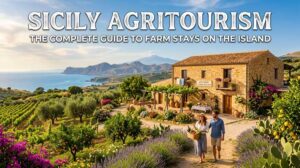
The agriturismo is a specifically Italian accommodation category a working farm or rural estate that offers rooms, meals and in many cases activities (olive oil and wine tasting, farm tours, cooking classes) alongside the practical accommodation function. Sicily has some of the finest agriturismi in Italy, and they represent one of the most specific and most rewarding accommodation experiences on the island for visitors who want something beyond the hotel and B&B format.
The best are concentrated in the areas with the strongest agricultural traditions: the Etna foothills (wine and pistachio country), the Hyblaean plateau near Ragusa (carob, almonds, the Ragusano DOP cheese), the Belice valley in the southwest (olive oil, excellent table grapes) and the Madonie mountains north of Palermo (mountain honey, wild mushrooms, the specific terroir of the Madonie DOC wines). A stay of 2 to 3 nights at a quality agriturismo provides a depth of encounter with the Sicilian agricultural landscape and food culture that no urban accommodation can offer. Meals are typically prepared with the property’s own produce and should be booked in advance.
Logistical note: virtually all agriturismi require a rental car. They are by definition not in town centres, and public transport access is limited to non-existent.
Practical Tips for Booking
Book accommodation in Sicily significantly earlier than you would for most European destinations. The best properties in Taormina, Ortigia and the smaller baroque towns fill 3 to 4 months in advance for July and August. For September and October, 6 to 8 weeks is usually sufficient. For spring (April to June), booking 4 to 6 weeks ahead is comfortable except for the most sought-after boutique properties.
Accommodation in the historic centres of Palermo, Catania and Taormina requires attention to the ZTL (restricted traffic zone). Most hotels in the ZTL have parking arrangements or can advise on the nearest car parks; clarify this before arrival to avoid fines. The ZTL cameras operate 24 hours a day in most historic centres.
July and August prices in Taormina and the beach towns are significantly higher than spring or autumn. September offers the best combination of warm weather, manageable crowds and reasonable prices across the island. Read our complete best time to visit Sicily guide for the full seasonal picture.
Frequently Asked Questions about Where to Stay in Sicily
What is the best base for a first visit to Sicily?
Palermo is the best overall base for a first visit the most culturally rich, the most historically layered, the best connected to the rest of the island by road and the most rewarding for the combination of monuments, food and daily life. Two nights in Palermo at the start of an island circuit provides the strongest foundation for understanding what Sicily is before you encounter the rest of it.
Where should I stay in Sicily without a car?
Palermo and Catania are the two best bases without a car both have international airports, train connections to the main Sicilian cities and town centres that are entirely walkable. From Palermo, Cefalù and Monreale are day-trippable by bus. From Catania, Taormina and Syracuse are accessible by train. The Valley of the Temples at Agrigento is the most difficult major attraction to reach without a car.
Is it better to stay in Taormina or Catania?
Taormina for scenic beauty, luxury and the specific atmosphere of a clifftop resort above the Ionian Sea. Catania for authenticity, value, food culture and practical transport connections. Taormina is more beautiful; Catania is more real. For a 10-day island circuit, staying one or two nights in each gives both experiences. Giardini Naxos is the budget alternative to Taormina with the same access to the area’s main attractions.
Where is the best place to stay in Sicily for beaches?
For the finest sandy beaches in western Sicily: San Vito Lo Capo (base: Trapani) and Mondello (base: Palermo). For the finest eastern coast beaches: Taormina’s Isola Bella and Mazzarò coves. For the Val di Noto coast: Vendicari and Calamosche beach (base: Noto or Syracuse/Ortigia). For the islands: Favignana (Egadi Islands, ferry from Trapani) and the Aeolian Islands (ferry from Milazzo).
Choose Well, Move Often
Sicily rewards the visitor who moves. The island is large enough that a single base cannot provide access to its full range without significant daily driving, but varied enough that each base change reveals a different character of the place. Two nights in Palermo for the Arab-Norman history and the street food, two in Taormina or Catania for the Etna and Ionian coast, two in Ortigia for the Greek heritage and the baroque southeast, one in the Val di Noto for the chocolate and the light on the golden limestone, one night in Agrigento for the temples at dawn this is the sequence that gives the most complete picture of the island in the shortest time.
For the full planning picture, read our 10-day Sicily itinerary, our 7-day Sicily itinerary and our Sicily travel tips guide.
Did this guide help you plan where to stay? Save it to Pinterest or share it with someone planning their first Sicily trip.