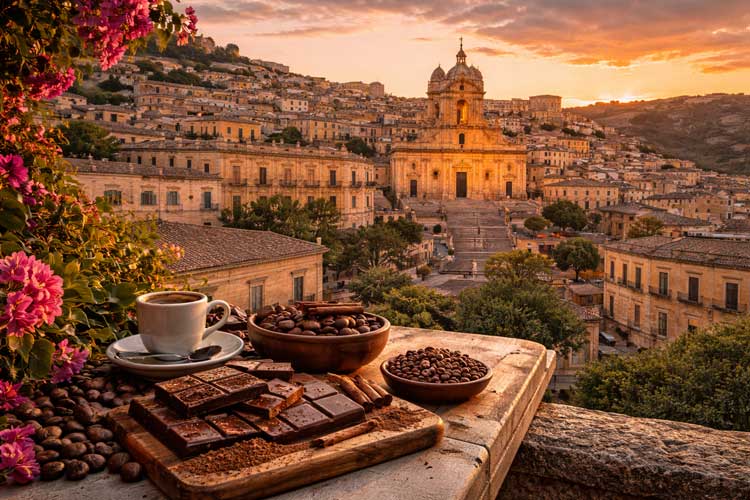
Modica is a city built on contradiction. It sits across four hills and two deep valleys in the Hyblaean plateau of southeastern Sicily, its baroque churches and palaces tumbling down steep slopes on all sides, its upper and lower halves connected by a staircase of 250 steps and a complex network of alleys, terraces and dead ends that turn every walk through the city into an act of mild exploration. It was almost entirely destroyed by the earthquake of 1693 and almost entirely rebuilt in the following decades, which gives it the peculiar character of a city that is both ancient in its bones and young in its architecture a medieval plan dressed in baroque clothing, worn with the ease of a city that has had three centuries to grow into its new identity.
And then there is the chocolate. Modica’s chocolate is made using a technique introduced by the Spanish in the 16th century, who had learned it from the Aztecs: raw cacao ground with sugar at low temperature, without cocoa butter, milk or vanilla, the sugar crystallising within the paste to give a texture that shatters and melts unevenly and releases flavour in waves. It is unlike any other chocolate in the world, and there is no better place to eat it than here, in the city that never stopped making it the old way.
In this guide
- Modica Alta and Modica Bassa understanding the city
- Duomo di San Giorgio Rosario Gagliardi’s masterpiece
- Corso Umberto and Modica Bassa
- Modica chocolate the complete guide
- San Nicolò Inferiore the cave church
- Salvatore Quasimodo the Nobel laureate’s birthplace
- The best viewpoints in Modica
- What to eat in Modica beyond chocolate
- Guided tours in Modica
- Day trips from Modica
- Practical information
- Frequently asked questions
Quick facts about Modica
- UNESCO status: Late Baroque Towns of the Val di Noto (2002)
- Location: Southeastern Sicily, province of Ragusa, 15 km from Ragusa, 30 km from Noto
- From Catania: 110 km, approximately 1 hour 30 minutes by car
- From Syracuse: 65 km, approximately 1 hour by car
- How many days: 1 full day minimum; 2 nights ideal as a base for the Val di Noto
- Best time to visit: April to June, September to October; the ChocoModica festival runs in November
- Famous for: Aztec-method chocolate, Duomo di San Giorgio, the “city of 100 churches”, Inspector Montalbano filming location
Modica Alta and Modica Bassa understanding the city
Modica is two cities in one, arranged vertically rather than horizontally. Modica Bassa (Lower Modica) occupies the valley floor where the rivers Janni and Pozzo once converged before being channelled underground in the early 20th century. The main street, Corso Umberto I, runs along the line of the old riverbed, flanked by baroque palaces, the Cathedral of San Pietro, chocolate shops and restaurants. This is where most visitors spend most of their time.
Modica Alta (Upper Modica) climbs the steep slopes above, its alleys and staircases rising through successive layers of stone to the Duomo di San Giorgio at the summit, and beyond it to the highest viewpoints over the city. Modica Alta is older, quieter and more architecturally concentrated than the lower town the churches are grander, the alleys narrower, the views more dramatic, and the tourist density lower. The physical effort of climbing from Modica Bassa to Modica Alta is real but modest: the main staircase of 250 steps from Corso Umberto to the Duomo di San Giorgio takes approximately fifteen minutes at a comfortable pace and is one of the great urban walks in southeastern Sicily.
Understanding the vertical division of the city is the key to navigating it. Start in Modica Bassa, walk the Corso, taste the chocolate and visit the Cathedral of San Pietro. Then climb the 250 steps to Modica Alta, visit the Duomo di San Giorgio, explore the upper alleys, and descend by a different route the city rewards those who find their own way through it.
Duomo di San Giorgio Rosario Gagliardi’s masterpiece
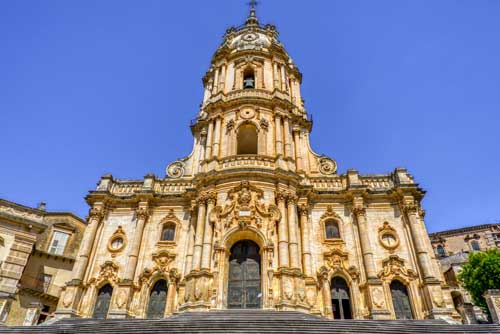
The Duomo di San Giorgio in Modica Alta is the finest building in the city and one of the great baroque churches of Sicily. It was designed by Rosario Gagliardi, who also designed the Duomo di San Giorgio in Ragusa Ibla and the Cathedral of San Nicolò in Noto, making him the defining architectural figure of the Val di Noto reconstruction. The Modica Duomo, begun in 1702 and completed in 1738, is considered his greatest achievement: a 62-metre facade of three curved and tapering tiers, each layer of columns more vertical than the one below, rising to a finial above the central bay with the concentrated authority of a building that knows exactly what it is trying to be.
The staircase of 250 steps that connects the Duomo to Modica Bassa below is as important as the church itself. From the foot of the stairs, looking up the full flight with the facade above, you are looking at one of the most theatrical spatial compositions in Sicilian baroque a church that has been positioned and designed to be approached from below, its drama built into the act of ascent. Climb slowly. The view from the piazza at the top, looking back down the stairs and across the city below, is one of the finest urban views in southeastern Sicily.
Inside the Duomo, the blue stucco decoration and gilded details of the baroque interior are notable, but the most interesting single object is the solar meridian marked on the floor of the nave: a brass line running north-south, calibrated so that at precisely midday on the summer solstice a shaft of light through the oculus above strikes a specific point on the line. It is a reminder that the baroque architects of the Val di Noto were not only building for spiritual effect they were building instruments of observation and measurement as well. Arrive at midday if you can to see it in action.
Corso Umberto and Modica Bassa
The Corso Umberto I is the spine of Modica Bassa, running east to west along the line of the old riverbed through the most architecturally dense section of the lower city. The buildings on either side are a continuous sequence of baroque palaces, civic buildings, churches and aristocratic residences in the warm local limestone, punctuated by the grand staircase of the Cathedral of San Pietro at the western end.
The Cathedral of San Pietro is distinguished from the Duomo di San Giorgio by scale and position rather than quality: a broad, horizontal building at street level, approached by a staircase flanked by twelve life-size statues of the Apostles that were added in 1876. The interior contains frescoes of Old and New Testament scenes and a statue of the Madonna di Trapani brought from western Sicily. The cathedral is active and plays a central role in Modica’s religious life services are held regularly, and the building can be closed to visitors during them.
Walking the full length of the Corso from east to west takes approximately twenty minutes at a tourist pace, passing the Palazzo della Cultura (which houses the Civic Archaeological Museum and the Museo del Cioccolato), the Garibaldi Theatre, numerous aristocratic palaces and the concentration of chocolate shops that have made the street famous in food travel circles across Europe. The late afternoon passeggiata, when Modica’s residents walk the Corso for their evening aperitivo, is the finest time to experience the street as a living urban space rather than an architectural set piece.
Modica chocolate the complete guide
Modica chocolate deserves its own section because it is genuinely unlike anything else available in Italy and because the experience of buying, tasting and understanding it in the city that invented this version of the process is significantly different from buying a bar in a specialty food shop in London or New York.
The production method is simple in principle and extraordinary in result: raw cacao paste is ground with sugar and flavourings at a temperature that never exceeds 40 degrees Celsius. Because the chocolate is never heated beyond this point, the sugar crystals remain intact rather than dissolving into the fat which means the finished bar has a grainy, crystalline texture that shatters when broken and releases flavour through the friction of chewing rather than through the smooth melt of conventional chocolate. It is a texture that confuses some visitors on first encounter and delights almost everyone on second.
The classic flavours are vanilla and cinnamon, reflecting the Spanish colonial connection to Mexico where cacao was first cultivated. More recent innovations include chilli, orange, carob, sea salt, Bronte pistachio and Modica rum. Each chocolate shop on the Corso has its own house specialities, and buying one bar from three or four different producers and comparing them is one of the most interesting food activities available in southeastern Sicily.
Antica Dolceria Bonajuto, founded in 1880 at Corso Umberto 159, is the oldest chocolate shop in Modica and the most famous. Its production methods are documented and its flavour range is the broadest. It also offers tasting sessions and chocolate-making demonstrations. Cioccolato di Modica Sabadì is the most respected artisan producer among Italian food critics, with a focus on single-origin cacao and minimal flavouring. Both are worth visiting; the differences between their products reflect genuine differences in production philosophy rather than marketing.
The Museo del Cioccolato di Modica on Corso Umberto covers the history of cacao in Sicily from the Spanish colonial period through the present, with exhibits on the production process, period equipment and the cultural significance of the chocolate tradition for Modica’s identity. Entry costs approximately €3 and takes 45 minutes. The November ChocoModica festival brings chocolate producers from across the island and beyond to Corso Umberto for a weekend of tastings, demonstrations and events one of the finest food festivals in southeastern Sicily.
Modica chocolate-making workshop
Learn the Aztec cold-press technique from a local chocolatier, make your own bar with the flavours of your choice and take it home. Available in English, small groups, approximately 1.5 hours.
👉SEE THE BEST Modica chocolate-making workshop here
San Nicolò Inferiore the cave church
The most unusual and least visited monument in Modica is also the oldest. San Nicolò Inferiore is a Byzantine church carved directly into the limestone rock of the hillside below Modica Alta. It dates to the 12th century and remained completely unknown until 1987, when restoration work on a building above it accidentally broke through to the cave beneath. The discovery revealed intact Byzantine frescoes of extraordinary quality, painted directly on the rock walls and ceiling, and a physical space of remarkable intimacy: a low-ceilinged cave no larger than a medium-sized room, with carved columns, carved apses and the remnants of a liturgical programme that had been sealed and forgotten for eight centuries.
The church is open to visitors for a small entry fee of approximately €2.50 and takes fifteen minutes to visit. It sits on a side street off the Corso Umberto, easily missed without knowing to look for it. No other monument in Modica provides quite the same quality of physical encounter with the pre-baroque, pre-earthquake, pre-reconstruction city the city that existed before 1693 and that the earthquake erased almost everywhere else.
Salvatore Quasimodo the Nobel laureate’s birthplace
Modica is the birthplace of Salvatore Quasimodo, who won the Nobel Prize in Literature in 1959 the only Nobel laureate in literature that Sicily has produced. Quasimodo was born here in 1901, the son of a railway stationmaster, and left the city young, spending his adult life in Milan where he developed into one of the leading figures of Italian Hermeticism, the modernist poetic movement that dominated Italian literature in the mid-20th century.
The house in which he was born, on Corso Umberto, has been preserved as the Casa Natale di Salvatore Quasimodo and is open for guided visits. The bedroom is furnished as it would have appeared in 1901; another room recreates the Milan studio where he wrote his mature work. The visit is brief but provides an unexpected cultural dimension to the chocolate and baroque narrative that dominates most Modica itineraries a reminder that this small city on a Sicilian hillside gave the world one of the 20th century’s significant poets.
The best viewpoints in Modica
Modica’s vertical topography creates exceptional viewpoints at multiple levels, each offering a different perspective on the city and the surrounding Hyblaean landscape. The following are the finest:
Belvedere Pizzo, in the upper part of Modica Alta, provides the broadest panoramic view over the city: the whole of Modica Bassa below, the Corso running through it, the Cathedral of San Pietro on the left and the hills rising on either side. This is the classic sunset viewpoint, when the city turns amber and the sky over the plateau deepens to violet. The walk up from the Duomo di San Giorgio takes approximately ten minutes on steep alleys.
The piazza of the Duomo di San Giorgio, reached by the 250 steps from the Corso, provides the finest mid-level view: the city stretching east and west below, the Valle dei Santi between Modica Alta and Modica Bassa, and the Hyblaean hills on the horizon. This is the view that appears most frequently in photographs and films of the city, including multiple episodes of Inspector Montalbano.
Chiesa di San Giovanni Evangelista, at the very top of Modica Alta, has a viewing terrace adjacent to the church that is the highest freely accessible viewpoint in the city. The view extends across the full width of the Hyblaean plateau on clear days, with the distant shimmer of the Ionian Sea visible on the southeastern horizon. The church itself, with its relatively simple baroque exterior and richly decorated interior, is one of the more peaceful spaces in the upper city.
What to eat in Modica beyond chocolate
Modica’s food culture is rooted in the Hyblaean agricultural tradition of sheep farming, carob cultivation, almonds and olive oil, with a strong seafood component from the nearby coast. Several dishes are specifically associated with the city.
Scaccia ragusana is the most distinctively local food in Modica: a thin, layered flatbread of dough folded repeatedly around a filling of tomato, ricotta and caciocavallo cheese, then baked until the exterior is crisp and the interior creamy. It is sold in bakeries and small food shops throughout the city and makes an excellent lunch or mid-morning snack. Different from anything available elsewhere in Sicily and extremely good.
Mpanatigghi are small filled pastries of Arab origin, specific to Modica: a shortcrust shell filled with minced beef, chocolate, almonds, cinnamon and spices. The combination of meat and sweet spices in a pastry is a direct legacy of the medieval Arab culinary tradition that the Spanish and Norman periods absorbed into Modicano cooking. They are available at the better pastry shops on and off the Corso and are one of the genuinely specific food experiences of the city.
For dinner, the restaurant Accursio on Via Grimaldi holds a Michelin star and is the finest creative kitchen in the Val di Noto after Ragusa’s Ristorante Duomo Chef Accursio Craparo’s menu draws on the full range of Hyblaean seasonal produce with a technical sophistication and an emotional connection to the territory that makes it one of the most rewarding dining experiences in southeastern Sicily. Advance booking is essential. At the other end of the price range, Radici on Corso Umberto is consistently recommended for honest Sicilian cooking at fair prices and is the best option for a dinner without a reservation.
Guided tours in Modica
Modica’s layered history Byzantine, Norman, Arabic, Spanish baroque is significantly enriched by a guide who knows how to read the layers. The Duomo di San Giorgio in particular, with its solar meridian, its pre-earthquake portal preserved in the lower structure, and the specific symbolism of Gagliardi’s architectural programme, yields considerably more to an informed visitor than to one reading a standard description.
Modica baroque walking tour with a local guide
A guided walk through Modica Alta and Bassa covering the Duomo di San Giorgio, the cave church of San Nicolò Inferiore, the solar meridian and the chocolate tradition. Available in English, approximately 2 hours.
👉SEE THE BEST Modica baroque walking tour with a local guide here
Val di Noto baroque towns tour Modica, Noto and Ragusa
A full-day guided circuit of the three UNESCO baroque towns of southeastern Sicily the most efficient way to see Modica, Noto and Ragusa in a single day with expert commentary from Syracuse or Catania.
👉SEE THE BEST Val di Noto baroque towns tour Modica, Noto and Ragusa here
Modica sits at the centre of the Val di Noto baroque cluster and is one of the best bases in southeastern Sicily for day trips. All the major destinations are within 30 to 60 minutes by car.
Day trips from Modica
Ragusa (15 km, 25 minutes): The most architecturally complex of the baroque towns, split between Ragusa Ibla below and Ragusa Superiore above, connected by 242 steps and home to the two-Michelin-star Ristorante Duomo. Read our complete guide to things to do in Ragusa.
Noto (30 km, 40 minutes): The finest example of baroque urban planning in Sicily, with the finest bar in Italy (Caffè Sicilia) and the Infiorata flower festival each May. Read our complete guide to things to do in Noto.
Scicli (15 km, 20 minutes): The quietest and least touristy of the UNESCO baroque towns, with the celebrated Palazzo Beneventano, rock churches carved into the clifftop, and the familiar streets of the Inspector Montalbano series. A perfect half-day excursion.
Cava d’Ispica (15 km, 20 minutes): A dramatic limestone gorge carved by the Ispica river, with ancient cave dwellings, rock-cut tombs, Byzantine chapels and the ruins of the ancient city of Ispica built into the canyon walls. An extraordinary natural and archaeological site almost entirely unknown to international visitors and barely 20 minutes from Modica.
Syracuse and Ortigia (65 km, 1 hour): The ancient Greek city with the finest island old town in southeastern Sicily. A full day is needed. Read our complete guide to things to do in Syracuse.
Book your Sicily rental car
Compare prices across all major car hire companies in Sicily, including Palermo and Catania airports, and book in advance to get the best rates. Always select full coverage (zero excess) when booking in Sicily.
👉COMPARE THE BEST RENTAL CARS HERE
Practical information for visiting Modica
How to get there
From Catania, the drive takes approximately 1 hour 30 minutes via the A18 and SS115 (110 km). From Syracuse, approximately 1 hour via the SS115 (65 km). From Ragusa, 25 minutes (15 km). Modica is accessible by train from Syracuse, Ragusa and Catania on the regional network, though services are infrequent and the train station in Modica Bassa is a short walk from the Corso. A rental car gives the most flexibility for reaching Cava d’Ispica and the beaches. Read our Sicily road trip guide for driving tips across the island.
Getting around
Modica Bassa is entirely walkable. Modica Alta requires either climbing the 250-step staircase from Corso Umberto or driving up via a separate road to park near the Duomo di San Giorgio. Local taxis are available for the uphill journey. The combination of the physical effort and the views on the staircase makes climbing up worth doing at least once, even in summer start early in the morning before the heat builds.
When to visit
April, May, June, September and October are the best months. The ChocoModica festival in November is one of the finest food events in southeastern Sicily and a genuine reason to visit at that time of year. July and August are hot and significantly more crowded. Read our complete guide to the best time to visit Sicily for the full seasonal picture.
How many days
One full day is the minimum for a meaningful visit covering the Duomo, the Corso, the chocolate and the cave church. Two nights makes Modica a genuine base for the Val di Noto cluster, with time for day trips to Ragusa, Noto and Scicli. Read our complete Sicily 7-day itinerary for how to integrate Modica into a broader island circuit.
Frequently asked questions about Modica
Is Modica worth visiting?
Yes, strongly. Modica is one of the most beautiful and most distinctive small cities in Italy the combination of baroque architecture, extraordinary topography, the chocolate tradition and the cave church of San Nicolò Inferiore is entirely specific to this place. It is less polished than Noto and less famous than Ragusa, which means it retains a genuinely local character that both of those towns have partly lost to tourism.
How long do you need in Modica?
One full day is sufficient to see the main highlights the Duomo di San Giorgio, Corso Umberto, the chocolate, the cave church and the viewpoints. Two nights as a base for the Val di Noto is the ideal length. Modica works well as a hub for day trips to Ragusa, Noto, Scicli and Cava d’Ispica.
What is Modica chocolate and why is it special?
Modica chocolate is made using a cold-process method introduced to Sicily by the Spanish in the 16th century, derived from the original Aztec technique of grinding cacao with sugar without heat. Because the sugar never dissolves into the fat, it crystallises within the paste and gives the finished chocolate a grainy, shattering texture entirely unlike conventional chocolate. It is produced exclusively in Modica and several other towns of the province of Ragusa, and the Indicazione Geografica Protetta (IGP) designation protects the name. No other chocolate in the world is made this way at commercial scale.
What is the Duomo di San Giorgio in Modica?
The Duomo di San Giorgio is the principal landmark of Modica, a baroque cathedral in Modica Alta designed by Rosario Gagliardi and built between 1702 and 1738. Its 62-metre triple-tiered facade and the 250-step staircase connecting it to Modica Bassa are considered among the finest examples of Sicilian baroque architecture. The interior contains a solar meridian on the nave floor that marks the summer solstice at midday, and a polyptych by Bernardino Nigro from the 16th century that is the largest of its kind in Sicily.
Can you visit Modica as a day trip?
Yes. Modica’s main sights are concentrated and the city is compact enough to see comfortably in a full day. It is a natural day trip from Ragusa (25 minutes), Syracuse (1 hour) and Noto (40 minutes). However, the evening atmosphere in Modica the passeggiata on Corso Umberto, the buildings lit at night, the calm of the upper city after the day visitors leave is significantly different from and better than the daytime experience, and staying overnight is strongly recommended if your schedule allows.
Plan your visit to Modica
Modica is a city that gives most generously to those who approach it without a fixed programme: who climb the 250 steps slowly, who eat a scaccia at a bakery on a side street, who find the cave church by chance and spend twenty minutes in its quiet interior, who sit at a table on the Corso at dusk and watch the passeggiata pass. It is one of the most specifically and irreplaceably itself places in Sicily, and it is one of the best reasons to spend time in the southeastern corner of the island.
For the complete Val di Noto experience, read our guides to Ragusa, Noto and Syracuse. For the full island, read our Sicily 7-day itinerary and our complete Sicily road trip guide.
Did this guide help you plan your Modica visit? Save it to Pinterest or share it with someone planning a trip to Sicily.