Trapani sits at the far western tip of Sicily, where the island narrows to a point and the land gives way to a sea that turns turquoise and then deep blue as it reaches towards the invisible coastline of Tunisia. It is a city that operates differently from the more famous destinations of eastern Sicily: less theatrical, less polished, less concerned with its own image. The streets of the old town smell of salt and fish and the particular cleanness of a sea wind that has crossed open water without interruption. The pace is slower. The food is different. And just offshore, the three islands of the Egadi archipelago float in water so clear that you can see the bottom from the deck of the ferry.
Trapani is one of the best bases in Sicily for those who want to explore the western side of the island, and it is considerably more rewarding than its relatively modest tourist profile suggests. The salt pans at sunset are among the finest natural spectacles on the island. Medieval Erice, perched above the city at 750 metres, is one of the most atmospheric hill towns in the Mediterranean. The Greek temple at Segesta ranks with anything at Agrigento. And the couscous served in Trapani’s restaurants is widely considered the finest expression of this North African dish in all of Italy.
This guide covers everything you need to know about the best things to do in Trapani and the surrounding area.
In this guide
- The old town: Corso Vittorio Emanuele and the baroque churches
- The seafront walk and Torre di Ligny
- The salt pans of Trapani and Paceco
- The Egadi Islands: Favignana, Levanzo and Marettimo
- Erice — the medieval town above the clouds
- Segesta — the Greek temple in the hills
- Riserva dello Zingaro
- Marsala and the wine route
- What to eat in Trapani
- Practical information
- Frequently asked questions
Quick facts about Trapani
- Location: Northwestern tip of Sicily, province of Trapani
- Airport: Trapani Birgi (TPS), also served by Palermo (PMO, 100 km)
- Best season: April to June, September to October
- How many days: 3 to 4 nights to cover city, salt pans, Erice and the Egadi Islands
- Famous for: Salt pans, Egadi Islands, fish couscous, medieval Erice, Greek temples at Segesta
- Ferry connections: Egadi Islands (Favignana, Levanzo, Marettimo), Pantelleria, Malta, Tunisia
The old town: Corso Vittorio Emanuele and the baroque churches

Trapani’s historic centre occupies a narrow peninsula that juts westward into the sea like a scimitar blade, giving the city an unusual elongated shape and ensuring that the sea is never more than a few minutes’ walk from any point in the old town. The main street, Corso Vittorio Emanuele, runs the full length of this peninsula from the bustling eastern entrance near the market to the Torre di Ligny at the western tip, lined on both sides with baroque palazzi whose ornate facades speak to the city’s former wealth as a major Mediterranean trading port.
Trapani was once one of the most important commercial cities in the western Mediterranean, its economy built on the trade of salt, coral and tuna. The wealth generated by this trade in the 16th through 18th centuries funded the construction of the baroque civic buildings, churches and aristocratic palaces that give the old town its architectural character. Unlike Noto or Ragusa, which were rebuilt entirely after the 1693 earthquake, Trapani’s old town grew organically over centuries and has a more layered, less theatrical quality — the Arab-Norman influence visible in the street plan, the Spanish baroque in the church facades, and the more modest vernacular architecture of the fishermen’s quarter all coexisting without contradiction.
The Cattedrale di San Lorenzo, on Corso Vittorio Emanuele, is the most important church in the old town: a baroque building of considerable grandeur, its pale stone facade rising directly from the pavement of the main street, its interior decorated with light blue and gold stucco work that gives it an almost maritime quality. The painting of the Crucifixion attributed to Van Dyck in the right transept is the most celebrated single work of art in Trapani. Entry is free.
The Chiesa del Purgatorio, a few streets away, is famous for housing the twenty wooden statues known as the Misteri di Trapani: life-sized 17th and 18th century figures depicting the Passion of Christ, carried through the streets of the old town in the extraordinary Good Friday procession that is one of the longest and most emotionally powerful religious events in Sicily, lasting over 24 hours. The procession, which takes place each year in the days before Easter, draws visitors from across Europe and is one of the most compelling reasons to time a visit to Trapani in spring. Read our guide to the best time to visit Sicily for the full Easter events calendar.
The Mercato del Pesce, the fish market, operates every morning except Sunday in the streets just off the eastern entrance to the corso. Smaller and less theatrical than Catania’s Pescheria, it nonetheless offers a vivid introduction to the seafood culture of western Sicily: swordfish, red prawns, sea urchins, octopus and the small, intensely flavoured local fish that end up in the city’s couscous pots and pasta sauces.
The seafront walk and Torre di Ligny
One of the finest ways to understand Trapani’s geography and its relationship with the sea is to walk the full length of the Mura di Tramontana, the old northern defensive wall that runs along the seafront from the market area to the Torre di Ligny at the peninsula’s tip. The walk takes about 30 minutes at a gentle pace and reveals, at different points, the salt lagoon to the south, the open Tyrrhenian to the north, the distant silhouette of Erice above, and the outline of the Egadi Islands on the horizon.
At the westernmost point of the city, the Torre di Ligny stands on a small rocky promontory connected to the mainland by a narrow stone path. Built by the Spanish in 1671 to defend against pirate raids, it is a squat, solid tower that houses a small archaeological museum with finds from the sea around Trapani, including bronze rams from the ancient naval battle of the Egadi Islands in 241 BC, the largest naval battle in antiquity and the encounter that ended the First Punic War. The tower’s rooftop terrace offers the finest panoramic view in the city: the full arc of the peninsula behind you, the open sea ahead, and on clear days the Egadi Islands floating on the western horizon. It is the best place in Trapani to watch the sunset.
The Castello della Colombaia, a 15th-century Aragonese fortress rising from a small island just offshore from the northern wall, visible throughout the seafront walk, cannot currently be visited inside but contributes powerfully to the skyline of the old town as seen from the water.
The salt pans of Trapani and Paceco

Six kilometres south of Trapani, the Saline di Trapani e Paceco are the most extraordinary natural and industrial landscape in western Sicily. A protected WWF nature reserve covering approximately 1,000 hectares of shallow coastal lagoons, the salt pans have been producing sea salt continuously for over two thousand years: the Phoenicians, the Romans, the Arabs and the Normans all harvested salt here, and the traditional windmills that once pumped water between the pans are still standing, some still operational, their white sails turning slowly against the sky.
The salt of Trapani is one of the finest in the world. Harvested entirely by traditional methods, it is coarser than industrial salt, mineral-rich and with a flavour that is noticeably more complex than table salt. It has protected designation of origin status and is used by some of the finest restaurants in Italy. The packets of Trapani sale integrale sold in the reserve’s shop are one of the best and most practical food souvenirs available in western Sicily — inexpensive, genuinely exceptional, and easily carried home. Read our guide to typical Sicilian products for more on the food specialities of the island.
The best time to visit the salt pans is in the late afternoon, from around 4pm onwards, when the low sun turns the shallow water and the piled salt crystals through a sequence of extraordinary colours: white, then pale gold, then deep amber, then pink, then a vivid flamingo rose that reflects the actual flamingos that feed in the shallower sections from autumn through spring. The salt pans are home to over 200 species of migratory and resident birds, including flamingos, herons, egrets, avocets and spoonbills, making this one of the most rewarding birdwatching locations in Sicily.
A self-guided visit to the reserve costs approximately €8, which includes access to the salt museum housed in one of the old windmills. A guided boat tour departing every 30 minutes takes visitors past the original windmills and to the finest sunset viewpoints at a cost of approximately €16 per person and is strongly recommended for the context it provides on the history and ecology of the reserve.
👉 BEST SALT PANS TOUR FROM TRAPANI
Without a rental car, the salt pans are not served by public transport and are most easily reached by joining an organised tour from the city. The taxi fare from the old town is approximately €15 each way.
The Egadi Islands: Favignana, Levanzo and Marettimo

The three main islands of the Isole Egadi sit just off the western coast of Sicily, visible from Trapani on any clear day, and they are among the finest island destinations in the entire Mediterranean. The Egadi Marine Reserve is the largest protected marine area in Europe, and the quality of the water, the clarity, the richness of the marine life, the colour that changes from pale turquoise in the shallows to deep cobalt in the open sea, is exceptional. A day trip to at least one of the islands is one of the most important things to do from Trapani.
Favignana
The largest and most accessible of the Egadi Islands, Favignana is a 20-minute hydrofoil ride from Trapani port. It is shaped like a butterfly and can be comfortably explored in a single day by bicycle, with the rental shops near the harbour offering good-quality bikes at approximately €10 to €15 for the day. The finest beaches are Cala Rossa, where white limestone cliffs sculpted by the sea form natural platforms above extraordinary clear water, and Cala Azzurra, a perfect small sandy bay at the eastern end of the island. The old tuna fishery, the ex Stabilimento Florio, tells the story of the bluefin tuna industry that once defined the economy of the entire western coast of Sicily.
Levanzo
The smallest of the three main islands and the most tranquil, Levanzo has a single small village, a handful of restaurants and very little infrastructure beyond the ferry connection. Its principal attraction is the Grotta del Genovese, a sea cave accessible only by boat or on foot from the village, whose walls are covered in prehistoric engravings and cave paintings dating back up to 10,000 years. The paintings of deer, horses, fish and human figures are among the finest examples of Palaeolithic art in Italy and are almost entirely unknown to international visitors. A visit requires a guide from the island; contact the custodian in advance to arrange access.
Marettimo
The most remote of the three main islands, Marettimo is a 75-minute hydrofoil ride from Trapani and rewards those who make the journey with the finest hiking in the Egadi archipelago, a small and unpretentious village, and the cleanest, most transparent water in western Sicily. The island has no cars, no beach clubs and no tourist infrastructure beyond a few simple restaurants and guesthouses. Walking the path around the headland to the abandoned Norman fortress at the summit, with views across the open Mediterranean in every direction, is one of the finest walks in Sicily.
Ferry and hydrofoil services to all three islands depart regularly from Trapani port. The hydrofoil is significantly faster than the ferry and more comfortable in rough weather. In summer, services run frequently throughout the day; in winter, schedules are reduced.
👉SEE THE BEST FULL-DAY EGADI ISLANDS BOAT TOUR FROM TRAPANI
Erice – the medieval town above the clouds
At 750 metres above the sea, the medieval town of Erice occupies the summit of Monte San Giuliano above Trapani and is one of the most atmospheric and visually extraordinary places in western Sicily. Founded by the Elymians in the first millennium BC, later occupied by every Mediterranean civilisation from the Phoenicians to the Normans, its street plan has barely changed in centuries: a labyrinth of narrow cobblestone lanes between honey-coloured stone houses, punctuated by small churches, convents, palazzi and the occasional glimpse of the sea and the salt pans far below.
The view from Erice’s belvedere on a clear day is one of the finest panoramas in Sicily: the entire northwestern coast stretches in both directions, the salt pans catch the light like mirrors, Trapani is laid out below like a map, and the Egadi Islands float on the horizon. On cloudy days the town sits above the cloud level, wrapped in mist, with the lanes lit by the diffused light of a maritime fog. Both conditions are beautiful in different ways.
The Castello di Venere, the Norman castle built over the site of an ancient temple dedicated to Venus, occupies the highest point of the town and can be entered for a small fee. The views from its walls are exceptional. The Torretta Pepoli, a 19th-century belvedere tower in the public garden adjoining the castle, is free to enter and offers equally fine views in a more relaxed setting.
Erice is famous throughout Sicily for the pastry shop of Maria Grammatico: a woman who learned her craft as a child in the Istituto San Carlo, a convent school, and who for decades has produced some of the finest traditional Sicilian pastries available anywhere on the island. Her almond biscuits, fig-filled pastries and marzipan fruits are legendary, and a visit to her shop on Via Vittorio Emanuele is as much a cultural experience as a gastronomic one.
The cable car (funivia) from the base of the mountain in Trapani’s Piazza Mercato del Pesce area climbs to Erice in about ten minutes and operates year-round, with occasional closures for maintenance. The alternative is a winding road drive of about 15 minutes. The cable car is the more dramatic arrival.
👉 SEE ERICE CABLE CAR AND TOWN TOUR
Segesta – one of the most beautiful Greek temples in the world
Thirty-five kilometres east of Trapani, in a valley of extraordinary natural beauty, the Tempio di Segesta stands alone on a hillside without a town, without a museum, without any of the infrastructure that usually surrounds a major archaeological site. It is simply a Greek temple, built around 420 BC and never completed, standing in a landscape of olive trees and wild flowers with a view to the sea on one side and the rocky hills of the Sicilian interior on the other. It is one of the most beautiful and most moving ancient monuments in the Mediterranean world.
The temple’s solitude is part of its power. Unlike the Valley of the Temples at Agrigento, which is a formal archaeological park with entrance booths and tour groups and a defined route, Segesta feels wild and isolated even in summer. You park, you walk ten minutes up a path, and then the temple is simply there, all 36 columns of it, intact to its full height, in a silence broken only by birdsong and the wind.
Above the temple, a short shuttle bus or 20-minute walk up the hill leads to the Greek theatre, carved into the summit of Monte Barbaro with a view over the entire valley that is even more dramatic than the theatre at Taormina. From here you can see the temple below, the surrounding hills, the distant glint of the sea, and the vast spatial ambition of the people who chose this site and built these monuments.
Entry to Segesta costs approximately €10 per adult. The shuttle bus to the theatre is additional. Opening hours are 9am to one hour before sunset daily. By car from Trapani the drive takes approximately 35 minutes via the A29 motorway. By bus, the AST service from Trapani reaches Segesta in about 50 minutes on days when it operates; check timetables in advance as services are limited.
👉BEST SEGESTA AND ERICE DAY TOUR FROM TRAPANI
Riserva dello Zingaro – the wild coast
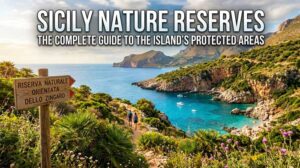
An hour north of Trapani, between the towns of Scopello and San Vito Lo Capo, the Riserva Naturale dello Zingaro is Sicily’s first and most celebrated nature reserve: a 7-kilometre stretch of completely undeveloped Tyrrhenian coastline, accessible only on foot along a coastal path that links a series of small coves and beaches of extraordinary beauty. There are no roads inside the reserve, no cars, no beach clubs, no built infrastructure beyond the path itself. Just limestone cliffs, Mediterranean scrubland, a sea of extraordinary clarity and the quiet of a coast that has not changed in centuries.
The main path along the coast takes about two hours to walk one way at a relaxed pace, with numerous possibilities to descend to the individual coves for swimming. The finest beaches inside the reserve include Cala dell’Uzzo, Cala della Disa and Cala Marinella, all small, pebbled and surrounded by clear water. Bring everything you need: food, water, sun protection and a towel. There are no services inside the reserve.
Entry costs approximately €5 per adult at the main entrance near Scopello. The reserve is open year-round but is at its finest in May and June, when the wildflowers are at their peak and the summer crowds have not yet arrived. Read our guide to the best beaches in Sicily for more on the beaches of the Zingaro and the surrounding coast.
Marsala and the wine route
Thirty kilometres south of Trapani, the city of Marsala is best known internationally for the fortified wine that bears its name, but it is also a beautiful and historically significant city in its own right. The historic centre, built on the promontory where the Phoenicians established their island city of Motya, has a coherent baroque character and a relaxed, bourgeois atmosphere that makes it a very pleasant afternoon destination from Trapani.
The wine cellars of Cantine Florio, established in 1833, offer guided tours and tastings of the full range of Marsala wines: from the dry, amber-coloured vergine style to the sweet, rich riserva that has been aged in oak for decades. The cellars themselves, filled with enormous barrels under vaulted stone ceilings, are beautiful spaces. Donnafugata, another historic producer with cellars in Marsala, also offers excellent tastings with advance booking.
The Marsala wine route connects the city with the surrounding vineyards and the island of Mozia (Motya), a Phoenician island city in the middle of the lagoon whose archaeological museum contains the extraordinary Giovinetto di Mozia: a 5th century BC marble figure of a young man, possibly a charioteer, considered one of the finest examples of ancient sculpture in Sicily. The island is reached by a short boat ride from the shore near Marsala.
What to eat in Trapani
The food culture of Trapani is distinctive within Sicily and reflects the city’s long history as a trading port between the Arab world and the European Mediterranean. The Arab influence, present throughout Sicilian cooking, is more concentrated and more explicitly maintained in the western part of the island, and nowhere more so than in Trapani’s kitchen.
Couscous al pesce
The defining dish of Trapani and widely considered the finest expression of fish couscous in Italy. Semolina grains steamed and dressed with a broth of mixed sea fish, tomato, onion, almonds, saffron and cinnamon, the couscous of Trapani has a depth and complexity that reflects both the quality of the local fish and the centuries of practice that have refined the recipe. It is a slow food in the original sense: couscous requires hand-rolling, the broth requires long cooking, and the assembly requires patience. The best versions are served in the trattorias of the old town, where they prepare it from scratch. Do not leave Trapani without eating it at least once. The annual Cous Cous Fest held each September in nearby San Vito Lo Capo celebrates this dish with an international cooking competition on the beach.
Pasta con le sarde alla trapanese
The western Sicilian version of the island’s classic sardine pasta, with a sauce that uses the local almonds, wild fennel, tomato and saffron to create a preparation of extraordinary balance. Slightly different from the Palermo version in its use of almonds and in the weight given to each ingredient, it is another dish that rewards a slow, attentive lunch in a trattoria where the kitchen is cooking for regulars rather than tourists.
Busiate al pesto trapanese
A pasta dish entirely specific to Trapani: busiate, a spiral fresh pasta, dressed with the local pesto made from crushed almonds, fresh tomatoes, garlic, basil and olive oil. This is not the Ligurian pesto of basil and pine nuts but something altogether different: raw tomato-based, almond-scented, deeply aromatic and entirely of this coastal stretch. It is one of the great regional pasta dishes of Sicily and available in every serious restaurant in the city.
Tonno di Favignana
The bluefin tuna of the Egadi Islands, once caught in the ancient mattanza net fishing ritual that defined the economy of the entire western coast, is still the finest tuna in Sicily. The mattanza itself has largely ceased, but tuna remains central to the food culture: served grilled with capers and lemon, preserved in olive oil for year-round use, or dried and grated as a substitute for bottarga. The tuna conserve sold in the shops of Trapani, packed in local olive oil, is one of the finest food souvenirs available in the city.
Trapani salt with everything
The finishing touch to almost every dish in Trapani is the local sea salt from the pans just outside the city. Available in coarse and fine grades, with and without herbs, it is sold in attractive packages in every food shop in the old town. A small tin of Trapani salt with dried herbs is possibly the most useful and most appreciated food gift you can bring home from western Sicily. For more on exceptional Sicilian food products, read our guide to typical Sicilian products.
Book your Sicily rental car
Compare prices across all major car hire companies in Sicily, including Palermo and Catania airports, and book in advance to get the best rates. Always select full coverage (zero excess) when booking in Sicily.
👉Compare rental cars on DiscoverCars
Practical information for visiting Trapani
How to get there
Trapani Birgi Airport (TPS) receives a limited number of flights, primarily from other Italian cities and from a small number of European destinations during summer via Ryanair. For more flight options, fly into Palermo Falcone-Borsellino Airport (PMO), approximately 100 kilometres east of Trapani, and travel onwards by bus (the Terravision service connects the airport to Trapani in about one and a half hours) or by car via the A29 motorway. The drive from Palermo airport to Trapani takes approximately one hour. By train from Palermo Centrale, the journey takes around two hours with a change at Alcamo Diramazione.
Getting around
Trapani’s historic centre is entirely walkable: the peninsula is only about 3 kilometres long and the main sights are all within comfortable walking distance of each other. For the salt pans, Erice, Segesta, the Zingaro and Marsala, a rental car gives the most flexibility. Without a car, organised tours from Trapani cover all of these destinations efficiently and represent good value.
When to visit
April through June and September through October are the ideal months. The weather is warm and settled, the sea temperature is rising in spring and still warm in autumn, and the tourist infrastructure is fully operational without the extreme summer crowds. July and August are busy, particularly around the salt pans at sunset and on the ferries to the Egadi Islands. The Misteri di Trapani procession at Easter is one of the most compelling reasons to visit in spring. For the full seasonal guide, read our article on the best time to visit Sicily.
Where to stay
The historic centre of Trapani is the best base for exploring the city and the surrounding area. Parking in the old town is limited but available in designated areas near the port.
How many days do you need
Three to four nights allows you to see the city properly, visit the salt pans at sunset, take a full day trip to the Egadi Islands, and spend a morning in Erice with the cable car. Adding a fourth night gives you time for Segesta and the Zingaro, which together make for one of the finest days available anywhere in western Sicily. Read our complete Sicily 7-day itinerary for how Trapani fits into a broader island circuit.
Frequently asked questions about Trapani
Is Trapani worth visiting?
Yes, particularly for those who want to explore the western side of Sicily. Trapani is an excellent base for some of the finest day trips on the island: the Egadi Islands, Erice, Segesta, the Zingaro reserve and Marsala. The salt pans at sunset are among the most beautiful natural spectacles in Sicily, and the city’s food culture, built around fish couscous and the finest tuna in the Mediterranean, is entirely distinctive. It receives fewer tourists than Taormina or Cefalù, which makes the experience more authentic.
How many days do you need in Trapani?
Three to four days is ideal. One day for the city centre, salt pans and Erice. One full day for the Egadi Islands. One day for Segesta and the Zingaro. A fourth day for Marsala and a relaxed final morning in the old town.
Can you visit the Egadi Islands as a day trip from Trapani?
Yes, easily. Hydrofoils and ferries depart from Trapani port regularly throughout the day, with the crossing to Favignana taking about 20 minutes by hydrofoil. A full day trip gives you enough time to explore one island thoroughly, including a bike ride around Favignana or a morning of swimming at Cala Rossa.
How do I get from Palermo to Trapani?
By car via the A29 motorway, the drive takes approximately one hour from Palermo city centre. By train from Palermo Centrale, the journey takes around two hours. By bus, the Segesta Autolinee service connects Palermo and Trapani in about two hours with a direct service. The bus is generally more convenient than the train for passengers without a car.
What is Trapani famous for?
Trapani is famous for its salt pans and traditional sea salt production, its role as the gateway to the Egadi Islands, its fish couscous (the finest in Italy), the medieval hilltop town of Erice above the city, the extraordinary Greek temple at Segesta, and the Misteri di Trapani Good Friday procession that is one of the most important religious events in Sicily.
Ready to discover Trapani?
Trapani operates on its own terms, and those terms suit a certain kind of traveller very well: someone who prefers authenticity to polish, who wants to eat extraordinarily well without paying Taormina prices, who is as interested in the sea and the salt and the ancient history of a place as in its cathedral and its piazza. The city gives you all of that, and then it points west towards the Egadi Islands and east towards Segesta, and it reminds you that western Sicily has been waiting for you to discover it.
For help planning the rest of your Sicilian trip, read our complete Sicily 7-day itinerary, our guide to things to do in Palermo, and our guide to the best beaches in Sicily.
Did this guide help you plan your Trapani visit? Save it to Pinterest or share it with someone who is planning a trip to Sicily.