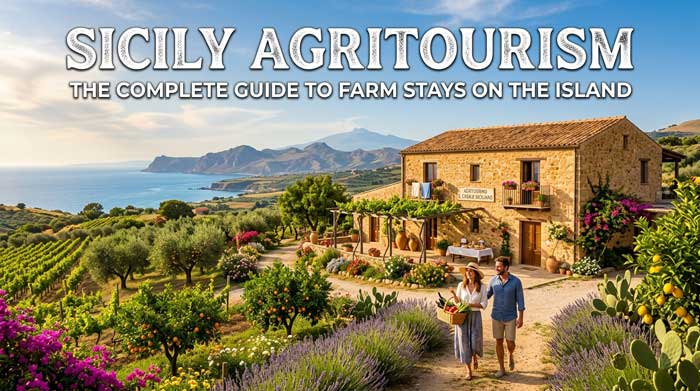
The Sicilian agriturismo the farm estate that offers accommodation and meals alongside its primary agricultural activity is the most rewarding slow travel experience available on the island. The morning at the olive pressing in October, the dinner with the estate’s own olive oil, wine and vegetables, the breakfast with the homemade marmalade from the estate’s own citrus trees, the view from the farm terrace across the vineyard toward the sea or the volcano: these are experiences that no hotel can provide because they require the specific combination of a working agricultural estate, a family kitchen and the generosity of a host whose professional identity is the land rather than the tourism industry. This guide covers the complete Sicilian agriturismo programme what to expect, where to find the finest estates and how to choose the agriturismo that matches the specific experience you are looking for.
In this guide
- What is a Sicilian agriturismo?
- The agriturismo food experience
- Etna slope agriturismo
- Val di Noto and Hyblaean plateau
- Western Sicily olive oil and salt
- Madonie and Nebrodi mountains
- The seasonal agriturismo programme
- How to choose the right agriturismo
- Booking tips
- FAQ
What is a Sicilian Agriturismo?
The agriturismo (from agricoltura and turismo agricultural tourism) is a specifically Italian legal category of accommodation: a farm or agricultural estate that is licensed to receive paying guests in rooms or apartments, to serve meals using a significant proportion of its own agricultural production and to offer farm-related activities (olive harvesting, grape picking, cooking classes, guided farm walks). The Italian agriturismo law requires that the agricultural activity is the primary business of the estate the tourism income must be secondary to the farming income, ensuring that the agriturismo remains a working farm rather than a hotel that happens to have a garden.
In Sicily, the agriturismo ranges from the simple farm room (a basic double bedroom in the farmhouse with a shared bathroom, breakfast included, dinner available on request) to the converted estate complex (the masseria the traditional Sicilian farm estate converted with swimming pool, wine cellar and full restaurant programme while maintaining the working farm character). The price range reflects this variety: from €40 to €70 per person per night at the most basic farm accommodation to €150 to €250 at the most refined estate conversion. The specific value proposition of the agriturismo compared to the hotel equivalent: the food quality, the landscape character and the human contact with a Sicilian farming family at the same price point as a standard hotel room.
The Agriturismo Food Experience
The agriturismo dinner is the most specifically rewarding meal available in Sicily at any price point the farm kitchen that uses its own olive oil (pressed from the estate’s trees in October and November), its own wine (vinified from the estate’s vineyard in September and October), its own vegetables (from the kitchen garden), its own cheese (from the estate’s sheep or goat flock), its own preserved products (the caponata made from the estate’s aubergine, the tomato sauce from the estate’s San Marzano tomatoes, the marmalade from the estate’s citrus) produces a table of specific coherence and specific quality that the restaurant sourcing from multiple suppliers and multiple markets cannot replicate.
The agriturismo dinner is typically a fixed menu of 4 to 6 courses the antipasto programme (the estate’s own preserved vegetables, cheese and salumi), the first course (pasta with the estate’s own ingredients the pasta con le sarde if wild fennel is available, the pasta al pomodoro fresco in summer), the second course (the grilled meat from the estate’s flock or the local farm, the fish if the estate is coastal) and the dessert (the seasonal fruit of the estate, the almond sweets from the estate’s own almonds). The wine is the estate’s own typically a simple table wine produced from the estate’s vineyards rather than the DOC production, served generously and at a fraction of the restaurant bottle price. The total cost for the full dinner programme: approximately €25 to €40 per person, wine included, at the best agriturismo. Read our complete Sicilian food guide.
👉 SICILIAN AGRITURISMO COOKING CLASS FARM TO TABLE IN THE ESTATE KITCHEN
A hands-on Sicilian cooking class at a working farm estate the market visit to select ingredients, the kitchen session preparing pasta, caponata and the seasonal first course, and a full lunch with the estate’s own wine. The most directly Sicilian food experience available. Available on working estates near Palermo, Catania and in the Val di Noto.
👉SEE THE BEST SICILIAN COOKING CLASS HERE
Etna Slope Agriturismo
The Etna lower slope agriturismo zone the band of estate farmhouses between 400 and 900 metres altitude on the Etna northern and eastern slopes provides the most dramatically scenic agriturismo experience in Sicily. The combination of the Etna summit visible above the estate, the ancient Nerello Mascalese vineyards on the volcanic basalt terraces, the chestnut and hazelnut orchards of the lower slope and the specific quality of the Etna agricultural landscape provides a farm stay context entirely unlike any other in Sicily.
The finest Etna slope agriturismo experience: the September or October stay during the harvest the grape picking on the alberello vines, the fermentation tanks receiving the new fruit in the cantina, the estate Nerello Mascalese at the dinner table alongside the Etna volcanic tomato and the estate chestnut programme. The Etna agriturismo is the most wine-focused of the Sicilian farm stay options most quality estates in the Etna DOC zone combine the accommodation with a cellar visit and tasting programme that the coastal agriturismo cannot provide. Price range: €80 to €180 per room per night for the quality Etna estates; the dinner programme is typically €30 to €45 per person. Read our complete Etna wine guide and Etna guide.
Val di Noto and Hyblaean Plateau
The Hyblaean plateau agriturismo zone the limestone tableland above Ragusa, Modica and the Val di Noto baroque towns provides the most gastronomically rich farm stay in Sicily. The specific Hyblaean agricultural programme (the Tonda Iblea olive oil, the Ragusano DOP cheese from the Modicana cattle, the Vittoria DOC wine, the Pachino cherry tomato, the local carob and the almond-based confectionery tradition of the Noto area) provides the most varied and the most specifically local estate food production available in any single Sicilian agricultural zone.
The Hyblaean plateau masseria the traditional large farm estate building in the volcanic limestone of the southeastern plateau is architecturally the most impressive agriturismo building type in Sicily: the fortified farmhouse with the internal courtyard, the stone arches and the specific rural baroque detailing of the 18th and 19th-century building tradition. The combination of the Hyblaean masseria architecture, the Tonda Iblea olive oil tasting, the Ragusano cheese at the dinner table and the proximity to the Val di Noto baroque town circuit makes the southeastern plateau agriturismo the most complete single farm stay programme on the island. Price range: €70 to €150 per room per night; dinner programme €25 to €40 per person. Read our complete Ragusa guide.
Western Sicily Olive Oil and Salt
The western Sicily agriturismo zone the Belice valley, the Castelvetrano area and the Trapani province provides the most olive oil-focused farm stay experience in Sicily. The Nocellara del Belice olive (the DOP table olive and oil variety of the Belice valley) is at its pressing season in October and November, and the agriturismo estates of the Castelvetrano and Campobello di Mazara area offer the most specific olio nuovo tasting programme available in Sicily the oil pressed within days of the harvest, cloudy and intensely green, available directly from the press with the estate’s own bread.
The western Sicily agriturismo is also the most accessible to the Egadi Islands (the hydrofoil from Trapani to Favignana), the Zingaro Reserve coastal trail and the Segesta temple and theatre programme the combination of the olive estate stay with the day trip programme to the finest ancient site in western Sicily and the finest marine reserve makes the western Sicily agriturismo the most logistically complete farm stay base on the island. Price range: €60 to €130 per room per night; the olio nuovo tasting and the dinner programme are typically included or available at minimal additional cost. Read our complete Sicily olive oil guide.
Madonie and Nebrodi Mountains
The mountain agriturismo of the Madonie and Nebrodi ranges provides the most specifically seasonal and the most atmospheric farm stay in the Sicilian interior. The chestnut and mushroom programme of October (the porcini and chiodini from the estate’s forest, the chestnut harvest from the estate’s grove, the specific mountain kitchen that these ingredients define), the spring wildflower programme (the orchid meadows, the wild asparagus, the first wild greens of the season) and the summer cool (the mountain temperatures 8 to 10 degrees below the coastal cities) provide three specific seasonal reasons to choose the Madonie or Nebrodi agriturismo over the lowland equivalent.
The mountain masseria kitchen is the most specifically seasonal of any Sicilian agriturismo food programme the chef who cooks what the forest and the farm provide that day, without a fixed menu, producing the most directly site-specific meal experience available in Sicily. The Nebrodi black pig (the semi-wild native breed that forages on the Nebrodi oak and chestnut forest floor) is the centrepiece of the Nebrodi mountain kitchen the estate-produced salumi, the fresh sausage grilled over wood and the specific flavour of a pig that has eaten acorns and chestnuts rather than commercial feed provide the most specifically territorial meat programme in Sicily. Price range: €50 to €120 per room per night; the mountain dinner programme is typically €20 to €35 per person. Read our complete mountain villages guide.
The Seasonal Agriturismo Programme
Spring (March to May): The wildflower programme at the Madonie agriturismo, the artichoke and broad bean kitchen, the first olive oil from the November pressing at its finest, the lambing season and the fresh ricotta programme. The most varied single agriturismo season.
Summer (June to August): The full beach programme accessible from the coastal zone agriturismo, the tomato and aubergine kitchen at its best, the summer fruit programme (peaches, figs, melons) from the estate orchard. The mountain agriturismo at its most comfortable for the visitor seeking coolness from the coastal heat.
Autumn (September to November): The Etna grape harvest in September and October, the olive pressing in October and November, the mushroom programme in the Madonie and Nebrodi from October. The most specifically seasonal and the most food-intensive agriturismo season.
Winter (December to February): The citrus kitchen at its best, the blood orange and clementine programme on the Etna coastal plain, the almond blossom at the Agrigento estates in February, the quietest and the most affordable season. Read our complete Sicily in autumn guide.
How to Choose the Right Agriturismo
The agriturismo choice depends on the specific programme priority. For the food and wine experience: the Etna slope estates (wine harvest) or the Hyblaean plateau masseria (olive oil, cheese). For the landscape experience: the Etna slope (volcanic landscape, Etna summit visible) or the Val di Noto plateau (baroque town proximity). For the nature experience: the Madonie or Nebrodi mountain estates (mushrooms, orchids, endemic wildlife). For the beach programme: the coastal agriturismo of the Trapani or Agrigento zone (proximity to the Egadi Islands or the Scala dei Turchi).
The key quality indicators for the agriturismo selection: the proportion of estate-produced products in the kitchen (the finest agriturismo uses primarily its own production; the less specific use primarily market-bought ingredients), the specific seasonal programme offered (the estate that offers harvest participation, cooking classes and farm walks is more engaged with the agriturismo concept than the one that simply offers accommodation in a farmhouse), and the owner’s presence and knowledge (the finest agriturismo is run by the family that owns the land and knows it in the way that only a lifetime of agricultural practice produces).
Booking Tips
The finest Sicilian agriturismo book up 4 to 8 weeks in advance for the October to November harvest season and for August. The spring season (April to June) requires 2 to 4 weeks advance booking for quality properties. The winter season (December to March) is the most spontaneously bookable 1 to 2 weeks is generally sufficient for most estates.
The best booking sources: the Agriturist website (the national agriturismo association directory), the Terranostra website (the Coldiretti farming cooperative agriturismo directory) and direct booking through the estate’s own website or phone. The agriturismo that is bookable only through these specialist channels (rather than through the standard hotel booking platforms) is typically the most specifically agricultural the one that has not invested in international platform visibility because its clientele finds it through word of mouth and specialist channels rather than through general tourism marketing. Read our complete Sicily travel tips.
👉The Sicilian agriturismo programme requires a rental car the estates are in the countryside, the olive pressing visits and the harvest participation require the flexibility of independent transport. Compare prices at Palermo and Catania airports on DiscoverCars. The agriturismo road trip is the most rewarding slow travel experience in Sicily.
👉COMPARE THE BEST RENTAL CARS HERE
FAQ about Sicily Agritourism
What is an agriturismo in Sicily?
An agriturismo is a licensed farm estate that offers accommodation and meals alongside its primary agricultural activity olive oil production, winemaking, cheese production or mixed farming. Italian law requires that the agricultural activity is the primary business, ensuring the agriturismo remains a working farm. The experience provides direct access to the estate’s own food production, the seasonal agricultural programme and the specific rural hospitality of a Sicilian farming family.
How much does an agriturismo cost in Sicily?
Room rates range from €40 to €70 per night at the most basic farm accommodation to €150 to €250 at the most refined estate conversions. The dinner programme costs €25 to €40 per person including the estate’s own wine. The agriturismo provides the finest quality-to-price ratio of any Sicilian accommodation category the estate dinner at €35 per person with estate wine is typically better than a restaurant meal at the same price.
When is the best time to stay at a Sicilian agriturismo?
October and November for the olive harvest and olio nuovo tasting. September and October for the Etna grape harvest. April and May for the spring wildflower and artichoke programme. Each season provides a specific agricultural experience unavailable in any other month choose the season that matches the specific farm activity you want to participate in.
The Farm That Feeds You
The Sicilian agriturismo provides the most direct available answer to the question that every visitor to Sicily eventually asks: where does this food come from? The answer at the agriturismo dinner table is specific and immediate the olive oil came from the trees visible from the terrace, pressed three weeks ago. The wine came from the vineyard on the hillside behind the house. The caponata was made from the aubergine that grew in the kitchen garden in August. The ricotta was made this morning from the milk of the sheep in the field below the window. The ingredients of the dinner have a specific geography they are not ingredients sourced from a market; they are the products of the specific soil, the specific climate and the specific agricultural knowledge of the family that prepared them. The agriturismo dinner is the most specific possible answer to the question of where Sicilian food comes from. It comes from here. From this land. From this family. From this harvest.
For the complete Sicily food programme, read our Sicilian food guide, our Sicily olive oil guide and our Etna wine guide.
Did this guide help you discover the Sicilian agriturismo? Save it to Pinterest or share it with someone who wants to eat from the land rather than from the menu.