San Vito Lo Capo sits on a promontory at the northwestern tip of Sicily, wedged between the limestone mass of Monte Monaco to the east and Monte Cofano to the west, its three kilometres of fine white sand curving around a bay of turquoise water that reads, on clear days, more Caribbean than Mediterranean. It has been voted among the finest beaches in Italy repeatedly and consistently, and the votes are not wrong: the sand is white, the water is shallow and transparent, and the mountain backdrop gives the setting a dramatic quality absent from most Italian beach destinations.
The town itself is small approximately 4,500 permanent residents and its food culture is one of the most specific in western Sicily: fish couscous, a dish that arrived here not through the medieval Arab occupation of Sicily but through the much more recent migration of San Vito fishermen to Tunisia in the early 20th century, who returned with Tunisian wives, Tunisian cooking techniques and a couscous tradition that the town adopted as its own. That tradition is celebrated each September in the Cous Cous Fest, one of the largest international food festivals in Italy and the single best reason to visit San Vito Lo Capo in autumn.
In this guide
- The main beach
- The Sanctuary-Fortress of San Vito
- Fish couscous the signature dish
- The Cous Cous Fest
- The Zingaro Nature Reserve
- Monte Cofano and the Mangiapane Cave
- Macari and the western coast
- Boat tours and water activities
- Practical information
- Frequently asked questions
San Vito Lo Capo quick facts
- Location: Northwestern tip of Sicily, province of Trapani
- From Trapani: 40 km, approximately 50 minutes by car
- From Palermo: 90 km, approximately 1 hour 40 minutes via A29 and SS187
- Beach: 3 km of fine white sand, turquoise shallow water
- Best months: May to June and September to October for beach; September for the Cous Cous Fest
- Famous for: White sand beach, fish couscous, Cous Cous Fest, access to the Zingaro Nature Reserve
- Avoid: August weekends the beach and town are at maximum capacity
- How long: 2 to 3 days ideal; day trip possible from Palermo or Trapani
The main beach

The beach at San Vito Lo Capo is three kilometres of fine, pale sand white enough in direct sun to create the Caribbean effect that photographs of the town reliably promise and that the reality consistently delivers. The water is shallow for a considerable distance from the shore, crystal clear due to the sandy seabed, and calm within the sheltered bay except in the relatively rare conditions when the libeccio wind arrives from the southwest. The combination of fine sand, shallow water and natural shelter makes it unusually suitable for families with young children, and its length means that it absorbs the summer crowds rather better than most popular Sicilian beaches.
The beach is divided between stabilimenti balneari (beach clubs with sun loungers and umbrellas for hire, showers, changing rooms and food service) and free public sections. In high summer, booking a sun lounger at one of the beach clubs is worth the cost free-section space on weekends in July and August is limited and competitive. The beach clubs along the central section of the beach have generally good food service, making a full beach day self-contained without needing to return to the town.
Cala Mancina, a smaller cove on the eastern side of the promontory reached by a 20-minute walk from the town centre, is a limestone cliff bay with notably clear water and excellent snorkelling. Less crowded than the main beach and more dramatically set, it is the finest alternative swimming spot within easy walking distance of the town.
The Sanctuary-Fortress of San Vito
In the centre of the town, surrounded by the pedestrian lanes of the historic quarter, the Santuario di San Vito Martire is one of the most unusual church buildings in western Sicily. Dating originally to the 5th century AD, when a Christian sanctuary was established on this remote promontory, the building was substantially rebuilt in the 18th century in a form that reflects its history more than its religion: it looks like a fortified bastion rather than a church, with thick defensive walls, battlements and a plan clearly designed to withstand the Saracen raids that threatened the Trapani coast for centuries.
The interior contains the venerated statue of San Vito, patron of the town, around which the annual summer festival is organised each June. The facade, with its unusual combination of ecclesiastical and military architectural vocabulary, is one of the more quietly interesting buildings in northwestern Sicily easy to walk past without noticing what it is, but worth examining closely for the evidence of three centuries of threat and adaptation compressed into a single structure.
The 18th-century Torre dell’Usciere, a watchtower on the northern edge of the town, and the ruins of the Tonnara del Secco (an abandoned tuna-processing plant) represent the other historic layers of San Vito’s past the tuna fishery that sustained the town’s economy for centuries before the beaches made tourism the dominant industry.
Fish couscous the signature dish
The fish couscous of San Vito Lo Capo has an origin story that is simultaneously accurate and charming. In the early 20th century, the town’s fishing economy declined and many San Vito fishermen emigrated to Tunisia in search of work in the North African fishing industry. Some stayed for years; some married Tunisian women; many returned. What they brought back was couscous the semolina grain dish that is the staple of North African cooking adapted to the seafood of the Sicilian coast and embedded into the local kitchen.
San Vito fish couscous is made with a semolina base prepared by hand using the traditional North African technique of rolling the grain between the palms a process called incocciare in the Trapanese dialect and served with a fish broth and a selection of the freshest seafood from the daily catch. The result is a dish with a genuinely specific character: neither purely North African nor purely Sicilian, but the product of a particular migration history that connected this small promontory to the other shore of the Mediterranean in a direct and personal way.
Every restaurant in San Vito Lo Capo serves couscous. The quality varies considerably seek out the restaurants that make the semolina by hand rather than using commercial grain, and where the fish broth is made fresh each morning rather than from a concentrate. The best versions are genuinely extraordinary: the grain has a texture and a flavour that the commercial product cannot replicate, and the broth is a concentrated essence of Mediterranean seafood that bears almost no resemblance to anything available in landlocked Europe.
The Cous Cous Fest organisers run a Couscuola a couscous school during the festival period and at other times of year, offering 30-minute lessons in the traditional incocciare technique. It is one of the more useful and authentic culinary experiences available in western Sicily.
The Cous Cous Fest
The Cous Cous Fest takes place annually in the last week of September, running for approximately ten days and transforming San Vito Lo Capo from a quiet beach town in shoulder season into one of the most animated food festivals in Italy. The festival has been held since 1997 and has grown into an internationally recognised event, attracting chefs from Morocco, Tunisia, Senegal, France, Spain, Peru and other countries to compete in a couscous world championship judged by a panel of food professionals.
The format combines a competitive element the championship, in which each national team presents a complete couscous with its own approach to ingredients and preparation with a public tasting structure that allows visitors to eat their way through the competing dishes for a modest entry fee (approximately €12 in recent years, covering access and one full serving from the competition kitchens). The evenings are animated by free concerts on the beach, cultural events and the general festive atmosphere of a small town that has been taken over by food, music and the unusual combination of cultures that this particular dish manages to assemble.
September in San Vito Lo Capo is, by general consensus, the finest month to visit: the sea is warm from the summer, the crowds are lower than in August, the couscous is everywhere, and the evening concerts on the beach are free. Book accommodation for the festival period months in advance the town fills up completely, and prices in September are typically higher than in July.
👉 COUS COUS FEST DAY TRIP FROM PALERMO
A guided day trip from Palermo to San Vito Lo Capo during the Cous Cous Fest beach time, festival tastings and live music in the evening before the return. One of the best day excursions from Palermo in September.
👉SEE THE BEST COUS COUS FEST DAY TRIP FROM PALERMO HERE
The Zingaro Nature Reserve
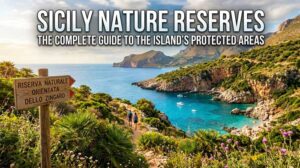
The Riserva Naturale dello Zingaro, immediately east of San Vito Lo Capo along the coast toward Scopello, is the first nature reserve established in Sicily (1981) and one of the finest coastal nature reserves in Italy. Seven kilometres of coastline between San Vito and Scopello entirely without roads, buildings or beach facilities contain a sequence of coves accessible only on foot or by boat: Cala Tonnarella dell’Uzzo, Cala dell’Uzzo, Cala Marinella, Cala Berretta and several others, each with clear water, limestone cliffs and the wild coastal scrubland of the Tyrrhenian coast in a state largely unchanged since before roads were built through this part of Sicily.
The main trail runs the full length of the reserve at varying distances from the coast, with side paths descending to the individual coves. The full one-way traverse takes approximately 3 to 4 hours at a comfortable pace; most visitors walk part of the trail and return by the same route, targeting one or two coves for swimming. There is a small museum at the northern entrance (near San Vito) covering the natural history and archaeological heritage of the reserve. Entry costs approximately €5.
The coves within the Zingaro are among the finest swimming spots on the Sicilian coast clear, sheltered, backed by cliffs, and populated almost exclusively by visitors who have made the effort to walk. Arrive early in July and August, bring everything you need for the day (no facilities inside the reserve), and wear proper walking shoes rather than flip-flops. The path is rocky and uneven in sections, particularly the descents to the coves.
👉 ZINGARO NATURE RESERVE BOAT TOUR WITH SWIMMING STOPS
See the sea caves and hidden coves of the Zingaro reserve from the water the only way to access several of the finest swimming spots along this stretch of coast. Departing from San Vito Lo Capo or Scopello, with multiple swimming stops included.
👉 SEE THE BEST ZINGARO NATURE RESERVE BOAT TOUR HERE
Monte Cofano and the Mangiapane Cave
Monte Cofano, the dramatic dolomite massif that rises immediately west of San Vito Lo Capo and is visible from the beach as a steep-sided limestone peak above the sea, is protected by its own nature reserve (the Riserva Naturale di Monte Cofano, established 1997). A circular trail runs around the base of the mountain, entirely at sea level, offering a 6-kilometre walk with exceptional views across the Tyrrhenian coast and into the sea caves carved into the mountain’s base. The walk is accessible to all fitness levels and takes approximately 2 hours. There are no sandy beaches around the mountain’s base the swimming is off rocks but the clarity of the water and the setting are extraordinary.
Within the Monte Cofano reserve, the Grotta Mangiapane at Scurati is one of the most remarkable and least visited sites in northwestern Sicily. An 80-metre-high natural cavern opening directly onto a valley, its entrance shelters a cluster of small stone buildings that were lived in continuously until the mid-20th century a cave settlement of the same type as Matera’s sassi, but on a domestic scale, with whitewashed walls, doorways and small courtyards that give the cave a quality of preserved intimacy rather than archaeological abstraction. Every Christmas since 1961, the local community stages a living nativity scene inside the Mangiapane cave, which has become one of the most atmospheric seasonal events in western Sicily.
Macari and the western coast
Macari, a small hamlet approximately 5 kilometres west of San Vito Lo Capo along the coastal road, is known primarily for one thing: the finest sunset view on the northwestern Sicilian coast. The hamlet sits on the western slope of Monte Monaco, looking out over the open sea toward the Egadi Islands with nothing between the viewpoint and the Atlantic horizon except water and fading light. The road from San Vito to Macari passes through a landscape of vineyards, olive groves and dramatic limestone outcrops that constitute some of the most beautiful driving in northwestern Sicily.
Castelluzzo, between San Vito and Macari, is a quieter alternative base with holiday apartments and a more intimate atmosphere than the main town. Its position gives easy access to both the San Vito beach and the Macari sunset while avoiding the August crowd density of the main resort.
Boat tours and water activities
The coastline around San Vito Lo Capo is best explored from the water. The limestone cliffs between San Vito and the Zingaro reserve contain sea caves, natural arches and hidden coves that are inaccessible on foot but straightforward by boat. Daily boat tours depart from the small harbour at the eastern end of the town, running east toward the Zingaro with multiple swimming stops, or west toward Monte Cofano and the Egadi Islands in clearer weather.
The trip to Favignana and the Egadi Islands, departing from either San Vito or the Trapani ferry terminal, is one of the finest day excursions available from this part of Sicily Favignana’s crystal water and the smaller islands of Marettimo and Levanzo are each extraordinary in their own right. Read our complete Trapani guide for ferry schedules and island day trip planning.
👉 NOLEGGIA LA TUA AUTO IN SICILIA CON DISCOVERCARS
San Vito Lo Capo, the Zingaro Reserve, Monte Cofano and the Trapani coast are best explored by car. Compare prices across all major rental companies at Palermo and Trapani airports and book in advance for the best rates.
👉COMPARE THE BEST RENTAL CARS HERE
Practical information for visiting San Vito Lo Capo
How to get there
By car from Palermo, take the A29 motorway toward Trapani and exit at Castellammare del Golfo, then follow the SS187 along the northern coast to San Vito Lo Capo (approximately 90 km, 1 hour 40 minutes). From Trapani, approximately 40 kilometres via the SP16 coastal road (50 minutes). By bus, seasonal services operate from Trapani and Palermo in summer the Russo bus company runs regular connections. By public transport, the journey requires a connection in Trapani. A rental car is strongly recommended for reaching the Zingaro Reserve trailhead, Monte Cofano and the surrounding coastal hamlets.
Parking
Parking in San Vito Lo Capo in July and August requires patience and an early arrival. The ZTL (restricted traffic zone) covers the historic centre and the seafront area park in the designated car parks at the edge of the pedestrian zone and walk to the beach. Paid parking is available at several points; free parking is increasingly scarce in high season. Arrive before 9am in August if you want a space within easy walking distance of the beach.
When to visit
September is the ideal month for the combination of warm sea, reduced crowds and the Cous Cous Fest. May and June are excellent for the Zingaro walks and the beach without summer heat. July is busy but manageable; August is the peak of Italian summer holidays and the town operates at maximum capacity, with parking, beach space and restaurant queues all reflecting this. Read our complete guide to the best time to visit Sicily.
Combining with Erice and Trapani
San Vito Lo Capo combines naturally with Erice (45 minutes by car) and Trapani (50 minutes) for a western Sicily circuit from Palermo. Read our complete Erice guide, Trapani guide and our Segesta guide for the full western Sicily picture. For the island-wide itinerary, read our Sicily road trip guide.
Frequently asked questions about San Vito Lo Capo
Is San Vito Lo Capo worth visiting?
Yes. It has one of the finest beaches in Sicily, exceptional fish couscous, direct access to the Zingaro Nature Reserve and some of the most dramatic coastal scenery in northwestern Sicily. For beach-focused visitors it is the outstanding choice in western Sicily, and for those combining beach days with nature excursions and the Erice-Segesta-Trapani cultural circuit it is an excellent base.
When is the Cous Cous Fest?
The Cous Cous Fest takes place annually in the last week of September. Exact dates change slightly each year check the official website couscousfest.it for the current edition’s programme. The festival runs for approximately ten days and includes the couscous world championship, public tastings, cooking workshops, concerts and cultural events.
What is fish couscous and why is it typical of San Vito Lo Capo?
Fish couscous is a dish of hand-rolled semolina grain served with a fish broth and fresh seafood, specific to the Trapani coast and particularly identified with San Vito Lo Capo. Its origins lie in the migration of San Vito fishermen to Tunisia in the early 20th century, who returned with the couscous technique and integrated it with the local seafood tradition. The result is a genuinely Mediterranean fusion dish with a specific local history that distinguishes it from the North African couscous from which it derives.
How far is the Zingaro Nature Reserve from San Vito Lo Capo?
The northern entrance to the Zingaro reserve is immediately adjacent to San Vito Lo Capo a 10-minute drive or a 30-minute walk east of the town centre. The reserve extends 7 kilometres along the coast toward Scopello and can be explored on foot along the main coastal trail or from the water on a boat tour.
What is the best beach near San Vito Lo Capo?
The main town beach is outstanding for swimming and for families. Cala Mancina, a 20-minute walk east of town, is the finest smaller cove near the centre. The coves within the Zingaro reserve Cala dell’Uzzo and Cala Marinella in particular are the finest overall swimming spots in the area but require a walk of 1 to 2 hours each way. The Monte Cofano coast, 5 kilometres west, offers cliff swimming with extraordinary clarity.
Where the Mediterranean meets Africa
San Vito Lo Capo is the point on the Sicilian coast where the two shores of the Mediterranean come closest together geographically, culturally and gastronomically. The white sand comes from the same geological formation as the North African coast across the water. The couscous came back with the fishermen who spent years on the other shore. The September festival brings chefs from eight or ten countries to compete in the bowl of a dish that belongs to all of them simultaneously. This is what makes San Vito Lo Capo more interesting than its beautiful beach alone would suggest: it is a place that has always faced south across the water, toward Africa, and whose culture reflects that orientation in everything from the grain in the pot to the fortified church in the town centre.
For help planning the rest of your western Sicily trip, read our complete guides to Erice, Trapani, Segesta and Marsala, and our complete day trips from Palermo guide.
Did this guide help you plan your San Vito Lo Capo visit? Save it to Pinterest or share it with someone planning a trip to western Sicily.