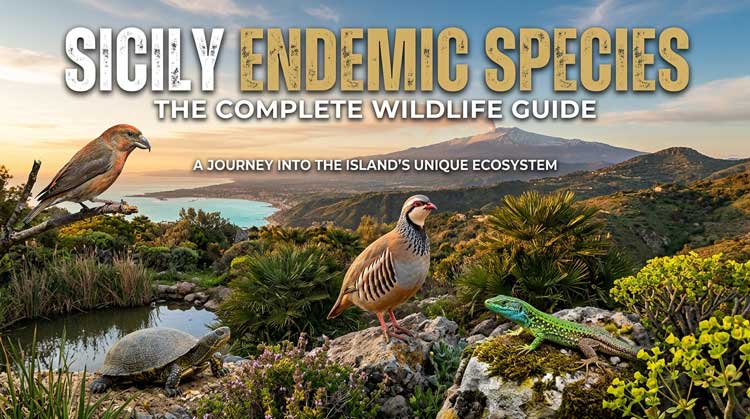
Sicily’s endemic species are the living proof of the island’s geological and evolutionary isolation the organisms that evolved in the specific conditions of the Sicilian landscape over thousands of years and that are found nowhere else on Earth. The Etna birch that grows only on the volcanic slopes of Europe’s highest active volcano, the Sicilian wall lizard that has diverged into multiple island-specific subspecies across the Sicilian archipelago, the mirror orchid whose specific flower mimics the body of a bee with extraordinary precision and the Bonelli’s eagle that nests in the Sicilian mountain cliffs together constitute a wildlife programme of genuine rarity and genuine specificity. This guide covers the most significant Sicilian endemic and near-endemic species with the specific locations where each can be encountered.
In this guide
- Endemic plants
- The Etna birch
- The Sicilian orchids
- Endemic and near-endemic mammals
- The Sicilian wall lizard
- Birds of prey and endemic birds
- Marine endemic species
- Endemic insects
- Where to see endemic species
- FAQ
Endemic Plants
Sicily’s flora contains approximately 200 plant taxa (species and subspecies) considered endemic or near-endemic to the island and its surrounding archipelagos a significant proportion of the approximately 2,700 total vascular plant species recorded in Sicily. The high level of plant endemism reflects the island’s complex geological history (the alternating periods of connection to and isolation from the mainland Italy and North Africa over the past 5 million years), the specific diversity of the Sicilian landscape (the volcanic substrate of Etna, the limestone karst of the Hyblaean plateau, the halophytic coastal habitats and the montane habitats of the Madonie and Nebrodi providing an extraordinary range of ecological niches for plant specialisation) and the specific climatic conditions (the Mediterranean climate with its summer drought selecting for specific drought-adaptation strategies).
The most botanically significant endemic plant zones: the Etna upper slopes (the alpine zone above 2,000 metres where the specific volcanic substrate and the extreme thermal range have produced the highest concentration of Etna-specific plant taxa), the Piano Battaglia plateau in the Madonie (the most species-rich single site for endemic orchids in Sicily), the Hyblaean coastal garigue (the low limestone scrubland of the southeastern coast, the most significant habitat for the Sicilian endemic sub-shrub community) and the Pantelleria island (the volcanic island south of Sicily with its own endemic flora including the cappero di Pantelleria, the specific caper variety that produces the finest capers available in the Mediterranean). Read our complete hiking guide.
The Etna Birch
Betula aetnensis (the Etna birch) is the most symbolically specific Sicilian endemic plant the tree that grows only on the volcanic slopes of Mount Etna, adapting to a substrate and a thermal regime available nowhere else on Earth, and that has become the most directly identifiable single symbol of the Etna natural heritage. The Etna birch is a small to medium-sized tree (rarely exceeding 10 metres in height) with the characteristic white papery bark of the birch genus, found in scattered stands on the Etna northern and eastern slopes between approximately 1,400 and 2,000 metres altitude the transitional zone between the chestnut and beech forest of the lower slopes and the volcanic desert of the upper mountain.
The specific ecological adaptation of the Etna birch: the species tolerates the specific combination of volcanic soil chemistry (the high heavy metal content of the basalt-derived soils, the low nitrogen availability, the extreme pH variability between the fresh lava and the weathered soil), the extreme temperature range (up to 30 degrees Celsius on summer days, below minus 10 degrees in winter), the periodic burial by ash falls and the physical disturbance of lava flows. These conditions eliminate most other tree species from the Etna upper slopes; the birch persists and colonises the fresh lava flows as one of the first woody pioneers the ecological role that makes it the most immediately visible biological response to the Etna volcanic activity. The finest stands of Etna birch are in the Monte Frumento delle Concazze area on the northern slope, accessible on the Etna northern slope hiking trails in spring and summer. Read our complete Etna guide.
👉 SICILY WILDLIFE TOUR ENDEMIC SPECIES, ORCHIDS AND THE ETNA BIRCH FOREST
A guided wildlife tour of Sicily’s endemic species the Etna birch forest, the Piano Battaglia orchid meadows, the Vendicari flamingos and the Madonie raptor programme. Expert naturalist guides. Spring (April to May) is the optimal season for the maximum number of endemic plant species in flower.
👉SEE THE BEST SICILY WILD TOUR HERE
The Sicilian Orchids
Sicily has one of the richest orchid floras in the Mediterranean approximately 70 species and subspecies of wild orchid recorded on the island, of which a significant number are endemic or near-endemic to Sicily and the surrounding islands. The specific richness reflects the combination of the limestone karst habitats (the primary orchid habitat type in the Mediterranean, the alkaline soil chemistry providing the specific mycorrhizal fungal communities on which most orchid species depend for germination) and the Sicilian climatic conditions (the Mediterranean winter rainfall and spring warmth providing the optimal germination and flowering conditions for the winter-active Mediterranean orchid guild).
The most celebrated Sicilian endemic orchid is Ophrys speculum the mirror orchid (Specchio di Venere in Italian), whose flower mimics the body of a female Speculum bee (Dasyscolia ciliata) with extraordinary precision: the labellum (the modified petal) has the specific iridescent blue-purple colouring of the female bee’s abdomen, the specific hairiness of the bee’s body surface and the specific shape that triggers the pseudo-copulation behaviour of the male bee. The male bee, deceived into attempting to mate with the flower, collects and deposits the pollen masses in a process of sexual deception pollination that is the most evolutionarily sophisticated pollination strategy in the European orchid flora. The mirror orchid flowers from February to April on the limestone grasslands of the southern and western coast. The Piano Battaglia plateau in the Madonie is the most species-rich single orchid site in Sicily, with up to 30 species recorded in a single morning walk in April and May.
Endemic and Near-Endemic Mammals
The Sicilian fauna includes several mammal species and subspecies of specific conservation interest the product of the island’s geographic isolation from the Italian mainland and from North Africa. The most significant:
The Sicilian wildcat (Felis silvestris silvestris Sicilian population). The European wildcat population in Sicily is genetically distinct from the mainland Italian population the specific isolation of the Sicilian population over thousands of years has produced measurable genetic divergence that is the subject of ongoing research. The Sicilian wildcat inhabits the Madonie, Nebrodi and Peloritani mountain forests and is among the rarest carnivores in Italy. The probability of encountering a wildcat in the field is low; the camera trap programmes operated by the Madonie Natural Park provide the most consistent photographic evidence for the population.
The lesser horseshoe bat (Rhinolophus hipposideros Sicilian population). The cave-dwelling bat species of the Sicilian interior the Hyblaean cave systems and the Nebrodi karst provide the largest bat colony habitats in Sicily. The Grotta di Carburangeli in the Palermo province and the Grotta di Santa Ninfa in the Trapani province host the most significant bat colonies accessible to visitors.
The Sicilian shrew (Crocidura sicula). The small insectivorous mammal endemic to Sicily and the adjacent small islands (Linosa, Pantelleria) the most genetically isolated mammal endemic in Sicily, representing a lineage that diverged from the mainland Crocidura population at least 500,000 years ago. The Sicilian shrew inhabits the agricultural and scrubland habitats of the coastal and low-altitude zones; it is rarely observed but frequently detected by its specific call and scent-marking behaviour.
The Sicilian Wall Lizard
Podarcis waglerianus (the Sicilian wall lizard) is the endemic lizard of Sicily the species that replaced the Italian wall lizard (Podarcis muralis) as the dominant Lacertid lizard of the Sicilian landscape and that has subsequently diversified into multiple island-specific subspecies across the Sicilian archipelago (Favignana, Marettimo, Lampedusa, Linosa and the other Sicilian satellite islands each hosting populations with specific morphological and genetic characteristics). The Sicilian wall lizard is the most commonly observed wild vertebrate in the Sicilian landscape visible on virtually every stone wall, dry stone terrace and rocky surface across the island from sea level to the treeline.
The specific evolutionary interest of the Sicilian wall lizard archipelago populations: the island populations on the Sicilian satellite islands show the specific evolutionary pattern of island dwarfism and gigantism (some island populations smaller, some larger than the mainland Sicilian population) and specific colour pattern divergence that make them a classic example of the rapid evolutionary divergence that island isolation produces. The Favignana population (smaller and more brightly coloured than the mainland equivalent) and the Lampedusa population (showing specific North African morphological affinities) are the most studied. Read our complete Favignana guide.
Birds of Prey and Endemic Birds
Sicily and its surrounding waters provide some of the finest raptor watching in Europe the combination of the Strait of Messina (the primary raptor migration crossing point between Sicily and mainland Italy, where the narrow sea crossing concentrates the migrating birds of prey), the Madonie and Nebrodi mountain breeding territories and the Sicilian Channel raptor migration route produce a raptor programme of extraordinary variety and abundance.
Bonelli’s eagle (Aquila fasciata). The most spectacular breeding raptor in Sicily the large eagle of the Mediterranean cliff and rocky mountain habitats, which breeds in the Madonie and Nebrodi ranges in small numbers. The Sicilian Bonelli’s eagle population is among the most significant in Italy and the most accessible for observation in the late winter and early spring when the pairs are performing their aerial courtship displays above the breeding territories.
Peregrine falcon (Falco peregrinus). A regular breeder on the coastal cliffs and inland rocky habitats of Sicily the fastest animal on Earth, recorded at over 380 km/h in a stoop. The Zingaro Reserve coastal cliffs host a regular peregrine breeding pair, visible from the coastal trail in late winter and spring.
Eleonora’s falcon (Falco eleonorae). The most specifically Mediterranean falcon the species that breeds on the sea cliffs of the Sicilian satellite islands (Marettimo, Favignana and the Egadi Islands) and times its breeding specifically to coincide with the autumn passerine migration, feeding its chicks on the migratory small birds that pass through in August and September. The Marettimo and Favignana populations are the most significant Eleonora’s falcon colonies accessible from the Sicilian mainland. Read our complete Sicily birdwatching guide.
Marine Endemic Species
The Sicilian marine environment the three surrounding seas (Tyrrhenian, Ionian and Sicilian Channel), the volcanic Aeolian Islands marine system and the Pelagian Island deep waters hosts a specific marine biodiversity programme of significant conservation value. The most notable endemic and near-endemic marine species:
Mediterranean monk seal (Monachus monachus). The most critically endangered marine mammal in Europe the monk seal population of the Sicilian Channel (historically breeding on the cave beaches of the Sicilian coastal islands) has been functionally extinct in Sicily for decades, with only occasional sightings reported. The Egadi Islands and the Pantelleria area occasionally report individual sightings; the species persists in the Ionian and Aegean seas in critically small numbers.
Pinna nobilis. The fan mussel the largest bivalve in the Mediterranean, reaching up to 120 centimetres, endemic to the Mediterranean and formerly abundant in the Sicilian seagrass beds. A mass mortality event in 2016 to 2019 (caused by the haplosporidian parasite Haplosporidium pinnae) eliminated an estimated 99.9 percent of the adult Mediterranean fan mussel population; Sicily’s Posidonia seagrass beds were among the most severely affected. Conservation programmes are attempting to rebuild captive populations for future reintroduction.
Endemic Insects
The Sicilian insect fauna includes numerous endemic species the product of the specific isolation and the specific habitat diversity of the island. The most significant from a visitor perspective:
The mirror orchid bee (Dasyscolia ciliata). The male bee that pollinates the Ophrys speculum mirror orchid through pseudo-copulation the insect whose specific form the orchid flower mimics with extraordinary precision. The bee is itself a near-endemic of the western Mediterranean, most abundant in Sicily and the surrounding islands where the mirror orchid occurs.
The Sicilian stag beetle (Lucanus tetraodon). The endemic stag beetle of the Sicilian deciduous forests the most visually dramatic insect of the Sicilian woodland habitats, the males with the specific enlarged mandibles of the stag beetle genus. Found in the Madonie and Nebrodi chestnut and oak forests in June and July.
Where to See Endemic Species
Piano Battaglia, Madonie (orchids, endemic plants). The most species-rich single site for endemic orchids in Sicily up to 30 orchid species in a morning walk in April and May. Accessible by road from Petralia Soprana. Read our complete mountain villages guide.
Mount Etna northern slope (Etna birch, volcanic endemic plants). The Etna birch forest at 1,400 to 2,000 metres on the northern slope accessible on the northern slope hiking trails from Piano Provenzana. Read our complete Etna guide.
Zingaro Nature Reserve (Bonelli’s eagle, peregrine, endemic coastal plants). The most accessible single site for the combination of endemic coastal scrubland flora and breeding cliff-nesting raptors. Read our complete Zingaro guide.
Strait of Messina (raptor migration, May). The most significant raptor migration crossing in Italy tens of thousands of honey buzzards and other raptors crossing the 3-kilometre strait in May. Read our complete Sicily birdwatching guide.
Vendicari Nature Reserve (flamingos, migratory birds, coastal endemic plants). The finest combined birdwatching and endemic coastal flora site in southeastern Sicily. Read our complete Vendicari guide.
FAQ about Sicily Endemic Species
What animals are endemic to Sicily?
The most significant: the Sicilian wall lizard (Podarcis waglerianus), the Sicilian shrew (Crocidura sicula), the Sicilian wildcat (Felis silvestris genetically distinct Sicilian population), the Etna birch (Betula aetnensis) and approximately 200 endemic or near-endemic plant species. The Eleonora’s falcon and the mirror orchid are near-endemic species with their most significant populations in Sicily.
Where is the best place for wildlife watching in Sicily?
The Piano Battaglia in the Madonie for orchids (April to May). The Etna northern slope for the Etna birch and volcanic endemic plants (May to October). The Strait of Messina for the raptor migration (May). The Vendicari Nature Reserve for flamingos and migratory birds (October to March). The Zingaro Reserve for breeding raptors and coastal endemic flora (year-round).
When is the best time to see endemic plants in Sicily?
April and May are the optimal months for the maximum number of endemic plant species in flower the orchid season peaks in April and May on the limestone grasslands and the Madonie plateau, the Etna endemic alpine flora flowers from May through July as the snowpack retreats, and the coastal endemic scrubland is in full flower from March through May.
The Species That Belong Only Here
The endemic species of Sicily are the organisms that the island made specifically for itself the Etna birch that evolved to colonise volcanic flows, the mirror orchid that evolved to deceive a specific bee, the Sicilian shrew that has been genetically isolated for 500,000 years on the same island that the Greeks colonised 2,700 years ago. The geological isolation that produced the endemic species is the same isolation that produced the specific cultural synthesis the island between the three seas, neither entirely Africa nor entirely Europe, neither entirely Greek nor entirely Arab nor entirely Norman, producing specific things that belong to it and to no other place. The Etna birch in the volcanic birch forest at 1,700 metres, with the active crater smoking above and the Ionian visible below, is as specifically Sicilian as the Cappella Palatina mosaic or the pasta con le sarde. It is the part of Sicily that was here before the Greeks arrived and will be here after the last tourist has gone.
For the complete Sicily nature programme, read our Sicily birdwatching guide, our hiking guide and our Sicily geology guide.
Did this guide help you discover Sicily’s endemic wildlife? Save it to Pinterest or share it with someone who wants to encounter the species found nowhere else on Earth.