In May 1980, approximately 3,000 people walked from Palermo to a construction site on the northwestern coast of Sicily and blocked the machinery building a coastal highway. The road would have connected Scopello to San Vito Lo Capo through a stretch of coastline that, at that point, was one of the last undeveloped sections of the Sicilian shore. The protesters stopped the work. One year later, in 1981, the area was designated Sicily’s first nature reserve.
The unfinished tunnel at the southern entrance to the reserve, carved into the rock and then abandoned, is still visible today. It is the most specific monument to an environmental victory in Sicily, and every visitor who passes through it is walking through the evidence of what that protest prevented.
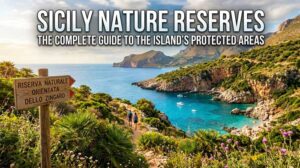
The Riserva Naturale dello Zingaro extends for 7 kilometres along the Gulf of Castellammare between Scopello and San Vito Lo Capo. It has no roads, no beach clubs, no bars inside the reserve and no cars. The only ways to see it are on foot, by boat or (for the adventurous) on horseback. What it offers is 7 coastal coves of exceptional beauty, a hiking trail above the sea with views that change with every bend, a botanical landscape of Mediterranean scrubland, endemic plants and nesting birds of prey, and a quality of wilderness that is genuinely rare within an hour’s drive of a Sicilian city.
In this guide
- The trails coastal path, mid-trail and high trail
- The seven coves
- Wildlife and flora
- Borgo Cusenza and the small museums
- Visiting by boat
- Scopello the village at the south entrance
- How to get to the Zingaro
- Practical information
- Frequently asked questions
Zingaro Nature Reserve quick facts
- Location: Gulf of Castellammare, province of Trapani, northwestern Sicily
- Park length: 7 km coastline (1,650 hectares total area)
- Entry fee (2025): €5 adults; €3 children 11 to 14; free under 11
- Opening hours: 7am to 7pm (April to September); 8am to 4pm (October to March)
- From Palermo: approximately 1 hour 30 minutes by car
- From Trapani: approximately 1 hour by car
- From San Vito Lo Capo: approximately 25 minutes to the north entrance
- Footwear: Flip flops and unsecured sandals are prohibited on the trails
- Dogs: Not permitted in the reserve
The trails coastal path, mid-trail and high trail
The Zingaro has three marked hiking routes of increasing difficulty and altitude. All three start from either the south entrance (near Scopello) or the north entrance (near San Vito Lo Capo).
The Coastal Path (Sentiero Costiero)
The standard visitor route and the one that the vast majority of people walk. The coastal path runs 7 kilometres from south entrance to north entrance at an altitude that varies between sea level (at the coves) and approximately 100 metres above sea level on the clifftop sections. The trail is largely well-marked and maintained, with rock-cut staircases descending to each of the seven coves and signposts at the main junctions. The terrain is uneven throughout a mix of limestone rock, compacted earth and occasional loose gravel and requires proper footwear. Flip flops are prohibited and this prohibition is enforced at both entrances.
Walking the full 7 kilometres one-way takes approximately 2 to 2.5 hours without stops. A round trip (returning to the same entrance) takes approximately 4 to 5 hours. With beach stops at two or three coves, allow a full day of 6 to 7 hours. The most common approach is to park at the south entrance (more parking available) and walk as far as the third or fourth cove before returning, which takes 3 to 4 hours including swimming.
There is no shade anywhere on the coastal trail. The limestone cliffs catch and radiate heat in summer, and the trail is fully exposed to the sun throughout its length. In July and August, starting before 8am is strongly recommended. The early morning light on the coves is extraordinary, and the trail is significantly cooler and quieter before 10am.
The Mid-Trail (Mezzacosta)
Running at approximately 200 to 400 metres altitude along the hillside above the coastal path, the Mezzacosta offers a more challenging 7.5-kilometre route with panoramic views over the coastline and the Tyrrhenian Sea but no direct beach access. The trail passes through denser Mediterranean scrubland, crosses the upper reaches of the reserve’s valleys and provides the best viewpoints for photography of the coast below. Suitable for fit hikers; allow 4 hours.
The High Trail (Alta Via)
The most demanding route, ascending to the ridgeline above the reserve at 600 to 900 metres with views extending to the Egadi Islands in good visibility. Not recommended in summer heat. Suitable for experienced hikers with proper equipment; allow 5 to 6 hours return. The combination of the high trail out and the coastal path back (or vice versa) is the most complete single-day experience of the reserve for serious walkers.
The seven coves
The coastal path provides access to seven coves along the reserve’s shoreline, each with its own character. From south to north:
Cala Capreria is the first cove reached from the south entrance, approximately 20 to 25 minutes from the ticket cabin. It is the most popular cove in the reserve closest to the entrance, the most photographed, and consequently the busiest. The water is exceptional (pebble and sand bottom, very clear, calm within the sheltered bay) but arrive early if you want space. By 11am on a summer weekend, the rocks are fully occupied.
Cala della Disa is smaller, further from both entrances, and reliably quieter than Cala Capreria. The approach path is steeper than average. The water is equally clear and the reduced crowd pressure makes it the preferred cove for those willing to walk a little further.
Cala dell’Uzzo is the most historically significant cove in the reserve, located near the north entrance and containing the Museo delle Attività Marinare a small museum housed in a former tuna-processing building documenting the traditional fishing methods of the Gulf of Castellammare. The beach itself is the closest to the north entrance car park, making it accessible without the full trail walk. Most boat tours departing from Castellammare del Golfo include a swimming stop here.
Cala Berretta sits almost exactly in the middle of the reserve, approximately equidistant from both entrances. It is one of the least-visited coves precisely because of its position reaching it requires committing to either a long walk from the south or a moderate walk from the north. The relative solitude and the quality of the water reward the effort.
Cala Marinella, Cala Tonnarella dell’Uzzo and the remaining coves toward the north entrance complete the sequence. Each has slightly different character varying shelter, depth, sun exposure and crowd levels but all share the fundamental quality of the Zingaro water: filtered through limestone, very clear, warm in summer and a specific shade of turquoise that photographs identically to the Maldives and actually exists.
Wildlife and flora
The Zingaro reserve protects one of the finest surviving examples of Mediterranean coastal macchia in Sicily the dense, aromatic scrubland of rockrose, wild rosemary, euphorbia, and the endemic Ampelodesmos mauritanicus grass that covers the hillsides above the coastal path. In spring (March to May), the reserve is in flower across its full extent: yellow Euphorbia, white Cistus, scarlet Ophrys orchids and the specific Sicilian flora of the limestone karst create a botanical spectacle that is the finest time of year to visit if the sea is not the primary priority.
The limestone cliffs above the coastal path are nesting territory for Bonelli’s eagle and peregrine falcons two of the rarest raptors in the western Mediterranean. The reserve also supports the Sicilian partridge, kestrels, choughs and more than 40 recorded bird species. Foxes, porcupines, weasels, eight species of bat and the endemic Sicilian wolf snake (harmless) complete the terrestrial fauna. The vivid green panfago grasshopper, found only in this part of Sicily, is visible at close range on the path edges from spring through autumn.
The Pools of Venus (Vasche di Venere), on the eastern edge of the reserve near the southern entrance, are natural rock pools formed by freshwater springs meeting the sea used since ancient times for their reportedly therapeutic mineral properties. They are a popular stopping point for boat tours and can also be reached on foot from the south entrance.
Borgo Cusenza and the small museums
Within the reserve, the historic hamlet of Borgo Cusenza has been partially restored as an open-air museum of rural Sicilian life. Mentioned in historical records as early as 1586 (by the poet and historian Antonio Cordici, who noted the sweetness of the livestock’s meat and the beauty of the cave drippings), the hamlet was continuously inhabited until the mid-20th century by families who farmed wheat, maintained orchards and kept livestock on the reserve’s slopes. The restored buildings contain displays of traditional agricultural tools, weaving equipment and domestic objects.
The Museum of Weaving in the reserve demonstrates the traditional craft of weaving baskets and mats from locally gathered palmetto and Ampelodesma fibres a technique still practised by artisans in the area. The Museum of Maritime Activities at Cala dell’Uzzo documents the tuna fishing and coastal fishing traditions of the Gulf of Castellammare. Both museums are small and informal but add cultural depth to a visit that would otherwise be purely natural.
Visiting by boat
A boat tour is the alternative for those who cannot or prefer not to walk the coastal trail, and it provides a genuinely different perspective on the reserve the coves approached from the water rather than from above, the cliff faces seen from the sea, and access to sections of coastline that the trail does not reach. The Pools of Venus and several sea caves are accessible only by boat.
Boat tours departing from Castellammare del Golfo (30 minutes from the south entrance by road) and from San Vito Lo Capo typically cover the full length of the reserve’s coastline with swimming stops at two or three coves. Some operators combine the Zingaro with a visit to Scopello’s tonnara and the dramatic faraglioni rock stacks visible offshore from the village.
👉 ZINGARO NATURE RESERVE BOAT TOUR WITH SWIMMING AND SNORKELLING
A guided boat tour of the Zingaro Nature Reserve coastline from Castellammare del Golfo or San Vito Lo Capo visiting the coves, the Pools of Venus and the sea caves with swimming and snorkelling stops. The finest way to see the reserve without hiking in summer heat.
👉 SEE THE BEST ZINGARO NATURE RESERVE BOAT TOUR HERE
Scopello the village at the south entrance
The village of Scopello, 1 kilometre from the south entrance of the reserve, is one of the most beautiful small settlements in western Sicily. A tiny hamlet of stone houses clustered around a 17th-century baglio (a type of Sicilian courtyard farm), with the former tonnara (tuna-fishing establishment) below the village cliffs and the extraordinary faraglioni isolated rock stacks rising from the sea offshore visible from the coastal terrace.
The Tonnara di Scopello, now a private holiday residence but visible from the road above, is one of the finest examples of Sicilian industrial archaeology in northwestern Sicily the tuna-processing warehouses, the net storage rooms and the small beach where the boats were hauled up, all preserved within the limestone cove below the village. Swimming is possible at the rocks around the base of the faraglioni when the private beach is not accessible.
Scopello is the finest base for visiting the Zingaro from the south. The village has several small restaurants serving western Sicilian food (pasta con le sarde, fresh tuna in season, pane cunzatu the local bread dressed with oil, tomato and local cheese) and a handful of accommodation options in converted farmhouses and stone buildings. Arrive early in summer as parking in Scopello itself is very limited.
How to get to the Zingaro
A car is strongly recommended. The reserve has no public transport connection directly to either entrance, and the nearest bus stops are in Scopello (south) and San Vito Lo Capo (north), each requiring additional walking or local taxi service.
From Palermo: Take the A29 motorway toward Trapani, exit at Castellammare del Golfo and follow the signs toward Scopello (approximately 1 hour 30 minutes, 90 km). The south entrance is 3 kilometres past Scopello on the coastal road; the parking area on the left is the main car park.
From Trapani: Take the A29 toward Palermo, exit Castellammare del Golfo, follow Scopello signs (approximately 1 hour, 40 km). Alternatively, drive north along the coast from San Vito Lo Capo to the north entrance (approximately 25 minutes from San Vito, 12 km).
From San Vito Lo Capo: The north entrance is 12 kilometres south of San Vito Lo Capo along the coastal road (approximately 25 minutes). Parking at the north entrance is limited arrive early in summer.
👉 RENT A CAR
The Zingaro is most rewarding as part of a western Sicily road trip. Compare rental prices at Palermo and Trapani airports and book in advance. Always select full coverage (zero excess).
👉 COMPARE THE BEST RENTAL CARS HERE
Practical information
Which entrance to use
The south entrance (near Scopello) has more parking, is the standard starting point for the coastal path and provides easy access to the most popular coves within the first 2 kilometres. The north entrance (near San Vito Lo Capo) has less parking but provides immediate access to Cala dell’Uzzo (the easiest cove to reach) and is preferred by those who want a shorter walk to the water. The two entrances are not connected by road if you enter from the south and walk to the north, you must either walk back the same way or arrange shuttle transport.
What to bring
Water a minimum of 2 litres per person (3 litres in July and August). There is no drinking water anywhere inside the reserve. Sun protection: sunscreen, hat and lightweight long-sleeved layers. Hiking shoes or trail runners (flip flops and unsecured sandals are prohibited). Water shoes for the pebbly beach entries. A dry bag or waterproof case for electronics at the coves. Snacks the only food available is at small kiosks near the entrances; there is nothing inside the reserve. No rubbish bins exist inside the reserve take everything out.
When to visit
May, June, September and October provide the best conditions: warm enough to swim, cool enough to walk comfortably and less crowded than July and August. Spring (March to May) is the finest time for the botanical interest the reserve is in flower and the bird life is at its most active. July and August are beautiful but hot; arrive before 8am and be prepared for company at Cala Capreria. Read our complete best time to visit Sicily guide.
Combining the Zingaro with the wider western Sicily circuit
The Zingaro fits naturally into a western Sicily day that also includes Scopello (immediately adjacent), the Segesta temple (45 minutes east), Erice and the Trapani salt pans. For a multi-day western Sicily circuit, the reserve pairs with San Vito Lo Capo to the north, Segesta to the east and Erice and Trapani further south. Read our complete Sicily road trip guide for the full western circuit.
👉 ZINGARO NATURE RESERVE GUIDED HIKING TOUR
A guided day hike through the Zingaro coastal trail with a local naturalist guide the history of the reserve, the endemic flora and fauna, the best coves for swimming and the story of how Sicilians saved this coastline from a highway in 1980. Available from Palermo and Trapani.
👉SEE THE BEST ZINGARO NATURE RESERVE GUIDED HIKING TOUR HERE
Frequently asked questions about the Zingaro Nature Reserve
Is the Zingaro Nature Reserve worth visiting?
Yes, without qualification. The Zingaro is the finest coastal hiking experience in Sicily and one of the most beautiful coastal reserves in the western Mediterranean. The combination of the hiking trail, the seven coves, the Mediterranean flora and fauna, and the quality of the water makes it a destination that stands independently rather than as a supporting attraction to the nearby towns and temples.
How difficult is the Zingaro hike?
The coastal path is rated easy to moderate. The trail is largely well-maintained with no sustained steep sections, though uneven terrain is continuous throughout. The primary challenge in summer is the heat and the complete absence of shade, rather than the physical difficulty of the trail itself. Fit walkers of any age can complete the full coastal path in a day with beach stops.
Which entrance should I use for the Zingaro?
The south entrance (near Scopello) for the full coastal trail experience and for combining with a visit to Scopello village. The north entrance (near San Vito Lo Capo) for easy access to Cala dell’Uzzo and Cala Tonnarella dell’Uzzo without the full trail commitment. The south entrance has significantly more parking.
Can you swim in the Zingaro Nature Reserve?
Yes swimming in the coves is the primary activity for most visitors and is entirely permitted. The beaches are pebble and rock rather than sand; water shoes are recommended for entering the water comfortably. The water is unmonitored no lifeguards, no facilities within the reserve. Swim only if confident in open water conditions.
Why is there a tunnel at the south entrance?
The partially-cut tunnel visible at the south entrance was excavated as part of the coastal highway project that prompted the 1980 protest. When approximately 3,000 Sicilians blocked the construction site and successfully campaigned for the area’s protection as a nature reserve, the highway project was abandoned. The tunnel was left exactly as it was a permanent monument to the environmental victory that created the reserve.
What a highway would have destroyed
The tunnel at the south entrance makes the Zingaro different from other beautiful places to visit. It is not simply a nature reserve that survived intact through benign neglect it is a nature reserve that was explicitly fought for and saved by specific people at a specific moment, and the evidence of what was prevented is still visible in the rock. Walking through it into the reserve beyond, where the limestone cliffs drop to turquoise water and the peregrine falcons quarter the hillsides, gives the place a quality of consequence that purely natural beauty, however extraordinary, does not always carry.
For help planning the rest of your western Sicily trip, read our guides to San Vito Lo Capo, Erice, Segesta, Trapani and our day trips from Palermo guide.
Did this guide help you plan your Zingaro visit? Save it to Pinterest or share it with someone planning a western Sicily trip.