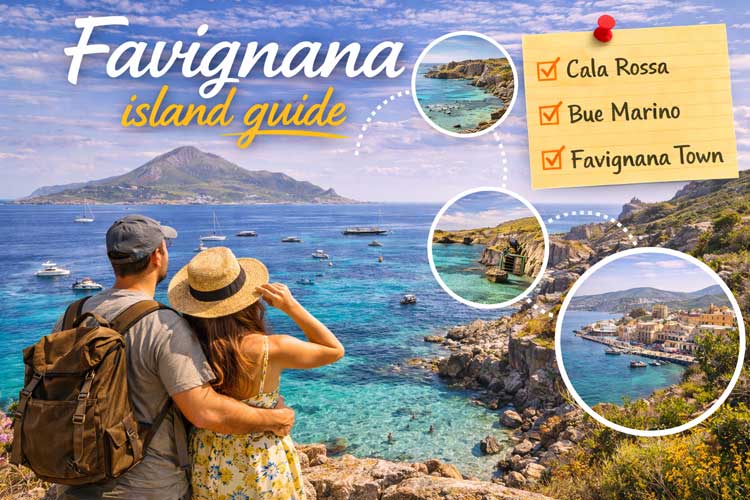
Favignana is a butterfly. From above from a drone, from Google Maps, from the approaching hydrofoil when the island rises above the Tyrrhenian horizon its shape is unmistakable: two roughly equal wings, the western one rising to the hill of Santa Caterina, the eastern one flat and low, connected at the narrow waist where the town sits. It is the largest of the three Egadi Islands (with Levanzo and Marettimo), 19 square kilometres of limestone, ancient tuff quarries, coastal caves, coves of implausible colour and a town that smells of the sea and of the dried oregano sold outside the harbour-front shops.
Most visitors arrive for Cala Rossa. The images are everywhere the reddish tuff walls descending to water that cycles through three shades of blue before deepening to dark azure and the reality, when you arrive, is that the images were accurate. Cala Rossa was voted the most beautiful beach in Italy by Skyscanner in 2011. That recognition has complicated its solitude, but the island offers enough variety, and the coves are numerous enough, that Favignana remains one of the finest small islands in the Mediterranean for those willing to explore beyond the famous photograph.
In this guide
- Getting to Favignana from Trapani
- Getting around the island
- Cala Rossa the legend and the reality
- The other beaches and coves
- The tuff quarries
- Ex Stabilimento Florio the tuna museum
- Favignana town
- Diving and snorkelling
- Boat tours
- Day trips to Levanzo and Marettimo
- Practical information
- Frequently asked questions
Favignana quick facts
- Location: Egadi Islands, 7 km off the coast of Trapani, northwestern Sicily
- From Trapani: 30 minutes by hydrofoil (Liberty Lines); 1 hour by car ferry
- Hydrofoil tickets: approximately €8 to €12 one-way (2025); book in advance in summer
- Island size: 19 km²; butterfly-shaped; highest point Santa Caterina hill (314 m)
- Best for: Cala Rossa, wild swimming, cycling, the tuff quarry landscapes, diving
- Best months: May, June, September, October warm sea, fewer crowds than July/August
- Cars on the island: Resident cars only in summer visitors reach beaches by bike, scooter or boat
Getting to Favignana from Trapani
The gateway to Favignana is Trapani, whose harbour serves as the mainland port for all three Egadi Islands. Two companies operate the crossing: Liberty Lines (hydrofoils, 30 minutes) and Caronte & Tourist (car ferries, approximately 1 hour). The hydrofoil is the standard choice for foot passengers visiting on a day trip or arriving without a car; the car ferry is used by residents transporting vehicles and by visitors who have pre-booked a car on the island (not recommended bikes are far more practical and enjoyable).
Hydrofoil tickets cost approximately €8 to €12 one-way in 2025. Multiple crossings run daily from early morning to late evening throughout the summer; services reduce in winter. Book in advance for July and August the hydrofoils fill on peak summer days and walk-up tickets can be unavailable at popular departure times. The Liberty Lines app and website allow advance booking.
From Palermo, reach Trapani by bus (Segesta Autolinee, approximately 2 hours from Palermo city centre directly to Trapani port) or by car on the A29 motorway. Read our complete Trapani guide for more on the city and the wider western Sicily circuit.
👉 RENT A CAR
A rental car gives you the flexibility to combine Favignana with Erice, Segesta and the Trapani salt pans in a single western Sicily day. Compare prices at Palermo and Trapani airports on DiscoverCars.
👉 COMPARE THE BEST RENTAL CARS HERE
Getting around the island
The single best decision you can make on Favignana is to rent a bicycle. The island is small (approximately 10 kilometres east to west at the widest), largely flat on the eastern wing where the main beaches are concentrated, and equipped with decent roads between the port town and all the major coves. Cycling between beaches takes 10 to 20 minutes at most, allows spontaneous stops at unmarked viewpoints and coves, and provides the island-at-its-own-pace quality that a scooter or car tour cannot replicate.
Bicycle rental is available from multiple operators around the harbour for approximately €10 to €15 per day. Electric bikes are available for those who want assistance on the hillier western section of the island. Scooters are also available for hire at slightly higher prices and are useful for reaching the more remote western coves efficiently.
Private cars are strongly discouraged in summer the island’s roads are narrow, parking at the major coves is limited, and the traffic congestion around Cala Rossa on peak summer mornings makes cycling or a boat approach considerably more pleasant than arriving by road. Many of the finest swimming spots are also accessible only on foot or by water, making the bicycle plus swimming shoes combination the optimal Favignana toolkit.
Cala Rossa the legend and the reality
The popular explanation for the name “Cala Rossa” is dramatic: that the waters of the bay turned red with the blood of Carthaginian and Roman sailors killed in the Battle of the Egadi Islands in 241 BC, the naval engagement that ended the First Punic War and established Roman dominance in the western Mediterranean. It is a good story. It is probably not true.
Recent underwater archaeology has clarified that the battle took place considerably further north, near the island of Levanzo rather than Favignana the evidence being the concentration of finds (bronze ship rams, anchors, helmets, ballista balls) on the seabed north of Levanzo, far from Cala Rossa. The name more likely derives from the reddish-orange hue of the ancient tuff quarry walls that frame the bay on both sides the warm iron-oxide colour of the cut stone that gives the cove its distinctive quality and its most striking photographs.
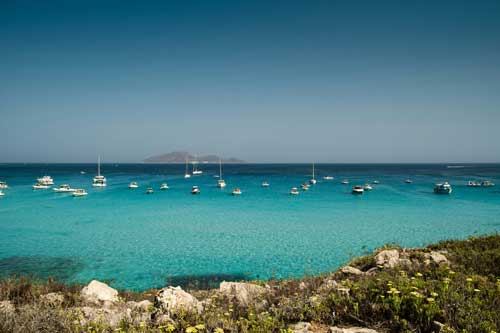
The cove itself is not a beach in the conventional sense. There is minimal sand and no beach club infrastructure. What exists is a large natural harbour of flat tuff rock platforms descending to the sea, carved and shaped by both geological erosion and centuries of quarrying, with the water between and around them cycling through pale turquoise in the shallows and intensifying to deep blue as the depth increases. The swimming is exceptional clean, calm within the sheltered bay, with visibility of several metres. The platforms provide sunbathing surfaces. There are no services (outside of occasional summer food trucks) bring water, food, rock shoes and snorkelling gear.
Cala Rossa is reached by bicycle (10 minutes from the port) or on foot along the coastal path. By road, follow signs north from the port you will descend to a viewing area, then continue on foot along the path to the bay. The finest approach is by boat, which allows entry from the sea and views of the tuff walls from the water angle that no land approach provides.
The other beaches and coves
Bue Marino, on the northeastern coast, is considered by many visitors who know the island well to be more spectacular than Cala Rossa. It sits at the base of an abandoned tuff quarry with cave openings and tunnels carved into the cliff face the quarry walls descend directly into the sea and the swimming in and out of the cave openings is one of the finest water experiences on the island. The access path is rougher than Cala Rossa and the swimming approach is more technical, which keeps the crowds lower. Bring rock shoes and at least an hour.
Cala Azzurra on the southeastern coast is the most accessible alternative to Cala Rossa easier to reach, the water more sheltered, and a small sandy section that gives it a more conventional beach character. A small bar offers drinks and limited food service in summer. It is less dramatic than Cala Rossa or Bue Marino but a good choice for families with young children or for those who want a more relaxed beach day with some shade available.
Lido Burrone, on the southern coast near the airport, is the only beach on Favignana with organised beach club infrastructure sun loungers, umbrellas, a restaurant, showers. The sandy beach and the relatively calm water make it the most conventional beach destination on the island. For visitors specifically seeking a comfortable organised beach day rather than a wild swimming and rock scrambling experience, Lido Burrone is the right choice.
Cala Rotonda, near Lido Burrone, is a smaller, quieter cove that receives fewer visitors than the main sites excellent for a peaceful swim between other stops on a clockwise bicycle circuit.
The tuff quarries
Favignana’s most specific and most surprising landscape is not its water but its stone. For centuries, the island was one of the primary sources of golden-yellow tufo (tuff) for construction across western Sicily soft volcanic sedimentary rock that could be cut easily with hand tools, transported by boat and used for the facades of Trapani’s historic buildings, the city of Marsala and dozens of coastal towns. The quarrying created a landscape of extraordinary character: vertical-walled rectangular pits descending into the island’s limestone, abandoned platforms and loading ramps at sea level, cave-like excavations opening directly onto the water.
The abandoned quarries around Cala Rossa, Bue Marino and other parts of the island’s coast are freely accessible and reward slow exploration. The warm colour of the cut tuff in afternoon light deep amber, orange and ochre against the turquoise water is the defining visual quality of Favignana, the reason the photographs are so saturated with colour that they read as artificially enhanced when they are not.
Ex Stabilimento Florio the tuna museum
In the town of Favignana, the Ex Stabilimento Florio is one of the most important industrial heritage buildings in the Mediterranean and an underrated visit. Built in 1859 by the Florio family the Palermo-based dynasty that dominated the Sicilian economy through the 19th century it was Europe’s first industrial tuna processing plant, operating at an industrial scale that made Favignana’s mattanza (the traditional tuna hunt) the most productive in the Mediterranean.
The mattanza was an ancient method of tuna fishing that positioned large nets across the migration routes of Atlantic bluefin tuna, herding the fish into a series of progressively smaller chambers until the final one the “Chamber of Death” where they were killed in a ritual of extraordinary violence and commercial importance. The Florio plant processed the catch at industrial scale, canning and exporting Favignana tuna across Europe. The last mattanza on Favignana took place in 2007, when the declining bluefin tuna population made it economically unviable.
The Stabilimento is now a museum documenting the history of the mattanza and the Florio enterprise, with the original industrial equipment, the vats, the canning machinery and the documentation of the Florio family’s commercial empire still in place. It is an excellent 45-minute visit that contextualises the island’s economic history and its relationship to the tuna that still appears on every menu.
Favignana town
The town of Favignana, clustered around the harbour at the island’s waist, is small enough to cross on foot in 10 minutes and large enough to offer a genuine town experience: a daily market with local produce and fish, a pasticceria with good morning pastries and granita, several restaurants serving freshly caught fish and the local speciality of tonno fresco (fresh tuna), small shops selling island products and a harbour-front passeggiata in the evenings that is as Sicilian in character as anything on the mainland.
The Fortezza di Santa Caterina, the castle on the hill above the western end of town, was a Bourbon prison before Italian unification and is now open for visits with views across the island and toward the other Egadi Islands and the Sicilian coast. The hike from the town to the castle summit takes approximately 30 minutes and provides the finest bird’s-eye view of Favignana’s butterfly shape.
Diving and snorkelling
The waters around Favignana are among the finest for diving in the Tyrrhenian Sea. The combination of clear water, varied underwater topography (the tuff quarry walls continue below the surface, creating vertical walls and overhangs) and the presence of ancient wrecks and artefacts from two millennia of maritime traffic makes the island a significant dive destination.
The dive site at Cala Rossa and Punta Marsala, accessible at depths of 10 to 12 metres, contains Punic and Roman artefacts from the ancient sea traffic that made this strait one of the busiest in the ancient Mediterranean. The wall dive at Secca del Toro, descending to 40 metres on the island’s northern coast, consistently encounters large shoals of barracuda and is considered one of the finest dives in the archipelago. Multiple dive centres operate from the port.
For snorkelling without a guide, Cala Rossa and Bue Marino provide the best access: clear water, interesting underwater rock formations and marine life at shallow depths. Rock shoes and a mask are the only equipment required.
Boat tours
👉 FAVIGNANA BOAT TOUR CALA ROSSA, BUE MARINO AND THE EGADI ISLANDS
Explore Favignana’s finest coves by boat, entering Cala Rossa and Bue Marino from the sea the finest approach to both. Most tours also include a stop at Levanzo or Marettimo with swimming. Available from Trapani or Favignana port.
👉SEE THE BEST FAVIGNANA BOAT TOUR HERE
Day trips to Levanzo and Marettimo
Favignana is the natural hub for exploring the other two Egadi Islands, both of which are reached by regular hydrofoil connections from Favignana port.
Levanzo (30 minutes by hydrofoil) is the smallest inhabited island in the Egadi group a tiny port, a handful of houses, walking trails to the rest of the island and, most importantly, the Grotta del Genovese: a cave on the western coast containing Palaeolithic cave paintings and Neolithic engravings that are among the oldest and finest prehistoric artworks in Italy, accessible by boat from the port with a licensed guide. The cave was rediscovered in 1949 and contains paintings of animals and humans dating to approximately 10,000 to 6,000 BC.
Marettimo (1 hour by hydrofoil) is the most remote and the most wild of the three islands, with no roads beyond the village and a trail network that crosses the island’s mountain spine between the port and the spectacular western coves. The diving around Marettimo is considered the finest in the Egadi Islands. It is an island for those seeking serious remoteness and serious walking.
👉 EGADI ISLANDS DAY TOUR FROM TRAPANI FAVIGNANA, LEVANZO AND MARETTIMO
A guided full-day boat tour of all three Egadi Islands from Trapani, with swimming stops at the finest coves of each island. The finest way to see the archipelago in a single day without overnight accommodation.
👉SEE THE BEST EGADI ISLANDS DAY TOUR HERE
Practical information
Day trip or overnight?
Favignana works as a day trip from Trapani the first hydrofoil of the morning arrives in time for a full day on the island, and the last hydrofoil returns to Trapani in the evening. A day trip allows time for Cala Rossa, Bue Marino, lunch in town and the Stabilimento Florio museum. Staying overnight adds the evening atmosphere of the town (restaurants, passeggiata, fewer people), time for the western coves and Santa Caterina hill, and the option of exploring Levanzo or Marettimo the following day.
When to visit
May, June, September and October are the finest months warm enough to swim, cool enough to cycle comfortably, and considerably less crowded than July and August. July and August are busy, hot and the coves fill early on weekends; arriving at Cala Rossa before 9am is essential to find space. The island is accessible year-round but most accommodation and restaurants close from November to March. Read our complete guide to the best time to visit Sicily.
Combining Favignana with western Sicily
Favignana fits naturally into a western Sicily circuit based on Trapani. The island combines well with Erice (30 minutes from Trapani by cable car), the Trapani salt pans at sunset, Segesta (40 minutes from Trapani) and Marsala (30 minutes from Trapani). Read our complete Sicily road trip guide for how to build this circuit.
Frequently asked questions about Favignana
Is Favignana worth visiting?
Yes, strongly. Cala Rossa alone would justify the crossing from Trapani, and the island offers considerably more: Bue Marino, the tuff quarry landscapes, the Stabilimento Florio museum, excellent diving and the option of day trips to Levanzo (prehistoric cave paintings) and Marettimo. It is one of the finest island destinations in the western Mediterranean.
How do you get to Favignana from Trapani?
By Liberty Lines hydrofoil from Trapani port approximately 30 minutes, multiple crossings daily. Book online in advance in summer. Car ferries also operate but are primarily for residents. Most visitors travel as foot passengers and rent bicycles on the island.
What is Cala Rossa?
Cala Rossa is the most famous cove on Favignana, on the northeastern coast of the island, approximately 10 minutes by bicycle from the port. It is not a sandy beach but a natural harbour of flat tuff rock platforms descending to exceptionally clear turquoise water, framed by the warm reddish-orange walls of ancient tuff quarries. It was voted the most beautiful beach in Italy by Skyscanner in 2011. No services bring everything you need for the day.
Why is it called Cala Rossa?
The popular legend attributes the name to the battle between Romans and Carthaginians in 241 BC (the Battle of the Egadi Islands), which supposedly turned the bay red with blood. Recent underwater archaeology has confirmed that the battle actually took place north of Levanzo, not at Cala Rossa. The name more likely derives from the reddish hue of the ancient tuff quarry walls that frame the cove.
What is the Stabilimento Florio?
The Ex Stabilimento Florio is Europe’s first industrial tuna processing plant, built in 1859 by the Florio family of Palermo on Favignana. It operated for nearly 150 years, canning and exporting Favignana tuna across Europe at industrial scale. The last traditional mattanza (tuna hunt) on the island took place in 2007. The building is now a museum documenting the history of the tuna industry and the Florio commercial empire.
The butterfly island
Favignana is one of those places that provides exactly what it promises and then a little more. The photographs are accurate: the water at Cala Rossa really is that colour. But the island offers the quarry walls behind Bue Marino, the industrial archaeology of the Stabilimento Florio, the cave paintings of Levanzo an hour away by hydrofoil, and the particular evening quality of a small harbour town after the day-trip visitors have gone. These are the parts that no photograph anticipates.
For help planning the rest of your western Sicily trip, read our guides to Trapani, Erice, Segesta and our day trips from Palermo guide.
Did this guide help you plan your Favignana visit? Save it to Pinterest or share it with someone planning a trip to western Sicily.