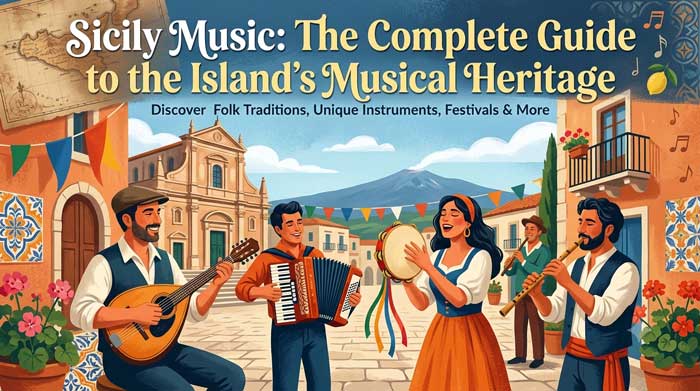
Sicily’s musical heritage is among the richest of any Italian region the product of the same layered cultural synthesis that produced the architecture, the art and the literature. The Arab musical traditions that shaped the Sicilian folk music (the specific modal scales, the melismatic ornamentation, the percussion instruments that distinguish the Sicilian popular music tradition from the mainland Italian equivalents), the operatic tradition that produced Vincenzo Bellini (the most lyrical and the most specifically Sicilian of the 19th-century Italian opera composers), the canti dei pescatori (the fishing songs of the Messina and Syracuse straits that preserve the Arab-derived cialome tradition), the tarantella siciliana and the sacred music of the Norman cathedral tradition together constitute a musical heritage of extraordinary variety and extraordinary historical depth. This guide covers the essential Sicilian music programme with the specific works, the specific artists and the specific places where it can be encountered.
In this guide
- Vincenzo Bellini the Catanian genius
- The Sicilian opera tradition
- The Teatro Massimo, Palermo
- Sicilian folk music
- Cialome the fishing songs
- The Sicilian tarantella
- The Arab musical heritage
- Contemporary Sicilian music
- Where to hear live music in Sicily
- FAQ
Vincenzo Bellini the Catanian Genius
Vincenzo Bellini (1801 to 1835) is the most celebrated Sicilian composer and the most specifically Catanian artist in any medium the composer whose melodic gift (the specific long-breathed cantilena melody that his contemporaries described as the most natural music they had ever heard, as if it had always existed and Bellini had only discovered rather than invented it) produced the operas that define the bel canto tradition at its purest and most lyrical. Bellini died at 33, leaving ten completed operas; the three masterpieces La Sonnambula (1831), Norma (1831) and I Puritani (1835, completed days before his death) are the most performed bel canto operas in the international repertoire and the works that most directly influenced the development of the Italian operatic tradition through Verdi and into the 20th century.
Norma the opera whose closing scene (the Druid priestess who condemns herself to death rather than betray her Roman lover) is the most dramatically concentrated in the bel canto tradition was praised by the Catanese actor who tasted the pasta alla Norma in the same terms he used for the opera: as the most perfectly accomplished thing in its kind. The connection between the opera and the pasta is not merely a culinary anecdote but a specific cultural statement about the quality of the Catanian achievement in each domain the pasta as good as the opera, the opera as good as the pasta, both expressing the specific Catanian capacity for the perfectly calibrated balance of flavour and form.
The Bellini locations in Catania: the Museo Belliniano (Casa Natale di Bellini, Piazza San Francesco d’Assisi 3 the birthplace museum with Bellini’s personal effects, manuscripts and the specific memorabilia of the composer’s short life), the Teatro Massimo Bellini (the opera house named for the composer, inaugurated in 1890 with a performance of Norma the most historically appropriate single opening programme for any Italian opera house), and the monument in the Piazza Stesicoro (the neoclassical statue above the Roman amphitheatre ruins that is the most photographed single civic monument in Catania). Read our complete Catania guide.
👉 SICILY MUSIC TOUR BELLINI’S CATANIA, THE TEATRO MASSIMO AND THE FOLK MUSIC TRADITION
A guided musical tour of Sicily the Bellini birthplace in Catania, the Teatro Massimo in Palermo, the folk music programme of the Ballarò Buskers festival and the specific Arab-derived musical heritage of the Sicilian popular tradition. Available from Catania and Palermo.
👉SEE THE BEST SICILY MUSIC TOUR HERE
The Sicilian Opera Tradition
The Sicilian operatic tradition extends well beyond Bellini the island has produced a disproportionate number of significant opera composers relative to its population and its position in the Italian cultural hierarchy. Giovanni Pacini (1796 to 1867), born in Catania, was one of the most prolific opera composers of the bel canto period (90 operas) and the primary competitor of Donizetti and Bellini in the 1820s and 1830s. Francesco Cilea (1866 to 1950), born in Palmi but associated with the Sicilian musical tradition, composed Adriana Lecouvreur (1902), the most performed Italian opera of the verismo period after Puccini. The Sicilian operatic tradition is the product of the specific social function of opera in the 19th-century Sicilian urban culture the opera house was the primary public assembly space for the bourgeoisie, the setting for the most important social encounters and the most visible display of civic culture, and the investment in opera production was the investment in the specific civic identity of each Sicilian city.
The Teatro Bellini of Catania (inaugurated 1890), the Teatro Massimo of Palermo (inaugurated 1897, the largest opera house in Italy) and the Teatro Vittorio Emanuele of Messina (19th century, the primary cultural institution of the northeastern capital) are the three principal opera houses of the Sicilian operatic programme. The Taormina Arte festival (the summer outdoor opera programme in the Greek theatre at Taormina) provides the most dramatically atmospheric operatic experience available in Italy the ancient theatre, the Etna profile and the Ionian as the backdrop for Verdi and Bellini in the open air. Read our complete Teatro Massimo guide.
The Teatro Massimo, Palermo
The Teatro Massimo Vittorio Emanuele the opera house at the top of Via Maqueda in Palermo, inaugurated in 1897 with Verdi’s Falstaff is the largest opera house in Italy and the third largest in Europe (after the Paris Opéra and the Vienna Staatsoper), with a seating capacity of 1,381 and an acoustic programme considered among the finest in Italy. The building was designed by Giovan Battista Filippo Basile (and completed by his son Ernesto Basile, the Liberty architect) in the eclectic neoclassical style of the late 19th-century Italian civic building tradition the specific combination of the Greek colonnade portico, the neoclassical dome and the Liberty decorative elements that makes it the most architecturally heterogeneous and the most specifically Palermitan of the Italian opera houses.
The Teatro Massimo is known internationally as the setting for the closing scene of The Godfather Part III (1990, directed by Francis Ford Coppola) the opera performance, the assassination on the steps, the specific visual use of the neoclassical facade that makes the building one of the most globally recognised single architectural images of Italian cinema. The irony that the most internationally famous scene associated with the largest opera house in Italy involves an assassination rather than a performance is the most specifically Palermitan cultural fact available in any film. The theatre is open for visits and for performances; guided tours of the interior (including the stage, the royal box and the architectural programme) are available daily. Read our complete Teatro Massimo guide.
Sicilian Folk Music
The Sicilian folk music tradition is the most Arab-inflected of any Italian regional musical heritage the specific modal scales (the use of the augmented second interval, characteristic of the Arab and Ottoman musical modes, in the melodic lines of the Sicilian folk songs), the melismatic ornamentation (the specific vocal technique of ornamenting a single syllable with multiple pitches, characteristic of the Arab musical tradition and present in the Sicilian vocal folk music as in no other Italian regional tradition) and the specific percussion instruments (the tammorra the frame drum of the southern Italian folk music tradition, related to the Arab daff and the marranzano, the Sicilian jaw harp, also of Arab derivation) together constitute a folk music vocabulary of specifically Arab-Sicilian character.
The most significant contemporary practitioners of the Sicilian folk music tradition: Rosa Balistreri (1927 to 1990) the most celebrated Sicilian folk singer of the 20th century, whose interpretations of the traditional Sicilian songs (the lamenti, the work songs, the love songs) are the most emotionally direct and the most musically specific versions of the tradition available in recorded form. Balistreri’s voice the raw, powerful, technically untrained but expressively overwhelming instrument of a woman who grew up in the most specific conditions of Sicilian peasant poverty is the most directly emotional encounter with the Sicilian folk tradition available without being physically present in the landscape that produced it.
Cialome the Fishing Songs
The cialome (the plural of cialoma, from the Arabic shalōma) are the work songs of the Sicilian fishermen specifically the tuna fishing communities of the mattanza (the traditional tuna trap fishing of the Sicilian Channel) who developed a tradition of call-and-response singing during the most intense phase of the hunt, when the tuna are driven into the innermost net and the rais (the master of the trap) directs the fishermen in the ritual of the kill. The cialome are sung in the Arabic-derived vocabulary of the Sicilian fishing tradition the specific words used in the mattanza (many of them Arabic in origin, preserved in the fishing community from the period of Arab dominance in the 9th to 11th centuries) are sung to the specific modal melodies that preserve the most direct surviving trace of the Arab musical tradition in Sicilian popular culture.
The mattanza has largely ended the last active tuna trap at Favignana concluded in 2007 but the cialome tradition has been preserved through recordings and the ethnomusicological documentation of researchers who worked with the last active fishing communities in the final decades of the 20th century. The Museo del Tonno at Favignana and the recordings of the Favignana fishing community provide the most accessible single encounter with the cialome tradition available in Sicily. Read our complete Favignana guide.
The Sicilian Tarantella
The tarantella siciliana is the most specifically Sicilian form of the pan-southern-Italian tarantella tradition the rapid dance music in 6/8 time that the southern Italian folk tradition uses for the most festive and the most energetic social occasions. The Sicilian version differs from the Neapolitan and the Calabrian equivalents in the specific ornamental programme of the melody, the specific percussion arrangement (the tamburello frame drum is the primary rhythmic instrument) and the specific step patterns of the associated dance tradition. The tarantella siciliana is encountered at the summer sagre (village festivals), the religious feast day celebrations and the Ballarò Buskers festival in Palermo the most accessible single annual event for the folk music programme in the city.
The Arab Musical Heritage
The Arab musical tradition that the Arab colonists and administrators brought to Sicily in the 9th to 11th centuries left the deepest single non-Italian influence on the Sicilian musical heritage deeper and more specifically traceable than the Spanish, the Norman or the Greek influences in the folk music tradition. The specific elements: the modal scales (the use of the Arab maqam system in the melodic vocabulary of the Sicilian folk songs), the ornamental tradition (the melisma and the microtonal pitch inflection of the Arab vocal technique preserved in the Sicilian canto tradition), the specific instruments (the marranzano jaw harp, the tammorra frame drum, the specific zampogna bagpipe variant of the Sicilian interior) and the specific work song traditions (the cialome of the mattanza, the songs of the wheat harvest) all preserve the Arab musical legacy in forms more directly audible than in any other Italian regional tradition.
Contemporary Sicilian Music
The contemporary Sicilian music scene has produced several internationally noticed artists Colapesce (the indie pop songwriter from Messina whose stage name references the Sicilian folk legend of the half-fish diver who held up the island from below), Dimartino (the Palermitan singer-songwriter whose work draws on the specific Sicilian folk and operatic tradition) and the duo Colapesce Dimartino (whose Musica Leggerissima won the Sanremo Music Festival secondary award in 2021 and reached number one in Italy, introducing Sicilian popular music to the largest Italian audience since the postwar canzone tradition). The specific quality of the contemporary Sicilian pop scene: the willingness to engage with the folk and operatic heritage as source material rather than as nostalgia the Arab modal inflection in a contemporary pop arrangement, the Bellini melodic gesture in a digital production, the cialome rhythm in an electronic track.
Where to Hear Live Music in Sicily
Teatro Massimo, Palermo. The primary opera and classical music programme season from October through June, with the summer programme including outdoor concerts in the piazza. Book tickets at the Teatro Massimo box office or online. Read our complete Teatro Massimo guide.
Teatro Bellini, Catania. The Bellini house the opera house named for the composer, with the most historically specific relationship between venue and repertoire of any Italian opera house. The Bellini operas performed in the Bellini theatre in the city of Bellini’s birth are the most specifically appropriate operatic experience in Italy. Read our complete Catania guide.
Taormina Arte, Greek Theatre. The outdoor opera and concert programme in the Taormina Greek Theatre from June through August the most atmospherically extraordinary performance setting in Italy. Read our complete Greek Theatre Taormina guide.
Ballarò Buskers Festival, Palermo (October). The most accessible single annual event for the Sicilian folk music tradition the street music festival in the Ballarò market district, with folk, traditional and contemporary Sicilian music in the most historically appropriate urban setting. Read our complete Palermo neighbourhood guide.
FAQ about Sicily Music
What is the most famous Sicilian music?
Vincenzo Bellini’s operas particularly Norma (1831) and La Sonnambula (1831) are the most internationally famous Sicilian musical works. The specific Bellini melodic style (the long-breathed cantilena melody) defined the bel canto tradition and influenced Verdi, Chopin and Wagner. The Teatro Massimo in Palermo and the Teatro Bellini in Catania are the primary operatic institutions.
What is Sicilian folk music like?
Sicilian folk music is the most Arab-inflected of any Italian regional tradition the specific modal scales, the melismatic vocal ornamentation and the percussion instruments (tammorra frame drum, marranzano jaw harp) all reflect the Arab musical heritage of the 9th to 11th-century Arab colonisation. Rosa Balistreri (1927 to 1990) is the most celebrated Sicilian folk singer of the modern period.
Where can I hear live music in Sicily?
The Teatro Massimo in Palermo and the Teatro Bellini in Catania for opera and classical music (October to June). The Taormina Arte festival in the Greek Theatre for outdoor opera and concerts (June to August). The Ballarò Buskers Festival in Palermo in October for the folk music tradition. The Marzamemi Cinema Festival in August for outdoor film screenings with live music accompaniment.
The Island That Sings in Arabic
The specific quality of Sicilian music is the quality of a tradition that cannot forget its origins. The Arab musical scales that the colonists of the 9th century brought to the island have not been erased by the Norman conquest, the Spanish domination or the Italian unification they are still audible in the specific modal inflection of the Sicilian folk song, in the melismatic vocal ornamentation of the canto tradition and in the cialome of the mattanza fishermen who sang their work songs in Arabic-derived words to Arabic-derived melodies until the last mattanza in 2007. The most lyrical Italian opera composer of the 19th century was born in Catania, on the slope of the volcano, in the city where the street food is Arab and the architecture is Norman and the music is the most specifically Mediterranean in Italy. Bellini did not choose to be Sicilian. But the melody he found was the melody of an island that had been singing in Arabic for a thousand years before he was born. You can hear it in Norma. You can hear it in the cialome. They are the same melody, in different clothes, from the same island.
For the complete Sicily culture programme, read our Sicily literature guide, our Sicily art guide and our Sicily festivals guide.
Did this guide help you discover Sicilian music? Save it to Pinterest or share it with someone who wants to hear the most Arab-inflected music in Italy.