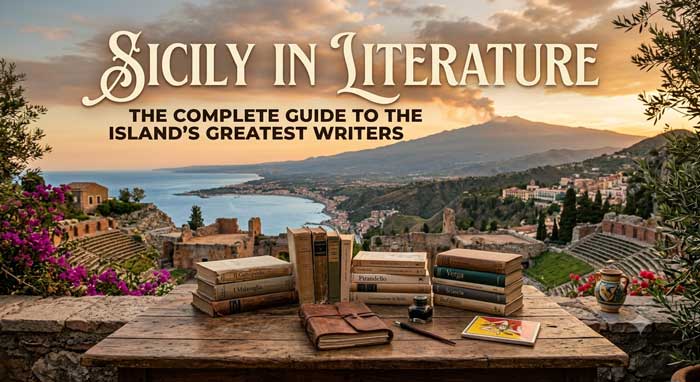
Sicily is the most written-about island in the Mediterranean and the region of Italy that has produced the greatest concentration of significant literary work per square kilometre from Giovanni Verga’s brutal naturalist chronicles of the Catania fishing community in the 1880s to Andrea Camilleri’s Montalbano detective novels of the 1990s and 2000s, from Luigi Pirandello’s Nobel Prize-winning theatrical explorations of identity and reality to Giuseppe Tomasi di Lampedusa’s single masterpiece, the most celebrated Italian novel of the 20th century. The specific quality of the Sicilian literary tradition the weight of history visible in the landscape, the specific social structure of a feudal society that modernisation never fully dissolved, the particular beauty that the writers found simultaneously consoling and oppressive has produced a body of work of extraordinary coherence and extraordinary diversity. This guide covers the essential Sicilian literary tradition and the specific places where it can be encountered on the island.
In this guide
- Giuseppe Tomasi di Lampedusa The Leopard
- Giovanni Verga the Catania naturalists
- Luigi Pirandello the Agrigento philosopher
- Leonardo Sciascia the Racalmuto moralist
- Andrea Camilleri the Montalbano phenomenon
- Vincenzo Consolo the baroque chronicler
- Foreign writers in Sicily Goethe to Lawrence
- Literary locations to visit
- FAQ
Giuseppe Tomasi di Lampedusa The Leopard
Giuseppe Tomasi di Lampedusa (1896 to 1957) wrote one book Il Gattopardo (The Leopard) and it is the most celebrated Italian novel of the 20th century, the work that most completely captures the specific quality of the Sicilian aristocratic consciousness at the moment of its historical dissolution. The novel follows the ageing Prince Fabrizio Salina through the Risorgimento of 1860 Garibaldi’s landing in Sicily, the unification of Italy, the end of the Bourbon kingdom and the beginning of the slow death of the feudal aristocratic world that the Prince represents with a prose of extraordinary sensory density and a philosophical melancholy that no other Italian novel of the century has matched in depth or in precision.
The most celebrated passage in the novel “If we want things to stay as they are, things will have to change” (the Gattopardismo, the Sicilian aristocratic strategy of superficial transformation to preserve essential stasis) has become the most frequently cited single phrase from any Italian novel of the century, the compressed expression of a Sicilian social philosophy so specific and so accurate that it has transcended its fictional context to become a general term for a specific political and social strategy. Lampedusa submitted the novel to two Italian publishers who both rejected it; he died in 1957 without seeing it published. It appeared posthumously in 1958, edited by Giorgio Bassani for Feltrinelli, and won the Strega Prize in 1959. The specific irony of the most celebrated Italian novel of the century being rejected by the publishers of the decade in which it was written is the most Sicilian biographical fact available in the Italian literary tradition.
The literary locations: the Palazzo Lampedusa on Via Butera in Palermo (the family palace, partially destroyed in the 1943 bombing, partially restored visible from the exterior); Santa Margherita di Belice (the country estate that appears in the novel as Donnafugata, now the Museum of Memory dedicated to the novel); and the Mondello beach (the Salina family’s summer retreat, the opening chapter’s setting). Luchino Visconti’s 1963 film adaptation (with Burt Lancaster as the Prince, shot partly at the Palazzo Gangi in Palermo the Osteria dei Vespri is in the same building) provides the most cinematically complete version of the novel’s visual world. Read our complete Palermo guide.
Giovanni Verga the Catania Naturalists
Giovanni Verga (1840 to 1922) is the founder of the Sicilian literary tradition in the modern sense the writer who in the 1880s turned from the fashionable romantic novels of his early career to the brutal naturalist chronicles of the Sicilian fishing and peasant communities that constitute the most significant Sicilian literary achievement of the 19th century. The two masterpieces I Malavoglia (The House by the Medlar Tree, 1881) and Mastro don Gesualdo (1889) together constitute the planned first two volumes of a five-novel cycle (the Ciclo dei Vinti, the Cycle of the Defeated) that Verga never completed; they are also the most completely realised Italian naturalist novels and the works that most directly influenced the development of the Italian literary tradition through the 20th century.
I Malavoglia is set in Aci Trezza the small fishing village on the Catania coast beneath the faraglioni sea stacks (the basalt columns that Verga, following Homer, identified with the rocks thrown by Polyphemus at Odysseus) and follows the Malavoglia family’s attempt to maintain their dignity and their fishing boat against the specific economic and social pressures of the Sicilian coastal community in the 1860s. The novel’s specific quality is the quality of the world it describes: Verga uses the dialect and the specific social vocabulary of the Aci Trezza community without authorial mediation, producing a narrative voice of extraordinary immediacy and authenticity. The Aci Trezza of I Malavoglia the specific village, the specific sea, the specific faraglioni is still there, 15 kilometres north of Catania on the Ionian coast. Read our complete Acireale guide.
👉 SICILY LITERARY TOUR THE LEOPARD, MONTALBANO AND THE LANDSCAPE OF SICILIAN LITERATURE
A guided literary tour of Sicily the Lampedusa Palermo locations, the Verga Aci Trezza fishing village, the Sciascia Racalmuto landscape and the Montalbano filming locations of the Val di Noto. The most culturally specific tour of the most written-about island in the Mediterranean. Available from Palermo and Catania.
👉SEE THE BEST MONTALBANO TOUR HERE
Luigi Pirandello the Agrigento Philosopher
Luigi Pirandello (1867 to 1936) was born in the contrada Caos outside Agrigento and won the Nobel Prize in Literature in 1934 the only Sicilian and one of only six Italians to have received the prize. His work the plays (Sei personaggi in cerca d’autore, Enrico IV, Così è se vi pare), the novels (Il fu Mattia Pascal, Uno, nessuno e centomila) and the hundreds of short stories constitutes the most philosophically ambitious single body of work in the Italian literary tradition and the work that most directly addresses the specific Sicilian identity crisis at the intersection of the individual, the social and the theatrical.
The specific Pirandellian themes the instability of identity, the impossibility of knowing oneself or others, the specifically theatrical quality of all social interaction derive from the specific social observation of the Sicilian bourgeoisie he was born into: the provincial class that performed respectability in public while enacting entirely different realities in private. The Casa Natale di Pirandello at the contrada Caos outside Agrigento is a museum and the site of the pine tree under which his ashes are buried at his request a pilgrimage destination for Italian and international literary tourists that provides the most personally specific literary encounter available in Sicily. Read our complete Agrigento guide.
Leonardo Sciascia the Racalmuto Moralist
Leonardo Sciascia (1921 to 1989) was the most specifically Sicilian writer of the 20th century the prose moralist from Racalmuto in the Agrigento province whose investigations of the Mafia, the Italian state, the Catholic church and the specific Sicilian relationship between power, complicity and truth constitute the most politically engaged and the most intellectually rigorous body of work in post-war Italian literature. His novels Il giorno della civetta (The Day of the Owl, 1961), A ciascuno il suo (To Each His Own, 1966), Todo modo (1974) and Il consiglio d’Egitto (1963) are simultaneously detective novels, political investigations and philosophical enquiries into the specific conditions that make justice impossible in a society structured around the primacy of personal loyalty over civic principle.
The Day of the Owl was the first Italian novel to deal directly with the Mafia as a social and political institution rather than as a criminal aberration the novel that named the thing that the Italian establishment had collectively refused to acknowledge, and that did so with the specific dry precision of a writer who had grown up in the landscape where it operated. Sciascia’s Racalmuto the small Agrigento province town where he was born, where he taught as a schoolteacher, where he returned to live and write is the landscape from which every observation in his work derives. The Fondazione Leonardo Sciascia in Racalmuto maintains his archive and is open to visitors; the town itself, with its specific quality of an interior Sicilian agricultural community, is the most direct encounter with the Sciascia literary world available on the island.
Andrea Camilleri the Montalbano Phenomenon
Andrea Camilleri (1925 to 2019) created the most internationally successful Sicilian literary character of the modern period Inspector Salvo Montalbano, the detective of the fictional southeastern Sicilian coastal town of Vigàta, whose 30-novel series (published between 1994 and 2021) has sold more than 30 million copies internationally, been translated into 30 languages and been adapted into the most watched Italian television drama in international markets. The Montalbano novels are set in a fictionalised version of the Porto Empedocle and Val di Noto landscape the coastal and inland southeastern Sicilian territory that Camilleri knew from childhood and that he transformed into the specific atmospheric world of Vigàta.
The Montalbano filming locations the RAI television series shot primarily in the Val di Noto baroque towns have become the most visited single literary pilgrimage circuit in Sicily and one of the most visited in Italy. The specific addresses: the Scicli town hall (the exterior of the Vigàta police headquarters), the Ragusa Ibla streets (the Vigàta town centre), the Punta Secca lighthouse and the beach (the location of Montalbano’s house, visible from the outside as a private property) and the Donnalucata market (various market scenes). The Montalbano circuit through Scicli, Ragusa and the southeastern coast is the most practically organised literary tourism programme in Sicily the locations are all marked, the fan community is global and the Val di Noto baroque provides one of the most visually extraordinary settings for any television drama in Italian history. Read our complete Sicily film locations guide, Scicli guide and Ragusa guide.
Vincenzo Consolo the Baroque Chronicler
Vincenzo Consolo (1933 to 2012) is the most stylistically ambitious Sicilian writer of the late 20th century and the least internationally known the prose stylist whose three major novels (La ferita dell’aprile, 1963; Il sorriso dell’ignoto marinaio, 1976; Retablo, 1987) constitute the most linguistically complex and the most historically specific engagement with Sicilian history available in the literary tradition. Consolo’s work rooted in the history of the Bourbon and post-Unification periods, written in a prose that incorporates Sicilian dialect, archaic Italian and the specific baroque rhetorical tradition of the island’s literary past is the most demanding and the most rewarding single body of Sicilian literary work for the reader who wants to understand the island’s relationship with its own history.
Il sorriso dell’ignoto marinaio (The Smile of the Unknown Mariner) set in the aftermath of the 1860 Garibaldi landing and the Brigandage suppression, taking as its visual starting point the portrait of an unknown young man in the Museo Regionale di Messina attributed to Antonello da Messina is the most specifically Sicilian historical novel of the century and the work that most directly confronts the specific violence of the Italian unification programme in Sicily. The portrait in the Messina museum is still there. Read our complete Messina guide.
Foreign Writers in Sicily Goethe to Lawrence
Johann Wolfgang von Goethe. The most celebrated single account of Sicily by a foreign writer is the Sicilian section of Goethe’s Italian Journey (Italienische Reise, 1816-1817), based on his visit in April 1787. His description of the Valley of the Temples (“To have seen Italy without Sicily is to not have seen Italy at all, for Sicily is the clue to everything”), his account of the Palermo botanical garden (where he had the insight that led to his botanical theory of the Urpflanze, the archetypal plant) and his observations on the specific quality of the Sicilian landscape in the spring light constitute the most influential single foreign literary account of the island.
D.H. Lawrence. Lawrence lived in Taormina from 1920 to 1922 (in the Villa Fontana Vecchia, still visible on the Via Fontana Vecchia) and the Sicilian period produced some of his most celebrated poetry (including the snake poem, the most specific single Lawrence Sicilian encounter available in print) and the completion of Sea and Sardinia (1921), which contains a significant Sicilian section. The Taormina of the Lawrence period the expatriate community, the specific quality of the clifftop town in the early 1920s is the most directly available foreign literary Sicilian landscape.
Giuseppe Bonaviri, Gesualdo Bufalino. Two less internationally known Sicilian writers whose work provides the most specific access to the Sicilian interior and the Sicilian baroque town experience respectively: Bonaviri (from Mineo in the Catania province) whose short fiction provides the most dream-like and the most mythologically resonant account of the Sicilian interior landscape; Bufalino (from Comiso in the Ragusa province) whose Diceria dell’untore (Plague Sower, 1981) is the most specifically Val di Noto baroque literary work of the century.
Literary Locations to Visit
Palermo: Via Butera (the Lampedusa family palace exterior), the Palazzo Gangi where Visconti filmed The Leopard, the Mondello beach (opening chapter of The Leopard). Read our complete Palermo guide.
Agrigento: Casa Natale di Pirandello and the pine tree with his ashes at the contrada Caos; the Fondazione Sciascia in Racalmuto (30 km from Agrigento). Read our complete Agrigento guide.
Aci Trezza (Catania coast): The Malavoglia village, the faraglioni sea stacks, the specific harbour that Verga described in his most celebrated novel. Read our complete Catania guide.
Val di Noto (Scicli, Ragusa, Donnalucata): The Montalbano filming locations Scicli town hall (police headquarters exterior), Ragusa Ibla streets, Punta Secca lighthouse. Read our complete Sicily film locations guide.
Taormina: Villa Fontana Vecchia on Via Fontana Vecchia (the D.H. Lawrence house, private property, visible from exterior). Read our complete Taormina guide.
👉The Sicilian literary circuit from the Pirandello birthplace at Agrigento to the Sciascia Racalmuto, the Verga Aci Trezza and the Montalbano Val di Noto locations requires a rental car. Compare prices at Palermo and Catania airports on DiscoverCars. The most culturally specific road trip in Italy.
👉COMPARE THE BEST RENTAL CARS HERE
FAQ about Sicily in Literature
What is the most famous book set in Sicily?
Il Gattopardo (The Leopard) by Giuseppe Tomasi di Lampedusa (1958) is the most celebrated the most internationally read Italian novel of the 20th century, set in the Sicilian aristocratic world of the 1860s Risorgimento. The Montalbano series by Andrea Camilleri is the most widely read contemporary Sicilian literary work internationally, with over 30 million copies sold.
Who are the most important Sicilian writers?
The canonical five: Giovanni Verga (the 19th-century naturalist), Luigi Pirandello (Nobel Prize 1934), Giuseppe Tomasi di Lampedusa (The Leopard), Leonardo Sciascia (the political moralist) and Andrea Camilleri (the Montalbano creator). Vincenzo Consolo is the most significant and most underread of the second tier.
Where are the Montalbano filming locations in Sicily?
The primary Montalbano filming locations are in the Val di Noto the Scicli town hall (police headquarters exterior), the Ragusa Ibla historic centre streets, the Punta Secca lighthouse and beach (Montalbano’s house) and the Donnalucata seafront market. All locations are in the Ragusa province, accessible from a Ragusa or Noto base. Read our complete Sicily film locations guide.
The Island That Wrote Itself
Sicily’s literary tradition has a specific quality shared by all the writers who contributed to it the quality of a landscape that is too beautiful and too heavy to ignore and too historically layered to describe simply. Verga found in the Aci Trezza fishing community the most specific expression of the defeated life that the modern world produces from its margins. Pirandello found in the Agrigento bourgeoisie the most vivid material for the theatrical exploration of identity that no one is certain about. Lampedusa found in the Palermitan aristocracy the most precise expression of the historical consciousness that knows it is ending and chooses to end beautifully. Sciascia found in the Racalmuto interior the most direct evidence for the specific Sicilian relationship between truth and power that the rest of Italy preferred not to examine. Camilleri found in the Val di Noto baroque the most atmospheric setting for the specific investigation of justice that his detective pursues without ever quite reaching it. The island did not produce these writers accidentally. It produced them because it was the right landscape for the things they needed to say too beautiful, too broken, too specific and too long-inhabited to be described by any other method than the one each of them found.
For the complete Sicily cultural programme, read our Sicily film locations guide, our Sicily for history lovers guide and our Sicily street art guide.
Did this guide help you discover the literary landscape of Sicily? Save it to Pinterest or share it with someone who wants to read the island before they visit it.