Sicily is the largest island in the Mediterranean and one of the most geologically active places in Europe. It has the continent’s highest active volcano, a second active volcano on an offshore island, a network of ancient lava gorges carved into basalt, a nature reserve with an unbroken coastal trail above turquoise coves, and 1,500 kilometres of coastline with some of the clearest water in the Italian seas. The outdoor possibilities are enormous and largely underexplored by visitors who come primarily for the baroque architecture and the food.
These seven experiences cover the full range of what the Sicilian landscape offers from the physically demanding (the Etna summit hike, the Stromboli night ascent) to the exhilarating-but-accessible (body rafting the Alcantara Gorge, tandem paragliding above the Tyrrhenian coast) to the purely spectacular (snorkelling at Isola Bella, kayaking the Egadi Islands). All of them are available through guided operators and can be booked in advance. None of them require specialist experience. All of them are worth doing.
The 7 experiences
- 1. Hike Mount Etna to the summit craters
- 2. Body raft the Alcantara Gorge
- 3. Night hike Stromboli volcano
- 4. Trek the Zingaro Nature Reserve coastal trail
- 5. Tandem paragliding over the Tyrrhenian coast
- 6. Snorkel at Isola Bella
- 7. Sea kayak the Egadi Islands
Quick guide
- Most demanding: Stromboli night hike (900m, 4 to 5 hours), Etna summit hike (guide required above 2,900m)
- Best for families: Zingaro Reserve coastal trail, Etna jeep tour, Isola Bella snorkelling
- Best adrenaline: Alcantara body rafting, tandem paragliding
- Best season: May to June and September to October for all outdoor activities
- Always book in advance: Stromboli (compulsory guide, fills weeks ahead in summer), Etna summit hike
1. Hike Mount Etna to the Summit Craters
Mount Etna is the highest active volcano in Europe at 3,357 metres and one of the most continuously active volcanoes in the world it has been in a state of more or less continuous eruption for at least 500,000 years, with documented eruptions recorded for 2,700 years by the Greek colonists who watched it from the coast. Hiking to the summit crater area is the single most dramatic natural experience available in Sicily, and one of the most specific on any island in the Mediterranean.
The standard route begins at the Rifugio Sapienza on the southern slope (1,900m), accessible by car from Catania in approximately 90 minutes. From Rifugio Sapienza, the cable car ascends to 2,500m, from which point a jeep shuttle carries you to 2,900m the departure point for the on-foot ascent to the summit crater area at 3,000 to 3,200m. A licensed volcanic guide is compulsory above 2,900m, both for safety reasons (the crater rim is geologically unstable and the correct route changes with each eruption) and because the guide provides the geological context that transforms the walk from a physical achievement into an understanding of what you are standing on.
The landscape in the final 400 metres of altitude is unlike anything in mainland Italy or the standard European hiking repertoire: black lava desert interrupted by steaming crater vents, sulphur deposits turning the rock yellow and orange at the rims, the view in clear conditions extending across the entire island to the south and west and as far as Calabria and Malta on the horizon. The smell of volcanic gas, the crunch of fresh lava underfoot and the specific quality of the air at altitude combine to produce an experience that is genuinely hard to place in a familiar category. Physical fitness requirement: moderate to good. The altitude gain from the cable car top station is approximately 700 metres on loose volcanic terrain; trekking poles and closed shoes are essential.
👉 MOUNT ETNA SUMMIT HIKE WITH LICENSED VOLCANIC GUIDE
A guided half-day hike to the Etna summit craters with a licensed volcanic guide cable car and jeep transfer included, summit access above 2,900m, the crater rim views and the geological explanation that makes the experience complete. Available from Catania and Taormina.
👉SEE THE BEST MOUNT ETNA SUMMIT HIKING TOUR HERE
2. Body Raft the Alcantara Gorge
The Alcantara Gorge is a basalt canyon carved by lava flows from Etna approximately 8,000 years ago and subsequently eroded by the Alcantara River into a series of narrow passages and natural pools. The tourist access at Gole dell’Alcantara near Motta Camastra provides a dramatic viewpoint and a short walk, but the most physically intense experience of the gorge is found 2 kilometres upstream at the Gurne dell’Alcantara a section of natural rock pools, water slides and jumps accessible only on a guided body rafting expedition.
The body rafting programme begins with full technical equipment: wetsuit, helmet, river footwear and life jacket. The guide leads a group of up to eight people into the river, where the programme involves swimming through cold (12 to 14 degrees Celsius year-round, regardless of the air temperature above) crystal-clear water, negotiating natural rock chutes, jumping from basalt ledges up to 7 metres into the pools below, and navigating through the narrow passages where the basalt walls press to within a metre of each other overhead. It is cold, physical, genuinely thrilling and entirely safe with an experienced guide. The duration is approximately 2 hours in the water.
The Alcantara Gorge is 15 minutes by car from Taormina and combines naturally with an Etna visit on the same day the gorge in the morning, the volcano in the afternoon, or vice versa. Read our complete Mount Etna guide for the full eastern Sicily outdoor circuit.
👉 ALCANTARA GORGE BODY RAFTING AND CANYONING TOUR
A guided body rafting experience in the Alcantara Gorge wetsuit, helmet and life jacket provided, the Gurne natural pools, rock jumps up to 7 metres and the cold basalt canyon of one of Sicily’s most dramatic natural landscapes. Available from Taormina and Catania.
👉SEE THE BEST ALCANTARA GORGE BODY RAFTING TOUR HERE
3. Night Hike Stromboli Volcano
Stromboli is the northernmost of the Aeolian Islands, a nearly perfect volcanic cone rising 924 metres from the Tyrrhenian Sea, and the most continuously active volcano in the world it has been erupting at regular intervals of approximately every 15 to 20 minutes for at least 2,000 years. The Greek sailors who used it as a lighthouse called it the Lighthouse of the Mediterranean. The night ascent to the crater rim (918m) to watch the eruptions from above in darkness is among the most extraordinary nature experiences available in Italy.
The ascent takes approximately 2.5 to 3 hours on a well-maintained but steep path 900 metres of altitude gain on volcanic terrain, with the final section on loose scoria and ash. A licensed guide is compulsory for all access above 400 metres; this is not a bureaucratic formality but a genuine safety requirement on an active volcano where eruptive patterns can change. The guide times the ascent to arrive at the crater rim at the point when the volcano’s lighting conditions are most dramatic typically at nightfall, so that the lava glow is visible against the dark sky rather than washed out by daylight.
From the crater rim, the eruptions which project lava bombs and incandescent material 100 to 300 metres into the air at intervals of minutes are visible at close range on the far side of the crater bowl, with the Tyrrhenian Sea visible on all sides in the darkness below. The descent is by headtorch on the same path. The total round trip is 5 to 6 hours. Stromboli is reached by hydrofoil from Milazzo (approximately 2 hours) or from the other Aeolian Islands. Book guide and accommodation weeks in advance for July and August Stromboli fills completely in peak season. Read our complete Aeolian Islands guide.
👉 STROMBOLI NIGHT HIKE TO THE CRATER RIM
A guided night ascent to the summit of Stromboli with a licensed volcanic guide the 900m climb in the evening light, the crater rim at nightfall and the live eruptions of the world’s most continuously active volcano visible in the darkness. One of the most extraordinary nature experiences in the Mediterranean.
👉SEE THE BEST STROMBOLI HIKING TOUR HERE
4. Trek the Zingaro Nature Reserve Coastal Trail
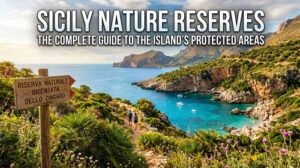
The Zingaro Nature Reserve on the northwestern coast of Sicily is the first nature reserve established in the island’s history (it was created in 1981 after a successful public campaign that blocked the construction of a coastal road through the area) and contains 7 kilometres of completely unspoilt Tyrrhenian coastline accessible only on foot. No motorised vehicles, no permanent structures, no beach services just the coastal trail, the Mediterranean scrubland of wild oregano, euphorbia and lentisk, the limestone cliffs and the five coves below them.
The main coastal trail runs from the northern entrance at Scopello (where the 16th-century tonnara and the limestone faraglioni in the bay provide the most photographed coastal landscape in western Sicily) to the southern entrance at San Vito Lo Capo, or in the opposite direction. The full trail takes approximately 3 hours at a comfortable pace with swimming stops. The five coves (Cala dell’Uzzo, Cala Capreria, Cala Marinella, Cala Mazzo di Sciacca and Cala Berretta) are accessed by short descents from the main trail each one a small bay of limestone and crystal-clear water that can be reached only by those who walk to it. In July and August, arrive at the northern entrance before 9am. Read our complete Zingaro Nature Reserve guide.
5. Tandem Paragliding Over the Tyrrhenian Coast
Tandem paragliding flying with a licensed instructor pilot who controls the wing while the passenger simply enjoys the view is available at several locations along the Sicilian coast and provides the most complete aerial perspective on the island’s landscape available without a chartered flight. The two finest locations are Cefalù (launching from the ridge above the town and soaring above the Norman cathedral, La Rocca and the Tyrrhenian coast for 15 to 20 minutes before landing on the beach) and the Taormina area (launching from the Alcantara ridge and soaring above the Ionian coastline with Mount Etna on one side and the sea on the other).
No experience is required for tandem paragliding the passenger’s role is to run a few steps on take-off and then sit in the harness for the duration of the flight. The sensation of the launch the wing filling above you and the ground falling away as the thermal lifts you off the ridge is the most specific single moment of the experience. The view from altitude of the Sicilian landscape, whether the Tyrrhenian coast seen from above Cefalù or the Etna-sea-gorge panorama from above Taormina, is genuinely different from any other viewpoint available to a visitor on the island. Flights typically last 15 to 25 minutes.
👉 TANDEM PARAGLIDING OVER CEFALÙ AND THE TYRRHENIAN COAST
A tandem paragliding flight above Cefalù with a licensed instructor launching from the ridge above the Norman cathedral, soaring above the Tyrrhenian coast and landing on the beach. No experience required. The finest aerial view of the Sicilian north coast available.
👉SEE THE BEST TANDEM PARAGLIDING TOUR HERE
6. Snorkel at Isola Bella
Isola Bella is a small limestone island connected to the Taormina coastline by a sandbar that appears and disappears with the tides a nature reserve and marine park with some of the clearest snorkelling water on the eastern Sicilian coast. The rocky seabed around the island at 3 to 5 metres depth supports dense populations of Mediterranean sea life: octopus, sea bream, moray eel, sea bass, starfish, sea urchin and occasional visits from larger pelagic species. The water clarity is exceptional, a product of the island’s protected status and the absence of boat traffic inside the reserve boundary.
The simplest approach is to swim out from the beach at Mazzarò (below Taormina, accessed by cable car) with your own mask and fins equipment rental is available on the beach. A guided snorkelling tour by small boat takes you to the additional coves and rocky outcrops around the headland that are inaccessible from the beach, including sections of seabed with the most concentrated marine life. The guided option also includes instruction for inexperienced snorkellers and access to the areas inside the reserve boundary that independent swimmers cannot enter. Read our complete Taormina beach guide.
👉 ISOLA BELLA SNORKELLING TOUR MARINE RESERVE TAORMINA
A guided snorkelling tour of the Isola Bella marine reserve near Taormina the clearest water on the eastern Sicilian coast, Mediterranean marine life at 3 to 5 metres depth and access to the protected sections of the reserve. Equipment provided. Suitable for all levels.
👉SEE THE BEST ISOLA BELLA SNORKELLING TOUR HERE
7. Sea Kayak the Egadi Islands
The Egadi Islands Favignana, Levanzo and Marettimo are the westernmost islands of Sicily, 15 kilometres off the coast of Trapani, with some of the clearest water in the Italian seas and a coastline of sea caves, natural arches and hidden coves that is best explored by kayak. The islands are a Marine Protected Area: fishing is regulated, boat traffic is controlled and the underwater visibility, in the absence of propeller disturbance and fuel pollution, reaches 30 to 40 metres in places.
A guided sea kayak tour of Favignana or Levanzo typically covers 10 to 15 kilometres of coastline over half a day, stopping to swim in the sea caves, explore the natural arches at water level and access coves that are too shallow or too rocky for motor boats. The specific quality of paddling at the waterline through a sea cave on a calm morning the cave interior lit by the reflection of the turquoise water, the sound of the sea amplified by the rock walls is an experience that the standard boat tour, which stays offshore, cannot provide. Kayaking experience is helpful but not required for the flat-water conditions typical of the Egadi in calm weather. Read our complete Favignana guide.
👉 EGADI ISLANDS SEA KAYAK TOUR FAVIGNANA AND LEVANZO
A guided sea kayak tour of the Egadi Islands marine reserve the sea caves, natural arches and hidden coves of Favignana and Levanzo, with swimming stops in water of exceptional clarity. The finest way to explore the Egadi coastline. Suitable for beginners in calm conditions.
👉SEE THE BEST EGADI ISLANDS SEA KAYAK TOUR HERE
👉 Most of these outdoor experiences require a car to reach the departure point the Etna southern slope, the Alcantara Gorge northern entrance, the Zingaro Reserve at Scopello, the Trapani port for the Egadi ferries. Compare rental car prices at Palermo and Catania airports and book in advance.
👉COMPARE THE BEST RENTAL CARS HERE
Planning your outdoor Sicily
The best season for all seven of these experiences is May to June and September to October warm enough for water activities, cool enough for altitude hiking and paragliding, with the crowds at the major access points significantly reduced from the August peak. The Etna summit and Stromboli require advance booking regardless of season; the Alcantara body rafting and Zingaro trail are walk-up in spring and autumn but book up fast in July and August.
A rental car is the practical foundation of an outdoor Sicily itinerary. The Etna and Alcantara are both accessed from the Catania area; the Zingaro and Egadi Islands are both in the northwest near Trapani; Stromboli requires the Milazzo-Aeolian hydrofoil. The full outdoor circuit of the island east coast one week, west coast the next covers the complete range in two weeks.
For the complete planning resources, read our Mount Etna guide, the Aeolian Islands guide, the Zingaro guide, the Favignana guide and our complete Sicily road trip guide.
Planning an outdoor Sicily trip? Save this guide to Pinterest or share it with someone who needs convincing that Sicily is more than beaches and baroque churches.