
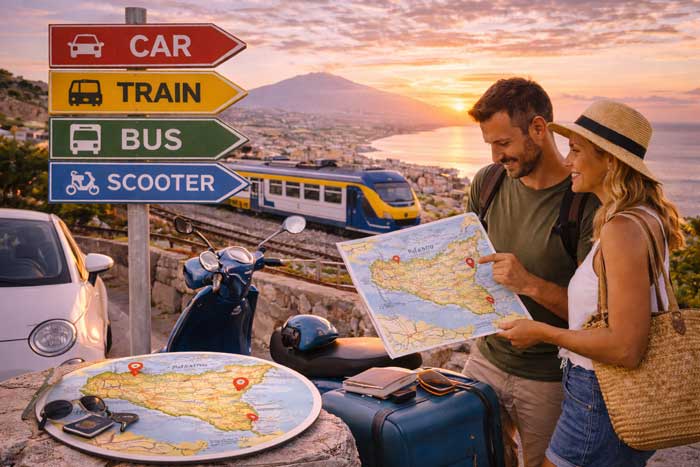
Getting around Sicily requires a decision early in the planning process, because the decision affects everything that follows. The island is larger than most visitors expect approximately 300 kilometres from Palermo to Syracuse and its finest destinations are distributed across a terrain that includes mountain roads, coastal motorways, narrow baroque town centres with restricted traffic zones and archaeological sites with no public transport access. The honest answer to “what is the best way to get around Sicily” is: a rental car for most itineraries, combined with trains and buses for the specific routes where they genuinely work.
This guide explains all the transport options in Sicily with the practical detail that allows you to make the right choice for your specific itinerary what the trains actually cover, which bus routes are faster than the train, which destinations require a car regardless of what the map suggests and how to drive in Sicily without being surprised by the ZTL cameras.
In this guide
- Renting a car in Sicily
- Driving in Sicily what to know
- ZTL zones the most important driving rule
- Trains in Sicily
- The Ferrovia Circumetnea
- Buses in Sicily
- Ferries and hydrofoils
- Getting from the airports
- Getting around without a car
- Practical tips
- FAQ
Sicily transport quick summary
- Best overall: Rental car the only option that gives full access to the island
- Best without a car: Train + bus between major cities; Palermo and Catania as bases
- Train works well: Palermo to Cefalù, Catania to Taormina, Catania to Syracuse
- Bus is better than train: Palermo to Trapani, Palermo to Syracuse, Catania to Agrigento, Catania to Noto and Ragusa
- Needs a car: Valley of the Temples, Zingaro Reserve, Selinunte, Vendicari, Val di Noto villages, Etna vineyards, Sicilian interior
- Ferries: Trapani for Egadi Islands; Milazzo for Aeolian Islands; year-round services
Renting a Car in Sicily
A rental car is the recommended transport option for most Sicily itineraries. The argument is not about comfort or preference but about access: the finest experiences on the island the Valley of the Temples without a tour bus, the Zingaro Reserve coastal trail from the Scopello entrance, the Etna DOC vineyards at harvest time, the Vendicari Nature Reserve at dawn are not accessible by public transport at the pace and timing that makes them worthwhile. A rental car makes the difference between a Sicily trip that covers the main cities and one that genuinely covers the island.
The practical considerations: book the car as far in advance as possible, particularly for July and August when available vehicles sell out and prices increase dramatically. A car booked 3 months in advance can cost 40 percent less than the same car booked 2 weeks before the trip. Always select full coverage insurance (zero excess) the additional cost of €10 to €15 per day eliminates the risk of significant charges for the minor scratches and dings that are a standard feature of driving on narrow Sicilian roads. A small or compact car (Fiat 500 or equivalent) is more practical than a larger vehicle for the narrow streets of the historic centres and the mountain roads.
Rental car prices in Sicily in 2025: approximately €30 to €50 per day for a small car, plus fuel (approximately €1.80 to €2.00 per litre) and tolls on the motorways. The main motorways are the A19 (Palermo to Catania), the A18 (Catania to Messina along the Ionian coast) and the A29 (Palermo to Trapani). Toll charges on these routes are modest typically €3 to €8 for a single journey.
👉Compare rental car prices at Palermo and Catania airports across all major companies. Book as early as possible for the best rates. Always select full coverage it is non-negotiable on Sicilian roads.
👉COMPARE THE BEST RENTAL CARS HERE
Driving in Sicily What to Know
Driving in Sicily is manageable and often beautiful the coastal roads, the mountain passes and the vineyard routes of Etna are among the most scenic driving environments in Italy. It is also, in the cities, an experience that requires adjustment. Sicilian urban driving is characterised by a specific relationship with traffic rules that can be surprising to visitors from northern European countries: motorcycles filtering, parking on double yellow lines, roundabout priority conventions that differ from standard Italian rules and the general understanding that traffic flow takes priority over strict regulatory compliance.
The practical advice: drive conservatively in the cities, give way to anything larger than you unless you are absolutely certain of your right of way, park in official car parks rather than attempting street parking in the historic centres, and treat the GPS as advisory rather than definitive in the smaller towns where the routing sometimes takes you through streets that are technically passable but practically alarming. The motorways (autostrade) are fast, well-maintained and straightforward.
Petrol stations in rural areas close for lunch (typically 1pm to 4pm) and may not open at all on Sundays. Fill the tank whenever it drops below half on rural stretches of the island, particularly in the Sicilian interior and on the southern coast between Agrigento and Ragusa.
ZTL Zones the Most Important Driving Rule in Sicily
The ZTL (Zona a Traffico Limitato restricted traffic zone) is the single most important thing to understand before driving in Sicily. The historic centres of Palermo, Catania, Taormina, Noto, Ragusa, Syracuse and most other Sicilian cities are restricted zones where entry by non-authorised vehicles is prohibited during specific hours (typically 7am to 8pm, but varying by city). Automatic cameras at the zone entrances photograph every vehicle entering; fines are issued automatically and arrive by post weeks or months after the trip often after the visitor has returned home.
The practical rules: always park outside the ZTL and walk in. Most hotels in the historic centres have parking arrangements or can direct you to the nearest car park clarify this before arrival. Do not follow the GPS into the old town of Taormina, Noto or central Palermo without first checking whether your route passes through a ZTL. The blue parking signs with the ZTL logo and the times of operation are posted at zone entrances; when in doubt, stop and read them before proceeding. Read our complete Sicily road trip guide for the full ZTL information by city.
Trains in Sicily
Sicily has a Trenitalia rail network connecting the major coastal cities, and on the routes it covers well, it is an excellent option. The system works well for: Palermo to Cefalù (approximately 50 minutes, direct, scenic coastal route through the Tyrrhenian coast, approximately €6 to €9); Catania to Taormina-Giardini station (approximately 45 minutes, approximately €4 to €8, with a connecting bus to Taormina town centre via the Taormina Link service); Catania to Syracuse (approximately 1 hour 20 minutes, approximately €7 to €11).
The system works less well for: the Palermo to Catania route (3 to 3.5 hours via Messina, requiring a change at Messina station, with the risk of missing the connection and being stranded the bus is faster and more direct at approximately 2.5 hours); Palermo to Agrigento (approximately 2 hours via the inland route through Enna, but the service is infrequent and the station at Agrigento is some distance from the Valley of the Temples); and almost any route that passes through Messina, where connection times need generous buffers.
Important practical notes: Trenitalia tickets must be validated (stamped) in the yellow machines on the platform before boarding failure to validate results in an on-the-spot fine regardless of whether you have a valid ticket. Check trenitalia.com for current timetables and prices. For the Palermo to Cefalù route, the train travels directly along the Tyrrhenian coast with the sea visible throughout the journey this is one of the most scenic train routes in Sicily and worth taking for the experience alone even if you have a car.
The Ferrovia Circumetnea
The Ferrovia Circumetnea is one of the most specific transport experiences in Sicily and one of the most overlooked by visitors focused on getting between the main cities efficiently. Built in the 1890s on a narrow-gauge track, the Circumetnea runs a 110-kilometre circuit around the base of Mount Etna from Catania in the south, through the vineyards and lava fields of the northern slope, around the western side of the volcano and back. The journey takes approximately 3.5 hours for the full circuit and passes through the most atmospheric sections of the Etna wine country, including the village of Randazzo and the lava-stone towns of the northern slope.
The Circumetnea is the finest way to see the Etna vineyards without a rental car, and the best way to understand the scale of the volcano from a ground-level perspective. It is not fast transport it is a specific experience that rewards treating it as a half-day excursion rather than a means of getting from A to B efficiently. Tickets are purchased from FCE Catania or via the DropTicket app; book in advance for summer weekends when the service fills.
The Barocco Line is a separate train experience in southeastern Sicily: a vintage service using restored trains from the 1930s and 1950s that runs seasonally between Syracuse and the Val di Noto baroque towns Fontane Bianche, Noto, Modica, Ragusa and Scicli. The service operates primarily on weekends and in summer. It is a genuinely charming way to move between the baroque towns and the period carriages add an appropriate historical register to a journey through the UNESCO-listed baroque landscape.
Buses in Sicily
Intercity buses in Sicily are, on several routes, significantly better than the train faster, more direct and serving destinations that the train network does not reach. The main routes where buses are the clear choice over trains: Palermo to Trapani (approximately 2 hours by direct bus, versus a slow local train service); Palermo to Syracuse (the bus via the A19 motorway is faster and avoids the Messina connection); Catania to Ragusa, Noto and Agrigento (direct bus services, no train equivalent); Catania to Enna (1 hour by bus).
The main bus companies operating intercity services are AST (Azienda Siciliana Trasporti, the regional public operator), SAIS Trasporti (long-distance intercity, particularly the Palermo-Catania route), and Interbus (covering tourist destinations including Catania to Taormina and Catania to Syracuse). FlixBus also operates some Sicilian intercity routes. Bus tickets are purchased at the company offices at bus stations, from newsagents and tabacchi (tobacco shops) near bus stops, or online from the company websites. Tickets must be validated before boarding.
Important practical limitation: bus services in rural Sicily and in the smaller towns correspond to school hours and market times, which means early morning departures, limited midday services and virtually no services on Sunday afternoons. For rural destinations, always check the Sunday schedule before planning a return journey that depends on the bus.
Ferries and Hydrofoils
Ferry and hydrofoil services connect mainland Sicily to the offshore islands that constitute some of the finest experiences the island region offers. The two main departure points are Trapani (for the Egadi Islands Favignana, Levanzo and Marettimo) and Milazzo (for the seven Aeolian Islands Lipari, Vulcano, Stromboli, Salina, Filicudi, Alicudi and Panarea).
Liberty Lines operates the primary hydrofoil (aliscafo) service from both ports fast, comfortable and weather-dependent (services are cancelled or delayed in rough sea conditions, which occur most frequently in autumn and winter). Siremar operates the slower car ferries (traghetti) from the same ports, useful for those taking a vehicle to the larger islands. From Trapani, the hydrofoil to Favignana takes approximately 30 minutes; from Milazzo, the hydrofoil to Lipari takes approximately 55 minutes and to Stromboli approximately 2 hours.
Book hydrofoil tickets in advance for July and August the services fill, particularly on summer Friday evenings (departing from the mainland to the islands) and Sunday evenings (returning). The ferry services are available year-round; some Aeolian island connections reduce frequency in winter but do not stop entirely. Read our complete guides to the Aeolian Islands and Favignana for full island access information.
Getting From the Airports
Palermo Falcone Borsellino Airport (PMO), 30 kilometres northwest of the city centre, has three main transfer options to central Palermo. The Palermo Airport train station connects directly to Palermo Centrale station (approximately 50 minutes, approximately €6, trains every 30 minutes). The Prestia e Comandè shared bus service (the collectivo) connects the airport to central Palermo for approximately €8 per person, departing when full (every 30 to 40 minutes approximately). A private taxi costs approximately €40 to €50 and takes 30 to 40 minutes depending on traffic. Rental car collection: all major companies have desks in the arrivals hall.
Catania Fontanarossa Airport (CTA), 7 kilometres south of the city centre, is the closer and more convenient airport. The Alibus shuttle bus connects the airport to Catania central train station (Catania Centrale) for approximately €4, running frequently. A taxi to the city centre costs approximately €15 to €20. The Catania metro (Ferrovia Circumetnea urban section) is being extended to the airport check current status as the extension was in progress in 2025. Rental car collection: all major companies have desks in the arrivals hall.
Getting Around Without a Car
A car-free Sicily itinerary is possible and works best for visitors based in Palermo or Catania who want to focus on the major urban destinations with day trips to the easily accessible surrounding areas. The practical car-free circuit: fly into Palermo, spend 2 to 3 days in Palermo (bus to Monreale at €1.50 per trip, train to Cefalù at €6 to €9 each way), then train to Catania (2.5 hours by bus, from €14), spend 2 to 3 days in Catania (train to Taormina at €4 to €8 each way, train to Syracuse at €7 to €11 each way), then end in Syracuse/Ortigia.
The destinations that are genuinely difficult or impossible without a car on a comfortable timetable: the Valley of the Temples (Agrigento), the Zingaro Nature Reserve, Selinunte, the Vendicari Nature Reserve, the Val di Noto villages beyond Noto, the Etna vineyards, the Sicilian interior and most of the western coast south of Trapani. For these destinations, guided day tours departing from the major cities are the practical alternative to a rental car. Read our day trips from Palermo guide for the organised tour options available from the capital.
Practical Tips
Validate your train and bus tickets before boarding always. The validating machines (obliteratrici) are yellow boxes on the platform or near the bus door. An unvalidated ticket is treated as no ticket regardless of whether you paid for it. This rule is enforced with on-the-spot fines and is one of the most consistent sources of avoidable cost for visitors to Sicily.
Check Sunday schedules carefully for all public transport. Bus and train services on Sundays in Sicily are significantly reduced often to a single morning departure in each direction on rural routes. If your itinerary requires a Sunday bus connection in a smaller town, always verify the specific Sunday timetable rather than assuming the weekday schedule applies.
For the Palermo to Catania route, the bus (SAIS or Interbus, approximately 2.5 hours, approximately €14 to €18) is faster and more reliable than the train, which requires a change at Messina and takes 3 to 3.5 hours. The bus also departs from more central locations in both cities.
In Taormina, the town centre is pedestrianised and the cable car (funivia) from the town to Mazzarò beach below costs approximately €3 each way and operates throughout the day. Parking in Taormina is expensive and limited use the Lumbi car park above the old town and take the free shuttle down, or park below and take the cable car up.
Frequently Asked Questions about Getting Around Sicily
Do I need a car in Sicily?
For a full-island itinerary that includes the Valley of the Temples, the Zingaro Reserve, the Etna vineyards, the Val di Noto villages and the western coast, yes a rental car is the only practical option. For a city-focused itinerary based in Palermo, Catania and Syracuse with day trips to Cefalù and Taormina, a car is optional and public transport is manageable.
Is it safe to drive in Sicily?
Yes. The roads are maintained to a reasonable standard, the motorways are fast and straightforward, and the general driving environment in Sicily, while more assertive than northern European driving, is navigable with patience and defensive driving. The main practical hazards are narrow streets in historic centres (avoidable by parking outside and walking in), the ZTL cameras (avoidable by not entering restricted zones) and aggressive lane filtering by motorcycles in city traffic (normal Sicilian practice, not dangerous if anticipated).
What is the best way to get from Palermo to Catania?
The bus (SAIS or Interbus, approximately 2.5 hours, €14 to €18) is faster and more reliable than the train for this route. The train via Messina takes 3 to 3.5 hours and requires a change at Messina station. By car on the A19 motorway the drive takes approximately 2.5 hours. Read our complete Sicily road trip guide for the full driving routes across the island.
How do I get to the Aeolian Islands from Sicily?
From Milazzo (45 minutes west of Messina on the A20 motorway), Liberty Lines hydrofoils run year-round to all seven Aeolian Islands. The crossing to Lipari takes approximately 55 minutes; to Stromboli approximately 2 hours. Book tickets in advance for summer weekends. Read our complete Aeolian Islands guide.
Move at Your Own Pace
The transport decision in Sicily is ultimately a question of what kind of trip you want. The train between Palermo and Cefalù is one of the most scenic rail journeys in Italy and worth taking for the experience regardless of whether you have a car. The bus from Catania to Noto is reliable, cheap and direct. But the road from Scopello to the Zingaro Reserve at 8am, the Etna vineyard road at harvest time, the salt pans between Marsala and Trapani at sunset these are only available to the person behind the wheel. Sicily is large enough that the car does not feel like a burden; it feels like the tool that makes the island fully accessible.
For the complete planning picture, read our Sicily road trip guide, our Sicily travel tips guide and our where to stay in Sicily guide.
Did this guide help you plan your Sicily transport? Save it to Pinterest or share it with someone planning their first visit to the island.


