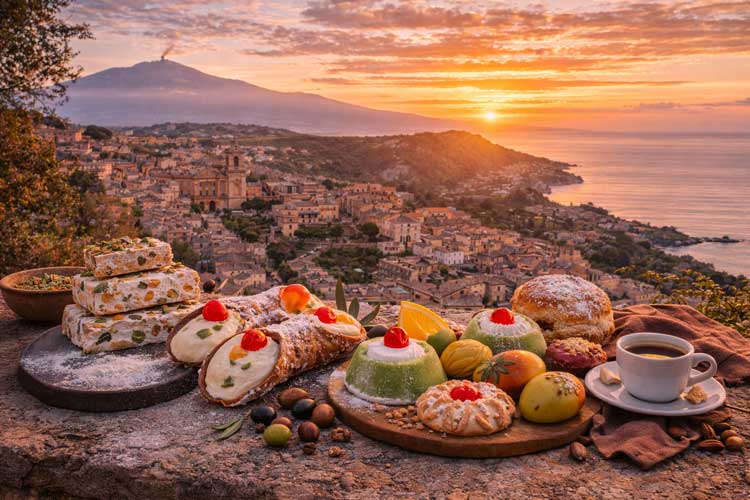
Sicily has been called the most important island in the history of European pastry, and the claim is not an exaggeration. The Arabs who ruled the island from the mid-9th to the early 11th century introduced sugarcane, almonds, pistachios, citrus, cinnamon and saffron the complete ingredient set that makes the Sicilian pastry tradition distinctive. The enclosed nuns of the island’s monasteries then spent several centuries developing, refining and guarding the recipes that transformed these ingredients into the cassata, the frutta di martorana, the cannolo and dozens of other preparations. The Spanish introduced chocolate from the New World in the 16th century, which Modica absorbed into a cold-process chocolate tradition unlike anything else in Europe. The result is a dessert culture of extraordinary depth and historical specificity one that rewards study before arrival and discovery in person.
This guide covers the essential Sicilian desserts and pastries: what each one is, where it comes from and where to find the finest versions across the island.
In this guide
- Cannolo Siciliano
- Cassata Siciliana
- Granita con Brioche
- Frutta di Martorana
- Minne di Sant’Agata
- Genovesi di Erice
- Cioccolato di Modica
- Sfince di San Giuseppe
- Gelo di Mellone
- Paste di Mandorla
- Where to find the best pastry shops in Sicily
- FAQ
Sicilian desserts quick guide
- The four essentials: Cannolo (filled fresh), cassata, granita con brioche, frutta di martorana
- Arab origin: granita, cassata (name from Arabic qas’at), almond paste, marzipan
- Convent tradition: frutta di martorana, genovesi di Erice, cassata (refined by nuns)
- Spanish influence: Modica chocolate (cold-process, from the Aztec tradition)
- Seasonal: Sfince (St Joseph’s Day, March 19), minne di Sant’Agata (February), gelo di mellone (summer)
- Best pastry cities: Palermo (cannolo, cassata, martorana), Erice (genovesi), Noto (Caffè Sicilia), Modica (chocolate), Catania (minne, pistachio)
Cannolo Siciliano
The cannolo is the most famous Sicilian pastry and the one whose reputation has spread furthest from the island to the Italian-American communities of New York and Boston, to The Godfather, to the consciousness of anyone who has ever thought seriously about Italian food. Its origin is Arab-Sicilian, most likely from the 9th or 10th century, and the recipe has been refined over a thousand years without losing its essential character: a fried tube of pastry, a filling of sweetened sheep’s milk ricotta, a garnish of candied orange peel or chopped pistachio, a dusting of icing sugar.
The cardinal rule is absolute: filled to order at the moment of purchase. A pre-filled cannolo shell has absorbed moisture from the ricotta and lost the textural contrast between crisp exterior and yielding cream that is the entire reason the construction works. Any pasticceria with pre-filled cannoli on display is telling you something important. The correct sequence is: order at the counter, watch the shell filled from a piping bag, receive it, eat it within three minutes. The icing sugar will get on your clothes regardless. This is normal and unavoidable.
The Palermo version is garnished with candied orange peel; the Catania version with Bronte pistachio. The town of Piana degli Albanesi, 24 kilometres south of Palermo, is considered by many Sicilian pastry authorities to produce the finest cannoli on the island and holds the Sagra del Cannolo each Carnival season. Read our complete Sicilian cannoli guide for the full history, the regional variations and the best pasticcerie across the island.
Cassata Siciliana
The cassata is the most elaborate and the most specifically Sicilian of all the island’s pastries a layered cake of sponge soaked in liqueur, fresh ricotta mixed with chocolate chips and candied fruit, a shell of green pistachio marzipan, white royal icing poured over the surface, and a final programme of candied fruit decoration in the Baroque tradition of maximum ornament. The name derives from the Arabic word qas’at, meaning the wide circular bowl in which the dessert is made evidence of the Arab origin of the recipe in its earliest form, which combined fresh ricotta with sugar (then a rare and precious Arab introduction) and a simple pastry crust.
The version we know today was developed in the convents of Palermo from the 17th century onward the enclosed nuns, many from aristocratic families who had entered religious life, brought to the confection the Baroque spirit of elaborate decoration and theatrical excess that characterises the architecture of the same period in southeastern Sicily. The cassata was originally an Easter pastry, made once a year for the celebration of the Resurrection. It is now available year-round at every serious pasticceria in Palermo and throughout the island, but the Easter cassata made with maximum care and presented with its full programme of candied fruit decoration is still considered the canonical version.
The cassatina is the individual portion version: a dome-shaped mini-cassata topped with a single Maraschino cherry, found in every pasticceria across Sicily and a more manageable introduction to the flavours of the full-sized cassata for those whose first encounter with the original proves overwhelming.
Granita con Brioche
The granita is not a dessert it is a breakfast, consumed from approximately 7.30am at the bar alongside the morning espresso or cappuccino. This distinction matters because the mental category of “dessert” implies an ending, an indulgence at the close of a meal. The granita in Sicily is the way the day begins from May through October, and understanding this changes how you approach it.
The granita is historically connected to the snow of Etna before industrial refrigeration, snow was gathered from the volcanic slopes in winter, stored in insulated pits covered with volcanic rock and straw, and sold throughout the summer months to produce the iced preparations that had been a feature of the Arab-Sicilian court kitchen since the 9th century. The sharbat (sherbet) of the Arab tradition fruit juice or flower water chilled with snow is the direct ancestor of the Sicilian granita.
What distinguishes the granita from a sorbet or a slushie is the texture: deliberately crystalline rather than smooth, produced by slow agitation during freezing to create a specific granularity. The flavours are the flavours of the island lemon from the Conca d’Oro, almond from the Hyblaean plateau, mulberry (gelsi), coffee, pistachio from Bronte, jasmine, watermelon. The granita is always served with a brioche col tuppo the soft, round Sicilian brioche with its distinctive topknot for dipping into the glass as the granita melts toward the edges. The combination is one of the finest breakfast experiences in the Mediterranean. Read our complete Bronte pistachio guide for the volcanic origin of the finest granita ingredient.
Frutta di Martorana
The frutta di martorana is the most visually extraordinary product of the Sicilian pastry tradition: small sculptures of almond paste (pasta reale) moulded and hand-painted with natural food dyes to exact replicas of real fruit and vegetables lemons, oranges, peaches, figs, pears, tomatoes, peppers, aubergines arranged in the windows of Palermo pasticcerie with a hyper-realistic quality that consistently deceives the eye from a short distance. The skill involved in the painting is considerable; the finest examples, produced by the best Palermo pasticcerie, are as much craft objects as food.
The origin is documented with unusual precision. The nuns of the Convent of the Martorana in Palermo prepared the first frutta di martorana for a visit by Pope Clement V, decorating the convent garden’s bare winter trees with fruits made from almond paste and sugar in place of the absent real fruit. The pope was reportedly astonished and enchanted, the story spread, and the technique became one of the most celebrated achievements of the Sicilian convent pastry tradition. The convent the Chiesa di Santa Maria dell’Ammiraglio, known as La Martorana, in Piazza Bellini is now a UNESCO World Heritage Site and one of the finest Norman-Byzantine buildings in Palermo.
Frutta di martorana is eaten at the Feast of All Saints (November 1st to 2nd) when Sicilian children traditionally receive it as a gift the Sicilian equivalent of the northern Italian tradition of sweets and chocolate at Easter. It is also the finest edible souvenir in Sicily: it travels well, is unique to the island and represents the living continuation of a 700-year tradition.
Minne di Sant’Agata
The minne di Sant’Agata literally “the breasts of Saint Agata” are small dome-shaped pastries specific to Catania and to the Festa di Sant’Agata in February. They take their shape from the martyrdom of the city’s patron saint, who was tortured by having her breasts removed in 251 AD; the pastries honour the saint with the specific Sicilian quality of transforming suffering into something sweet and beautiful, a transposition that is entirely characteristic of the island’s relationship with its religious history.
Each minne is a hemisphere of white royal icing covering a filling of sponge cake, ricotta and chocolate chips, topped with a single Maraschino cherry that completes the anatomical reference. The contrast between the clinical white exterior and the lush ricotta filling is one of the more specific gustatory experiences of the Sicilian pastry tradition. They are made year-round in Catania’s pasticcerie but are most authentically encountered in the week of the Festa di Sant’Agata, when they are displayed in every pastry shop window in the city alongside the other devotional sweets of the festival. Read our complete Catania guide.
Genovesi di Erice
The genovesi ericine are the speciality of Erice, the medieval hilltop village above Trapani, and one of the finest expressions of the Sicilian convent pastry tradition outside of Palermo. A shortcrust pastry case filled with a warm custard cream soft, rich and delicately flavoured with lemon dusted with icing sugar and eaten warm from the oven. The construction is simple; the execution, in the hands of the finest practitioners, is extraordinary.
The recipe was developed and perfected by the nuns of the Convent of San Carlo in Erice, from which Maria Grammatico the most celebrated pastry maker associated with the Erice tradition learned her craft as a novice in the 1950s and 1960s before opening her own shop on the Corso Vittorio Emanuele. Grammatico’s pasticceria is one of the most historically specific food destinations in Sicily: the continuation of a convent tradition that would otherwise have died with the last generation of nuns. Her genovesi, almond paste confections and frutta di martorana maintain the recipe standards of the monastic kitchen with the commercial availability of a modern shop. Read our complete Erice guide.
Cioccolato di Modica
The chocolate of Modica is one of the most historically specific food products in Sicily and the one with the most unusual production method. The Spanish who controlled Sicily from the 15th century onward brought cacao from the Aztec civilisation of Mexico along with the Aztec technique of processing it cold, without heat, mixing cacao paste with sugar and spices at a temperature below the melting point of the cocoa butter. The result is a chocolate in which the sugar crystals do not dissolve but remain granular within the cacao mass, producing a texture that crumbles rather than melts, releasing flavour in waves rather than as a continuous melt.
The flavours used in traditional Modica chocolate reflect both the Aztec origin (chilli, vanilla, cinnamon) and the Sicilian ingredient tradition (carob, orange, jasmine, Bronte pistachio, Etna sea salt). The chocolate contains no cocoa butter, no milk, no lecithin and no added fat only cacao paste and raw sugar. This simplicity is also its specific character: the flavour of the cacao is not softened by dairy fat but presented directly, at full intensity.
Bonajuto on Corso Umberto I in Modica, established in 1880 and the oldest chocolate shop in Sicily, is the most historically significant destination for Modica chocolate. The shop’s production methods and range of flavours are the standard against which all other Modica producers are measured. Read our complete Modica guide.
👉 MODICA CHOCOLATE TASTING AND VAL DI NOTO BAROQUE TOUR
A guided tasting of Modica cold-process chocolate in its birthplace, combined with a tour of the UNESCO baroque architecture of Modica, Noto and Ragusa. The finest combination of food history and architectural heritage in southeastern Sicily.
👉SEE THE BEST VAL DI NOTO BAROQUE TOUR HERE
Sfince di San Giuseppe
The sfince di San Giuseppe are fried dough puffs made specifically for the Feast of Saint Joseph on March 19th the traditional Father’s Day in Italy and one of the most eagerly anticipated seasonal pastries in the Palermo calendar. The dough is similar to a choux pastry or a zeppola, airy and light from the frying; the filling and topping of fresh ricotta cream mixed with chocolate chips, chopped pistachio and candied orange peel are piled generously on top in an expression of festive abundance.
In Palermo, the sfince appear in pastry shop windows from early March and disappear after March 19th. The combination of the hot, yielding fried dough with the cold ricotta cream applied to order (again, the Sicilian rule: assembled at the moment of purchase, not in advance) is one of the finest seasonal pastry experiences in the city. Outside of the festival period, they are occasionally available at certain pasticcerie year-round, but the March version, made with the best seasonal ricotta and eaten on the feast day itself, is the correct context for this specific pleasure.
Gelo di Mellone
The gelo di mellone is one of the most specific and least internationally known of all Sicilian desserts a cold, set jelly of watermelon juice, cornstarch, sugar and jasmine water, served in small portions dusted with cinnamon and decorated with chocolate chips and crushed pistachio. The result looks like a slice of watermelon rendered in gelatin, with the flavour of jasmine adding an unmistakably Arab-Sicilian aromatic note to the natural sweetness of the fruit.
It is made exclusively in summer, when Sicilian watermelons are at their sweetest and the jasmine which blooms intensely in the Palermo heat provides the freshest flowers for the infusion. It is sold from pastry shops and street stalls throughout Palermo from July through September, and is one of the most refreshing things available in the city during the hottest months. The gelo di mellone is the Sicilian dessert that most consistently surprises visitors who try it for the first time, because the flavour combination watermelon, jasmine, chocolate, pistachio does not exist in the same form anywhere outside of Sicily.
Paste di Mandorla
The paste di mandorla almond paste biscuits are the most widely distributed and most consistently excellent of the everyday Sicilian pastry tradition. Made from finely ground Sicilian almonds, sugar and egg white (and nothing else in the traditional recipe), they are soft and chewy within a barely crisp exterior, intensely flavoured with the almond’s natural oil, and entirely specific to the Sicilian almond particularly the almonds of the Noto area and the Hyblaean plateau, which have a different flavour profile from Spanish or Californian varieties.
The paste di mandorla are made in two forms: the smooth round version rolled in icing sugar, and the version pressed with a cherry or lemon peel before baking. Both are available at every pasticceria on the island and travel extremely well as food souvenirs they keep for two weeks at room temperature and are a more elegant and more specifically Sicilian alternative to the mass-produced biscuit tins found in tourist shops. In Noto, the almond paste tradition reaches its most refined expression: the Caffè Sicilia produces paste di mandorla of a quality that reflects the same seriousness of approach that made the shop internationally famous through the Chef’s Table profile of Corrado Assenza. Read our complete Noto guide.
Where to find the best pastry shops in Sicily
In Palermo, the essential pasticcerie are I Segreti del Chiostro (the former convent of Santa Caterina, Piazza Bellini the finest cannolo and cassata in the historic centre, in a setting of extraordinary quality), Pasticceria Cappello (Via Colonna Rotta, 68 cassata and seasonal pastries at the highest level) and Pasticceria Costa (Via Giosuè Carducci, 15 reliable year-round). For the full Palermo pastry picture, read our Palermo street food guide and our Palermo in 2 days itinerary.
In Catania, the Pasticceria Savia on Via Etnea (operating since 1897) is the most celebrated pastry shop in the city the canonical destination for the pistachio cannolo and the minne di Sant’Agata. In Noto, the Caffè Sicilia on Corso Vittorio Emanuele is one of the finest pastry shops in Italy. In Erice, the Pasticceria Maria Grammatico on the Corso Vittorio Emanuele is the most historically specific food destination in western Sicily. In Modica, Bonajuto on Corso Umberto I (est. 1880) is the oldest chocolate shop in Sicily and the standard for cold-process chocolate production.
👉 PALERMO PASTRY AND STREET FOOD TOUR
A guided walk through Palermo’s pasticcerie and historic markets with a local food expert cannoli filled to order, cassata, frutta di martorana, granita and the history of the Arab-Norman pastry tradition that produced them. The finest introduction to Sicilian sweet culture available.
👉SEE THE BEST PALERMO PASTRY AND STREET FOOD TOUR HERE
Frequently asked questions about Sicilian desserts
What is the most famous Sicilian dessert?
The cannolo is the most internationally recognised Sicilian dessert and the one most closely associated with the island’s food culture worldwide. Within Sicily, the cassata is considered the supreme expression of the Sicilian pastry tradition in terms of historical complexity and technical ambition. Both are essential.
What sweets did the Arabs bring to Sicily?
The Arab occupation of Sicily from the mid-9th to the early 11th century introduced sugarcane, almonds, pistachios, citrus fruit, cinnamon, jasmine and saffron the entire ingredient set that makes the Sicilian pastry tradition distinctive. The granita descends directly from the Arab sharbat tradition; the cassata’s name comes from the Arabic qas’at; almond paste (pasta reale, the basis of frutta di martorana) was an Arab development; the combination of sweet and aromatic (jasmine, cinnamon, saffron in desserts) is a direct Arab inheritance.
What is the difference between cassata and cannolo?
The cassata is a layered cake sponge soaked in liqueur, ricotta filling, marzipan shell, royal icing and candied fruit decoration served in portions from a whole cake. The cannolo is a fried pastry tube filled with ricotta cream, filled to order and eaten immediately. Both use sheep’s milk ricotta and both trace their origin to the Arab-Sicilian pastry tradition, but they are entirely distinct preparations with different textures, presentations and occasions.
Where can I take a cannoli-making class in Sicily?
Cannoli-making classes are available in Palermo, Catania and Taormina, typically as part of a broader Sicilian pastry or cooking class. The class covers frying the shell around the metal tube, preparing the ricotta filling and assembling the final cannolo. Read our complete Sicilian cannoli guide for the full recommendations.
The sweetest island in the Mediterranean
The Sicilian pastry tradition is the most direct surviving evidence of the Arab occupation of the island more direct, in some ways, than the architecture, because the architecture has been repaired, rebuilt and altered over ten centuries while the recipes have been maintained with the conservatism that the enclosed convent tradition imposes. The almond paste that the Arab court introduced in the 9th century is the same almond paste that Maria Grammatico learned to make in the Erice convent in the 1950s and still makes today. The sugar that arrived with the Arab cane cultivation is still the sugar in the cassata. The jasmine that perfumes the gelo di mellone grows in the same Palermo gardens where it grew a thousand years ago. To eat well in Sicily is to eat history directly.
For the complete food picture, read our Sicilian food guide, our complete cannoli guide, our Palermo street food guide and our Sicilian street food guide.
Did this guide help you plan your Sicilian pastry journey? Save it to Pinterest or share it with someone who needs a reason to book a flight to Palermo.