“Leave the gun. Take the cannoli.” The line from The Godfather has become one of the most quoted in cinema history, and it captures something true about the relationship between Sicily and its most famous pastry: the cannolo is not a dessert you decline. It is a priority. It takes precedence over most other considerations. And the Sicilian cannolo that inspired the line made with sheep’s milk ricotta, fried pastry, and the specific combination of candied orange peel, chopped pistachio, a dusting of icing sugar and sometimes a square of dark chocolate is categorically unlike any version you have encountered outside the island.
This guide covers everything: the history, the correct way to order and eat one, the regional variations that make a Palermo cannolo different from a Catania cannolo, the rule about fresh filling that distinguishes the genuine article from a tourist trap, and where to find the finest examples across Sicily. Read this before your first Sicilian pastry shop visit.
In this guide
- History from the Arab harem to the convent
- The anatomy of a perfect cannolo
- The golden rule: fill it fresh
- Regional variations across Sicily
- When to eat the seasonal ricotta question
- Best cannoli in Palermo
- Best cannoli in Catania
- Best cannoli elsewhere in Sicily
- How to order, eat and not embarrass yourself
- Cannoli-making classes and tours
- Frequently asked questions
History from the Arab harem to the convent
The origins of the cannolo are Sicilian and Arab, and the story involves an improbable setting: the harem of the emir of Caltanissetta, in the heart of Sicily, during the Arab dominion of the 9th to 11th centuries.
The most widely cited origin account holds that the women of the emir’s household the concubines of the Caltanissetta court created the first version of the cannolo as a celebratory sweet during the Carnival season. The Arab culinary tradition they brought to Sicily included the use of sheep’s milk ricotta, candied fruits, pistachios and cinnamon all ingredients still present in the traditional cannolo today. The fried pastry tube, which gives the cannolo its name, was reportedly derived from the cane reeds (canne) of the Salso River near Caltanissetta, around which the pastry dough was originally wrapped for frying.
The name itself reflects this origin. In Sicilian dialect, cannolu means “little tube” derived from the Latin canna, meaning cane or reed. The standard Italian plural is cannoli; in Sicilian the plural is cannola. Both are correct. Saying “one cannolo” is technically correct for a single pastry; “two cannoli” for the plural. Saying “one cannoli” is a grammatically English construction but is understood without difficulty.
After the Norman conquest of Sicily in the 11th century, the recipe passed from the court households into the convents. For several centuries, the production of cannoli and other elaborate Sicilian pastries (cassata, frutta di martorana, pasta reale) was primarily the domain of the enclosed nuns of Sicilian monasteries women who had often brought culinary knowledge from aristocratic families and who maintained the production of refined sweets as both a devotional practice and an economic activity. The convent of the Martorana in Palermo is traditionally credited with several of the most important developments in the cannolo recipe; the monastery of Santa Caterina d’Alessandria in Palermo continued to produce traditional pastries until the late 1980s.
The cannolo eventually transitioned from convent production to the commercial pasticcerie of the 19th and 20th centuries, and from there carried by the great Sicilian emigration of the late 19th and early 20th centuries to the Italian-American communities of New York, Boston and Chicago, where the cannolo became embedded in Italian-American food culture in a form that diverged somewhat from the Sicilian original but preserved the basic structure of fried tube and ricotta filling.
The anatomy of a perfect cannolo
A cannolo has three components: the shell, the filling and the garnish. Each one matters.
The shell (cialda). Made from a dough of flour, lard (or butter in some modern versions), sugar, cocoa, Marsala wine and sometimes cinnamon, rolled thin and wrapped around a metal tube (historically a cane reed) for frying. The frying produces the distinctive blistered, bubbled texture of the surface small raised air pockets in the fried dough that create the crunch when bitten. A good shell should be dry, not oily, and should maintain its crispness for several minutes after filling. The diameter ranges from approximately 2 cm (the small size, mini cannoli) to 4 to 5 cm for the standard size. The shell should shatter cleanly on the first bite without crumbling entirely.
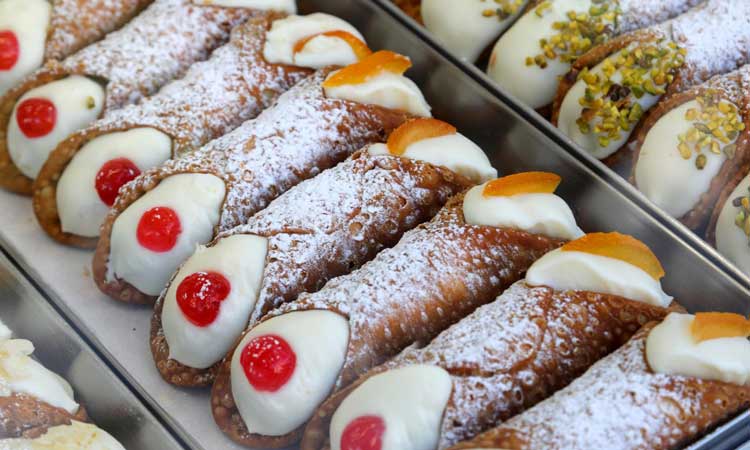
The filling (crema di ricotta). Authentic Sicilian cannoli filling is made exclusively with sheep’s milk ricotta not cow’s milk ricotta, which produces a wetter, less flavourful result. The ricotta is drained thoroughly (sometimes for 24 hours), passed through a sieve to remove lumps, combined with sugar and worked to a smooth, dense cream. The flavour of good ricotta cream is specific: slightly tangy, rich but not heavy, sweet without excess, with the characteristic grassy complexity of sheep’s milk. It should hold its shape when piped rather than flowing. Common additions to the basic ricotta include dark chocolate chips, candied orange peel (particularly in the Palermo tradition) and vanilla.
The garnish. The two traditional garnishes at the open ends of the cannolo are chopped pistachio (particularly the Bronte variety from Etna’s slopes) and candied orange peel. Some versions use a maraschino cherry or a square of dark chocolate. The garnish should be applied at the moment of filling, not pre-assembled. A final dusting of icing sugar completes the standard presentation.
The golden rule: fill it fresh
The single most important thing to understand about Sicilian cannoli is that they must be filled at the moment of ordering. This is not a preference; it is the difference between a genuine cannolo and a fraud.
A cannolo shell that has been filled in advance even an hour in advance will have absorbed moisture from the ricotta filling and will have lost its crispness. The shell becomes soft, chewy and damp. The textural contrast between the crisp shell and the yielding cream which is the entire point of the cannolo as a construction disappears completely. What remains is a tube of soggy pastry filled with sweet cheese. It is not good.
Every serious pasticceria in Sicily fills the cannolo to order. You can see the process: the empty shells in a tray, the piping bag of ricotta cream, the garnish elements arranged beside them. You order; the cannolo is assembled in front of you; you eat it within minutes. This is the correct sequence.
A pasticceria with pre-filled cannoli on display sitting in a refrigerated case or laid out on a tray in the shop window is telling you something important about its priorities. In tourist areas, pre-filling is common because it is faster and more convenient for high-volume service. It produces an inferior product. Seek out the places that fill to order. They are not hard to identify: you will see the shells stacked separately from the ricotta.
Regional variations across Sicily
The cannolo is Sicilian throughout the island, but the specific presentation varies by region in ways that reflect the local ingredient traditions.
Palermo: The Palermo cannolo is garnished with candied orange peel a reflection of the Arab-Norman culinary tradition that valued the preserved citrus of the Conca d’Oro, the orange-growing plain surrounding the city. The ricotta filling in the Palermo tradition tends to be smooth and relatively pure, with chocolate chips as the main textural addition. The candied orange peel at the end provides a citrus counterpoint to the sweetness of the cream.
Catania: The Catania tradition favours chopped pistachio specifically the Bronte pistachio from the volcanic slopes of Etna, approximately 40 kilometres northwest of the city. The bright green pistachio against the white ricotta cream is one of the most visually distinctive presentations of the cannolo in Sicily. The flavour combination of the slightly bitter, intensely flavoured Bronte pistachio against the sweet ricotta is one of the finest in the entire Sicilian pastry canon. Read our complete Bronte pistachio guide for more on this extraordinary ingredient.
Messina: The Messina variant incorporates chocolate sometimes as chips in the ricotta, sometimes as a coating on the inside of the shell. The combination of chocolate and ricotta in a cannolo format is specific to the Messina tradition and reflects the city’s historic commercial relationships with Catania’s chocolate trade.
Modica: The ancient Aztec-method chocolate of Modica (cold-processed, without cocoa butter) appears in cannolo variations specific to the Val di Noto area. A Modica chocolate cannolo the cold-process chocolate used both in the shell and as chips in the filling is one of the most specific regional variations in Sicilian pastry. Read our complete Modica guide for more on the chocolate tradition.
Piana degli Albanesi: The small town of Piana degli Albanesi, 24 kilometres south of Palermo, has an Albanian Greek heritage from medieval migration and a specific cannolo tradition that is considered by many Sicilian pastry authorities to produce the finest examples on the island. The Sagra del Cannolo held annually in Piana degli Albanesi during Carnival is the most celebrated cannolo festival in Sicily and the site of various world record cannolo attempts over the decades.
When to eat the seasonal ricotta question
The finest cannoli in Sicily are eaten in autumn and spring. The reason is the sheep.
Sheep’s milk ricotta is at its peak quality when the animals are grazing on fresh pasture which in Sicily means the spring grass of March to May and the autumn regrowth of September to November. The ricotta produced from sheep grazing on dry summer pasture or winter fodder is noticeably inferior in flavour, richness and complexity. The best Sicilian pasticcieri source their ricotta from specific shepherds and producers whose seasonal patterns they know precisely.
This does not mean that cannoli in July and August are worthless a good pasticceria manages the quality of its ricotta year-round. But the specific peak of the sheep’s milk ricotta calendar means that a cannolo eaten in October or April will often have a richer, more complex filling than the same cannolo eaten in August.
Best cannoli in Palermo
I Segreti del Chiostro (Monastery of Santa Caterina, Piazza Bellini) the pastry shop connected to the former Dominican monastery of Santa Caterina d’Alessandria, continuing a tradition of convent pastry-making that was one of the last surviving examples in Palermo. The cannoli are filled to order, the ricotta is exceptional and the cloister setting is extraordinary. The monastery and its baroque interior are described in our Palermo in 2 days guide.
Pasticceria Cappello (Via Colonna Rotta, 68) one of the most highly regarded pasticcerie in Palermo for traditional Sicilian pastry, with a ricotta cream of notable richness. The candied fruit and chocolate chip versions are both excellent.
Pasticceria Costa (Via Giosuè Carducci, 15) operating since 1960, with a reputation for the cassata and frutta di martorana as well as the cannoli. A good mid-range option in the Politeama district.
Best cannoli in Catania
Pasticceria Savia (Via Etnea, 302) operating since 1897, the most celebrated pastry shop in Catania and one of the most famous in Sicily. The pistachio cannolo here is the definitive version of the Catania tradition. The shop is on the main Via Etnea and is impossible to miss; the queue outside in the morning is the reliable indicator of its quality. The size of the cannoli is notably generous.
Caffè del Duomo (Piazza del Duomo) for location rather than strict pastry excellence, the terraces overlooking Catania’s baroque cathedral provide the finest setting for a mid-morning cannolo anywhere in the city.
Best cannoli elsewhere in Sicily
Caffè Sicilia, Noto (Corso Vittorio Emanuele, 125) Corrado Assenza, the fourth-generation pastry chef who was featured in Chef’s Table on Netflix, runs what many consider the finest pastry shop in southeastern Sicily. His cannoli incorporate ricotta with orange blossom and crushed toasted almonds a version that honours the traditional recipe while working at a level of refinement unusual even in Sicily. Read our complete Noto guide.
Bonajuto, Modica (Corso Umberto I, 159) the oldest chocolate shop in Sicily (est. 1880) also produces outstanding cannoli with the specific Modica chocolate integration. A necessary stop in Modica. Read our complete Modica guide.
Maria Grammatico, Erice the celebrated pasticceria of Maria Grammatico, who learned the convent pastry-making tradition as a novice before opening her own shop, is the most specific example of the relationship between Sicilian monastic pastry culture and the modern commercial pasticceria. The cannoli are excellent; the other almond paste confections are among the finest examples of their tradition in Sicily. Read our complete Erice guide.
👉 SICILIAN CANNOLI MAKING CLASS IN PALERMO OR TAORMINA
Learn to make authentic Sicilian cannoli from scratch with a local pastry chef from frying the shells around the metal tubes to working the sheep’s milk ricotta and assembling the final cannolo with traditional garnishes. Available in Palermo, Catania and Taormina.
👉SEE THE BEST SICILIAN CANNOLI MAKING CLASS HERE
How to order, eat and not embarrass yourself
Always order at the counter. In a Sicilian pasticceria, you stand at the counter (or find a table if the shop has one) and order verbally. Payment is typically made before receiving the pastry. Point at the shells if necessary and say “un cannolo” (one) or “due cannoli” (two). No complex Italian is required.
Confirm it will be filled fresh. Ask “lo fate al momento?” (do you fill it fresh?) if you are uncertain. This question will either receive a positive response or produce a slightly offended look, which also tells you everything you need to know.
Eat it immediately. A cannolo begins losing its shell crispness within minutes of filling. Eat it standing at the counter rather than carrying it away for later. The experience of eating a cannolo that was filled thirty seconds ago, with the shell still crackling on the first bite and the ricotta still cold from the fridge, is the correct one. Everything else is a compromise.
Hold it horizontally. The filling will slide out if you hold it at an angle. Both ends need to be managed. This is an engineering challenge as much as a culinary one. Bite from one end, rotate, bite from the other. Do not attempt to eat from the middle.
Expect icing sugar on your clothes. This is unavoidable. It is one of the cannolo’s defining characteristics. Dark clothing is inadvisable for a morning at the pasticceria.
Cannoli-making classes and tours
Cannoli-making classes in Sicily are among the most reliably excellent culinary experiences on the island, primarily because the skill involved is specific and teachable, the result is immediately edible and the process frying the shell, working the ricotta, assembling the cannolo gives hands-on contact with techniques that are otherwise invisible to visitors.
Classes are available in Palermo, Catania and Taormina, usually in the context of a broader Sicilian pastry or cooking class, and typically last 2 to 3 hours. The result is a cannolo made with your own hands, eaten at the counter with a glass of sweet Malvasia wine or espresso.
Street food tours in Palermo’s Ballarò and Capo markets typically include a pasticceria stop with cannolo tasting as part of the broader street food programme. Read our complete Palermo street food guide for the full picture of the Palermo food culture.
👉 PALERMO STREET FOOD AND PASTRY TOUR CANNOLI, GRANITA AND ARANCINE
A guided walking tour through Palermo’s historic markets and pasticcerie arancine at Ballarò, granita al limone at a bar in the old town and cannoli filled to order at one of the historic pasticcerie near the cathedral. The best introduction to Palermo food culture available.
👉 SEE THE BEST PALERMO STREET FOOD AND PASTRY TOUR HERE
Frequently asked questions about Sicilian cannoli
What is a Sicilian cannolo?
A Sicilian cannolo is a pastry consisting of a fried tube-shaped shell (cialda) made from flour, lard, Marsala wine and spices, filled with a sweetened sheep’s milk ricotta cream and garnished with candied orange peel, chopped pistachio, chocolate chips or a combination of these elements. It originated in Sicily during the Arab period (9th to 11th centuries) and has been one of the defining foods of Sicilian culture ever since.
Where did cannoli originate?
The most widely accepted origin account places the first cannoli in Caltanissetta, Sicily, during the Arab period of the 9th to 11th centuries, made by women in the emir’s household using the sheep’s milk ricotta, candied fruits and pistachios of the Arab culinary tradition. The recipe was subsequently developed by Sicilian convent nuns and eventually became a year-round commercial product in the pasticcerie of the 19th and 20th centuries.
What is the difference between a Palermo and Catania cannolo?
The primary difference is the garnish. Palermo cannoli are traditionally garnished with candied orange peel, reflecting the city’s Arab-Norman citrus tradition. Catania cannoli are traditionally garnished with chopped Bronte pistachio from the volcanic slopes of Etna. Both use sheep’s milk ricotta filling; both use a fried pastry shell. The difference in garnish creates a significantly different flavour experience.
How do you know if a cannolo is good?
The shell must be crisp if it is soft or chewy, it was pre-filled. The ricotta filling should be dense, smooth and subtly tangy, not watery or over-sweetened. The shell should be dry, not greasy. The cannolo should be filled in front of you at the moment of ordering. These four criteria identify the genuine article.
What does “take the cannoli” mean?
The line “Leave the gun. Take the cannoli” is from The Godfather (1972), spoken by the character Peter Clemenza after a murder. The line written by Mario Puzo and Francis Ford Coppola became one of the most famous in cinema history partly because of its absurdist juxtaposition of violence and domesticity, and partly because it captures something genuinely accurate about Sicilian cultural priorities. The cannoli comes first.
Leave the gun. Take the cannoli.
The Sicilian cannolo is a lesson in the relationship between technique and pleasure. The quality of the sheep’s milk ricotta, the crispness of the fried shell, the specific moment of assembly these are not mystifications of a simple pastry. They are the conditions that produce the experience: the crack of the shell, the cold ricotta, the bitter pistachio at the edge, the icing sugar that gets on everything. A cannolo filled thirty seconds ago, at the counter of a pasticceria in Palermo on an October morning, with a coffee alongside it, is a specific and unrepeatable pleasure. This is why Sicilians are territorial about it. They are right to be.
For the full Sicilian food picture, read our complete Sicilian food guide, our Palermo street food guide and our Palermo markets guide.
Did this guide help you plan your Sicilian cannolo pilgrimage? Save it to Pinterest or share it with someone who needs to understand what a real cannolo tastes like.