Sicily has been attracting painters and photographers for three centuries for a specific reason that has nothing to do with the monuments and everything to do with the light. The Sicilian light harsh white at midday in July and August, golden and directional in the early morning and late afternoon, warm and saturated in September and October, soft and moody after an April rain produces photographs that look processed even when they are not. The combination of the Mediterranean intensity with the specific colours of the Sicilian landscape (the golden limestone of the baroque, the black basalt of Etna, the turquoise of the Egadi coves, the yellow of the euphorbia on the coastal cliffs in spring) creates a photographic environment of unusual quality at almost every season and almost every hour outside the brutal midday white.
This guide covers the best photography locations in Sicily organised by subject baroque towns, volcanic landscapes, markets, temples, coastline and island with specific advice on the timing, light direction and seasonal conditions that make each location perform at its finest.
In this guide
- Understanding the Sicilian light
- Baroque towns the golden hour programme
- Ancient temples dawn and spring
- Etna volcanic drama and harvest colour
- Markets the morning hour
- Coastline and sea colour and clarity
- Islands the Aeolian and Egadi
- Street photography and people
- Best season for photography
- Practical tips
Understanding the Sicilian Light
The Sicilian light changes dramatically by hour and by season, and understanding this change is the foundation of all good Sicilian photography. The midday light in July and August overhead, white and harsh produces flat, shadowless images with blown highlights and colourless skies. This is the light that most summer visitors work with, arriving at the monuments between 10am and 4pm. It is the worst light available in Sicily and it is why so many tourist photographs of Sicilian monuments look disappointing relative to the monuments themselves.
The golden hour light the hour after sunrise and the hour before sunset is the light that transforms Sicilian photography. The low angle of the sun produces long shadows, directional contrast and a warm colour temperature that saturates the limestone of the baroque towns and the volcanic rock of Etna simultaneously. In Sicily, the golden hour in summer lasts approximately 45 to 60 minutes after sunrise and before sunset; in spring and autumn, it extends to 75 to 90 minutes and has a softer, more diffuse quality that many photographers prefer for the baroque towns specifically.
September and October are the finest photography months in Sicily by consensus among experienced landscape and architectural photographers. The lower sun angle compared to June and July produces longer shadows throughout the day (not only at golden hour), the atmospheric clarity is maximum after the summer heat haze disperses, and the specific warm quality of the autumn light on the golden limestone of the Val di Noto the Noto Cathedral at 5pm in late September is the image that most consistently exceeds the photographer’s expectations.
Baroque Towns the Golden Hour Programme
Noto. The finest baroque photography subject in Sicily. The Corso Vittorio Emanuele faces west and catches the afternoon light directly from approximately 3pm onward, with the golden hour beginning around 4.30pm in summer and 3pm in October. The Cathedral facade at the end of the Corso, caught at the moment when the afternoon light is at 45 degrees to the stone, produces the most consistent and most photographic result. The Via Corrado Nicolaci (the street of the Infiorata) is a secondary axis running perpendicular to the Corso; the light here in the late afternoon catches the upper palace floors while the street level is in shadow, producing the specific contrast between illuminated baroque detail and deep shadow that is the signature of the best Noto architectural photography. Read our complete Noto guide.
Ragusa Ibla. The Giardino Ibleo terrace above the baroque lower town provides the finest elevated view of the Ibla skyline the dome of San Giorgio and the campanili of the other churches visible above the rooftops in a composition that is standard in Sicilian photography for good reason: the specific combination of the curved baroque roofline, the valley below and the Iblean plateau behind is difficult to improve. The terrace faces west and is lit directly in the late afternoon; arrive 90 minutes before sunset for the full golden hour programme. The streets below the Cathedral of San Giorgio at street level in the early morning (before 8am) are the quietest and most atmospheric version of the Ragusa Ibla architectural subject. Read our complete Ragusa guide.
Palermo. The Quattro Canti (the baroque intersection of Via Maqueda and Corso Vittorio Emanuele) is lit directly in the morning from the east and the afternoon from the west on alternating facades the curved baroque fronts receive the sun sequentially through the day, allowing clean lighting of individual facades at most times. The Fontana Pretoria is front-lit in the morning from Via Maqueda and in the late afternoon from the cathedral direction; the specific marble white of the Florentine fountain against the darker Sicilian stone buildings behind it is most dramatic at these moments. Read our complete Palermo guide.
Ortigia. The Cathedral of Syracuse (the baroque facade concealing the Greek temple columns visible in the side walls) faces west and is directly lit in the late afternoon from approximately 3pm onward. The Piazza del Duomo at golden hour, with the Cathedral in warm light and the surrounding baroque palaces lit from the side, is the most photographed single evening scene in southeastern Sicily. The Fonte Aretusa (the freshwater spring at sea level, with the papyrus growing around the pool and the harbour behind) is morning-lit and most atmospheric in the early morning before the tourist traffic arrives. Read our complete Ortigia guide.
👉SEE THE BEST SICILIAN TOUR GUIDE HERE
Ancient Temples Dawn and Spring
The ancient Greek temples of Sicily are at their photographic finest in two specific conditions: at dawn in any season (the horizontal morning light from the east, the last sky still blue to the west, the temple stone lit from below its own pediment by the first direct light) and in spring (the wildflowers poppies, wild asphodelus, yellow euphorbia growing at the base of the columns in March and April, the specific contrast between the ancient stone and the living botanical programme that the summer site visit cannot provide).
The Temple of Concordia at Agrigento is east-facing on its plinth the sunrise lights the full facade in direct warm light from the moment the sun clears the eastern horizon. The Valley of the Temples opens at 8.30am; the walk to the Temple of Concordia takes 10 minutes from the main entrance. Arriving at opening, walking directly to the Temple of Concordia and photographing in the first 20 minutes of direct morning light with the western sky still pre-dawn blue behind the temple produces the most consistently cited of all Sicilian archaeological photographs. The same subject at 11am in August with overhead white light is a different image entirely. Read our complete Valley of the Temples guide.
The Segesta temple (unfinished, set alone in a valley northwest of Palermo) is north-facing and therefore difficult to front-light directly. The morning light from the southeast catches the east flank of the temple; the afternoon light from the southwest catches the west flank. The dramatic photography approach at Segesta is the theatrical setting the temple in the wide valley, the mountains behind, the absence of any other building captured from the road above the temple level, which provides an elevated perspective on the columned form within the landscape. The spring visit with green valley provides the most colour-rich version of this composition. Read our complete Segesta guide.
Etna Volcanic Drama and Harvest Colour
Etna provides three specific photography subjects that are unavailable elsewhere in Italy: the volcanic landscape at altitude (the black lava desert, the sulphur-yellow crater deposits, the steam from the active vents), the vineyard landscape in harvest (the ancient alberello vines on volcanic terraces in September and October, the autumn colour of the leaves against the black basalt soil) and the view of the volcanic summit from the sea or from Taormina (the most compositionally complete view of the volcano, with the cone and its steam above and the Ionian coast below).
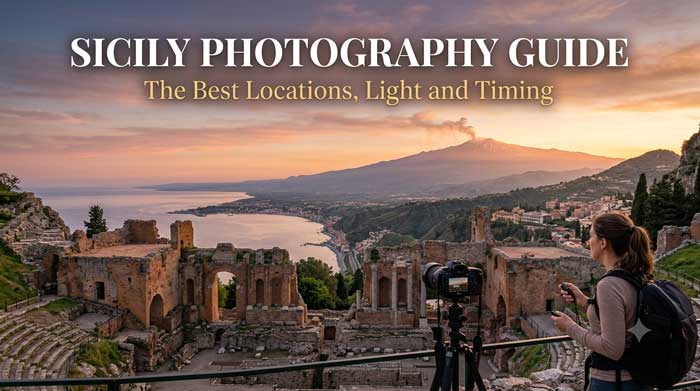
The Taormina view of Etna from the Greek theatre terrace or from the Piazza IX Aprile is best photographed in the early morning before the heat haze builds above the sea level. The clearest days in September and October provide the most dramatic versions of this view, with the autumn light catching the upper slopes and the volcanic steam catching the sun against the clear sky. At sunrise from Taormina, the Etna summit is the first landmass to be directly lit while the sea and the lower slopes are still in shadow the specific moment of the illuminated summit above the dark bay lasts approximately 10 minutes and is worth the early alarm. Read our complete Taormina guide and Etna wine guide.
Markets the Morning Hour
The Sicilian markets are among the finest street photography environments in Italy the density of colour, movement, product and human interaction compressed into a few medieval lanes produces images of considerable energy and specificity. The Ballarò market in Palermo is the most photographically rich: the vendors’ chants, the fish on the ice tables, the coloured produce stacked in towers, the movement of the morning crowd through the narrow lanes. The Pescheria in Catania (the fish market behind the Duomo) is the most theatrically dramatic the vendors’ salesmanship and the extraordinary product (the swordfish laid out on the counters, the sea urchin vendors splitting the ricci at the table) produce images that are specific to this location and this tradition.
The market photography hour is 7.30am to 10am. Arrive early for the full energy of the opening; by 10.30am the best product is sold and the markets begin to thin. Market photography involves human subjects the most ethically and practically effective approach is direct and warm engagement rather than covert shooting: a smile, a word of Italian (even just “posso?” may I?), a gesture toward the camera. Sicilian market vendors are accustomed to being photographed and generally welcoming of the attention; the direct approach produces better images and better interactions than the telephoto-from-distance method. Read our complete Palermo markets guide.
Coastline and Sea Colour and Clarity
The Sicilian coastline provides the full Mediterranean colour range the specific turquoise of the Egadi Islands over pale limestone, the deep cobalt of the open Tyrrhenian off Cefalù, the volcanic black of the Aeolian Islands coast, the emerald green of the Zingaro coves in May. The colour is most saturated in the morning (before 10am) and in the late afternoon (after 4pm); the midday light flattens the water colour and reduces the clarity of the underwater detail.
The Scala dei Turchi at Agrigento (the white eroded marl cliff descending to the sea) is best photographed at sunset from the cliff top looking north the warm light on the white surface, the shadow of the cliff edge creating the stepped profile visible from above, the sea below catching the last direct light. The timing is critical: 30 minutes before sunset from the northern viewpoint. Read our complete Scala dei Turchi guide.
The Cala Rossa at Favignana the former tuff quarry bay with the pale limestone seabed producing the turquoise colour is most photographically saturated in the morning (9 to 11am) when the sun angle illuminates the underwater seabed through the clear water. The specific turquoise intensity that makes the Cala Rossa images so widely shared on social media is a function of the sun angle relative to the water surface and the limestone bottom: mid-morning, with the sun at 30 to 45 degrees, is the optimum condition. Read our complete Favignana guide.
Islands the Aeolian and Egadi
Stromboli provides the most dramatic single island photography subject in the Italian seas the active volcanic eruptions visible at night from the boat off the Sciara del Fuoco or from the summit crater rim. The night boat tour photograph of Stromboli the volcanic cone silhouetted against the sky, the glow of the eruption visible above the summit, the reflection of the lava on the sea surface requires a long exposure (3 to 8 seconds at ISO 400 to 1600) and a stable platform. From the boat, shooting at the anchor point (the boat is still but the movement of the water introduces some motion) produces acceptable results with a wide aperture; from the Punta Labronzo viewpoint on land, the stability is better and the long exposure more controllable. Read our complete Stromboli guide.
Panarea provides the most aesthetically refined island photography in the Aeolian chain the white cube architecture of the village, the deep blue of the Tyrrhenian, the other islands visible on the horizon. The morning light on the white Panarea buildings (facing east and southeast) is clean and directional from 7 to 10am; the afternoon light on the western-facing terraces from 4pm onward. The view from the hillside above the village toward the Stromboli cone on the northeastern horizon is one of the most compositionally clean island views in the Mediterranean and requires only the morning walk up the path above the port to access. Read our complete Aeolian Islands guide.
Street Photography and People
Sicily is one of the finest street photography destinations in Italy the specific public life of the Sicilian city, the market culture, the passeggiata, the bar counter at 8am, the stigghiola grill in the Vucciria at 9pm, provide a continuous programme of human activity in specific and photogenic settings. The combination of the Sicilian willingness to be seen in public (the bella figura culture means that people in the streets of Palermo and Catania are dressed and composed for public visibility) and the settings (the baroque piazzas, the medieval market lanes) produces street photography images of a quality that is harder to achieve in more private or less architecturally rich urban environments.
The morning market (before 10am) and the evening passeggiata (7 to 9pm) are the two highest-density street photography opportunities in any Sicilian city. The light conditions for both are generally favourable the morning market in the shade of the market building or in the low-angle morning light, the passeggiata in the warm evening light before the sun drops below the building line. Respect for subjects is essential; the same direct and warm engagement recommended for market photography applies to all street photography in Sicily.
Best Season for Photography in Sicily
September and October are the finest photography months in Sicily for landscape and architectural photography. The lower sun angle, the maximum atmospheric clarity, the autumn colour on the Etna vineyards and the reduced tourist pressure at the major sites combine to produce conditions that most experienced Sicily photographers cite as the optimal visiting period. The specific warm quality of the September and October golden hour on the golden limestone of the baroque towns is the light that most frequently produces the images that define the visual identity of Sicily for international audiences.
April and May are the finest months for the wildflower programme the temples in spring, the coastal trails in bloom, the specific contrast between ancient stone and living botanical abundance. The light in May is softer than September but the seasonal content (the wildflowers, the spring green of the landscape) compensates. Read our complete guides to Sicily in spring, Sicily in September and Sicily in October.
Practical Tips for Photographing Sicily
The most important piece of equipment for Sicilian photography is not a camera but an alarm clock. The difference between arriving at the Valley of the Temples at 8.30am (opening time, first light on the Temple of Concordia) and arriving at 10.30am (after breakfast at the hotel, when the tour buses have already arrived) is the difference between a transformative image and a competent snapshot. The best Sicilian light is available for 45 to 90 minutes after sunrise and 45 to 90 minutes before sunset; the rest of the day, in summer, is the harsh midday light that no processing can significantly improve.
A polarising filter is more useful in Sicily than in most European destinations the combination of the intense light, the blue sky and the reflective sea surfaces means that polarisation significantly increases colour saturation and reduces glare in the coastal and sea photographs. The circular polariser for the Egadi coves, the Zingaro sea caves and the Ortigia harbour produces a specific increase in the turquoise water saturation that is difficult to achieve in post-processing.
For the baroque towns: a 24mm to 35mm lens provides the most workable perspective for the narrow streets the wider focal lengths distort the vertical lines of the baroque facades at close range, and the compressing effect of the longer focal lengths reduces the spatial depth that makes the Via Corrado Nicolaci in Noto or the Giardino Ibleo terrace in Ragusa Ibla most effective as compositions. For the landscape and coastal subjects: a 16mm to 24mm wide angle for the Etna summit crater panoramas and the coastal cliffs; a 70mm to 200mm telephoto for the Etna view from Taormina (compressing the distance between the summit and the coast) and the market portraits. Read our complete Sicily packing list for the equipment logistics.
For drone photography: the Sicilian archaeological parks (Valley of the Temples, Selinunte, Segesta, Neapolis Syracuse) prohibit drone flight within their boundaries without prior authorisation. The coastal natural reserves (Zingaro, Vendicari) have similar restrictions. The urban historic centres of Palermo, Catania and the Val di Noto baroque towns are subject to Italian airspace regulations that prohibit drone flight in densely populated areas without permits. Etna above 2,900 metres is in controlled airspace. Consult the ENAC (Italian civil aviation authority) drone flight maps before any drone photography in Sicily.
The Island That Photographs Itself
Sicily does not require the photographer to work hard for the image. The light arrives in the morning with a specific quality of gold and directionality that finds the best angle on the baroque stone without being asked. The markets fill with colour and movement and human energy at 8am whether or not you have your camera ready. The Etna summit catches the first direct light of the day from the sea 60 kilometres below while the rest of the island is still in shadow. The specific photograph that Sicily provides the image that looks more saturated than reality and more composed than accident is not the result of processing or luck but of showing up at the right place at the right hour. Sicily is generous with its light. The only requirement is the willingness to be up before 8am.
For the complete Sicily planning picture, read our best time to visit Sicily guide, our 2-week Sicily itinerary and our Sicily packing list.
Did this guide help you plan your Sicily photography? Save it to Pinterest or share it with someone who wants to photograph the most photogenic island in the Mediterranean.