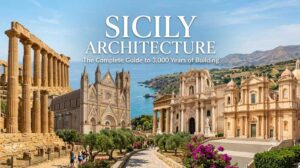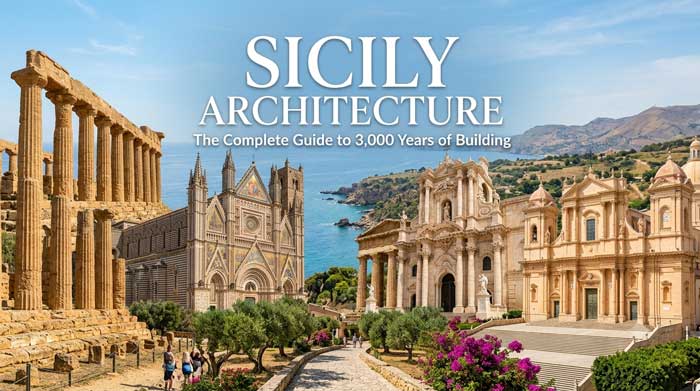
Sicily is the most architecturally layered island in the Mediterranean 3,000 years of building in successive civilisational programmes, each one leaving its most ambitious work on the island before the next arrived to build over, beside or within it. The Greek Doric temples of the 5th century BC, the Arab-Norman palatial and religious synthesis of the 12th century, the Spanish baroque rebuilding programme after the 1693 earthquake, the Liberty-era expansion of Palermo in the late 19th century and the specific Fascist rationalism of the 1930s are not simply historical phases they are physically present, simultaneously visible and simultaneously visitable in a way that no other single island territory in Europe can match. This guide covers every major architectural period with the specific buildings that best represent each tradition and the places where they can be encountered.
In this guide
- Greek Doric the 5th century BC temples
- Roman architecture in Sicily
- Arab-Norman synthesis the 12th century masterworks
- Gothic and Catalan-Gothic in Sicily
- Sicilian baroque the Val di Noto programme
- Liberty architecture Palermo’s Belle Époque
- Fascist rationalism and the 20th century
- Vernacular architecture the trulli and the trabocchi
- The ten finest buildings in Sicily
- FAQ
Greek Doric the 5th Century BC Temples
The Greek Doric temples of Sicily are the finest surviving examples of the Doric order in the world surpassing the monuments of mainland Greece in their state of preservation and equalling them in their architectural ambition. The Doric order the simplest and the most powerful of the three classical Greek architectural orders, characterised by the undecorated capital, the triglyphs and metopes of the frieze and the specific proportional system that governs the relationship between column height, column diameter and intercolumnar spacing was the preferred order of the Sicilian Greek colonial world, and the scale at which it was deployed in Sicily exceeded anything attempted on the Greek mainland.
The Temple of Concordia at Agrigento (440 to 430 BC) is the finest surviving Doric temple in the world the most complete, the most precisely preserved and the most architecturally accomplished of the Sicilian Greek temples. The Temple of Hephaestus at Athens is more celebrated; the Parthenon is more famous; but neither provides the specific combination of completeness and landscape setting that makes the Temple of Concordia the most directly overwhelming single ancient building available for the visitor. The temple at Segesta (approximately 430 to 420 BC), standing incomplete and roofless on the hill above the Sicilian interior valley never finished, never dedicated, the product of a Greek colonial ambition that was interrupted before it was fulfilled is the most romantically situated Doric temple in the ancient world and the most photographically extraordinary. Read our complete Valley of the Temples guide and Segesta guide.
Roman Architecture in Sicily
The Roman architectural legacy in Sicily is concentrated in two primary forms the villa programme (the private residential architecture of the Roman elite) and the urban infrastructure (the amphitheatres, the bath complexes and the road network). The Villa Romana del Casale at Piazza Armerina (310 to 340 AD) is the most significant single Roman building in Sicily not for its architecture (the building itself was a standard late Roman villa configuration) but for its floor mosaic programme, the most extensive and the most ambitious in the Roman world. The Roman amphitheatre at Syracuse (3rd century AD, one of the largest in Italy) and the theatre at Taormina (substantially rebuilt by the Romans from the earlier Greek structure in the 2nd century AD) are the most visible Roman architectural monuments on the island.
The specific Roman contribution to Sicilian architecture is the transformation of the Greek theatrical tradition into the Roman entertainment programme the Syracuse amphitheatre and the Taormina theatre modification both reflect the Roman shift from the Greek dramatic festival to the gladiatorial and theatrical entertainment of the imperial period. Read our complete Villa Romana guide.
Arab-Norman Synthesis the 12th Century Masterworks
The Arab-Norman architectural synthesis of 12th-century Sicily is the most extraordinary single architectural achievement in the medieval Mediterranean the combination of Norman structural engineering, Arab decorative programme and Byzantine mosaic tradition in buildings of specific and irreducible originality. The Norman kings of Sicily (Roger I, Roger II, William I and William II) employed Arab craftsmen, Byzantine mosaic artists and Norman stone masons simultaneously, producing buildings that belong to no single architectural tradition but to the specific synthesis that the Norman court of Palermo uniquely provided.
The Cappella Palatina (1130 to 1140) is the canonical masterwork the Norman arches over the nave, the Arab muqarnas ceiling of the side aisles and the Byzantine gold mosaic programme covering every wall surface produce a single interior of such specific beauty and historical complexity that it defies any single art historical categorisation. The UNESCO inscription of 2015 recognised the Arab-Norman Palermo monuments as “an outstanding example of a socio-cultural syncretism” the specific term that acknowledges the impossibility of attributing these buildings to any single cultural tradition. La Zisa (1165 to 1167), with its muqarnas fountain hall and its Arabic inscription from a Norman king, is the most specific secular expression of the same synthesis. Monreale Cathedral (1174 to 1185), with the largest Byzantine mosaic programme in the world covering 6,340 square metres of wall surface, is the most ambitious single building of the entire Norman programme. Read our complete Cappella Palatina guide, La Zisa guide and Monreale Cathedral guide.
👉 SICILY ARCHITECTURE TOUR GREEK TEMPLES, ARAB-NORMAN AND THE VAL DI NOTO BAROQUE
A guided architectural tour of Sicily’s finest buildings the Doric temples of Agrigento, the Arab-Norman Cappella Palatina and La Zisa, and the baroque programme of the Val di Noto. The most architecturally comprehensive single tour available on the most layered island in the Mediterranean. Expert guides, morning departures.
👉SEE THE BEST SICILY ARCHITECTURE TOUR HERE
Gothic and Catalan-Gothic in Sicily
The Gothic architectural tradition arrived in Sicily with the Angevin and Aragonese dynasties in the late 13th and 14th centuries, producing a specific Sicilian Gothic that combines the pointed arch and the vertical emphasis of the northern European Gothic tradition with the specific materials and the specific decorative programme of the Sicilian stone-carving tradition. The finest examples: the Palazzo Abatellis in Palermo (1490 to 1495, the finest Catalan-Gothic secular building in Sicily, now the Regional Art Gallery), the Church of Santa Maria della Catena in Palermo (early 16th century, the finest Gothic-Renaissance portal in the city) and the Palazzo Steripinto at Sciacca (late 15th century, the most dramatically decorated Catalan-Gothic facade in western Sicily). The Catalan-Gothic tradition in Sicily reflects the specific Spanish cultural influence of the Aragonese period the connection to the Catalan architectural tradition of Barcelona and Valencia that was the dominant Gothic programme of the western Mediterranean in the 15th century. Read our complete Sciacca guide.
Sicilian Baroque the Val di Noto Programme
The Sicilian baroque is the most coherent and the most ambitious regional baroque programme in Italy the rebuilding of the entire southeastern Sicilian plateau after the catastrophic earthquake of January 11th, 1693 in the specific architectural vocabulary of the Spanish viceregal baroque, producing eight towns of extraordinary visual unity in the warm Hyblaean calcarenite limestone. The UNESCO inscription of 2002 recognised the Val di Noto baroque as “the culminating point of Baroque art” the most concentrated and the most architecturally accomplished baroque urban programme in Europe.
The specific qualities of Sicilian baroque that distinguish it from the Roman, Neapolitan and northern European equivalents: the specific use of the warm golden-cream Hyblaean calcarenite that responds to the afternoon light with a colour warmth that marble and travertine cannot produce; the specific ornamental programme of the facade (the balcony brackets carved with fantastic grotesque figures human faces, lions, horses, female busts that are the most inventive single decorative element in the entire baroque repertoire); and the specific town planning of the rebuilt cities (the wide ceremonial axes, the piazze facing the cathedral, the concave and convex facades that animate the street front with the specific theatrical quality of the baroque urban vision at its most confident). The finest single baroque building in Sicily is the Noto Cathedral facade the most perfectly balanced and the most warmly lit baroque facade in Italy. Read our complete Sicilian baroque architecture guide and Noto guide.
Liberty Architecture Palermo’s Belle Époque
The Liberty style (the Italian Art Nouveau, named after the London department store whose aesthetic influenced the Italian decorative arts of the 1890s to 1910s) found its most exuberant and most specifically Sicilian expression in Palermo the late 19th and early 20th-century expansion of the city along the Via della Libertà produced the most concentrated single Liberty architectural district in southern Italy. The specific Palermitan Liberty: the stucco ornamental programme of the facade (the flowers, the female figures, the sinuous plant-form decoration of the Art Nouveau tradition applied to the limestone palazzo buildings of the Palermo upper-middle-class residential expansion), the coloured ceramic tile programme of the interior spaces and the specific combination of the Liberty decorative vocabulary with the Palermitan palazzo building tradition.
The finest Liberty addresses in Palermo: the Villa Igiea (1898 to 1900, by Ernesto Basile the most celebrated Sicilian architect of the Liberty period the most architecturally accomplished single Liberty building in Sicily, now the Rocco Forte Villa Igiea hotel), the Villino Florio all’Olivuzza (1899 to 1902, by Basile the most ornamentally extravagant Liberty residential building in the city, now a public building), and the Grand Hotel et des Palmes (1874, later modified by Basile the most historically significant Liberty hotel in Palermo, where Wagner completed Parsifal and where the Sicilian-American mafia allegedly agreed the structure of the American Cosa Nostra in 1957). Read our complete Palermo guide.
Fascist Rationalism and the 20th Century
The Fascist building programme of the 1920s to 1940s left a specific architectural legacy in Sicily the Rationalist style (the Italian version of International Modernism, stripped of ornament and characterised by the horizontal emphasis, the concrete construction and the specific geometric clarity of the Fascist aesthetic programme) produced several significant buildings in the main Sicilian cities. The most architecturally significant: the Palazzo delle Poste in Palermo (1928 to 1934, by Angiolo Mazzoni the most imposing single Rationalist building in the Sicilian capital), the University buildings in Catania and the specific Fascist town planning of the new settlements in the Sicilian interior (the bonifica programme that drained the malaria marshes and built the new agricultural towns of the 1930s on the rational grid plan of the Fascist urbanistica).
The most specific 20th-century architectural legacy in Sicily is the abusive building (the ediliza abusiva) of the post-war period the illegal construction programme that disfigured the Palermo periphery, the Agrigento coastal zone and significant sections of every Sicilian city from the 1950s to the 1980s, producing the landscape of unfinished concrete that is the most visible single architectural legacy of the specific Sicilian relationship between local government, construction interest and civic regulation. The contrast between this landscape and the Greek temples, the Norman mosaics and the baroque piazze it surrounds is the most architecturally dramatic single observation available in Sicily and the one that most directly requires historical and social explanation.
Vernacular Architecture
The vernacular architecture of Sicily the specific building traditions of the agricultural and fishing communities, developed without architects and without formal programmes is the most consistently overlooked element of the Sicilian architectural heritage. The masserie (the estate farmhouses of the agricultural interior, built in the local stone with the specific courtyard plan of the Mediterranean agricultural building tradition), the tonnare (the tuna processing complexes of the western coast, with the specific industrial architecture of the fish trap and processing tradition), the palmenti (the stone wine presses of the Etna slope, built from volcanic basalt in the specific configuration of the traditional wine-making process) and the bagghiù (the communal courtyard of the Sicilian urban residential building) are the most specifically local and the most directly functional architectural forms available in Sicily. The finest masseria on the Hyblaean plateau, the finest tonnara at Scopello and the finest palmento on the Etna slope are architectural experiences as specifically Sicilian as the Cappella Palatina, and significantly less visited. Read our complete Sicily wine regions guide.
👉The Sicily architectural circuit from the Greek temples at Agrigento to the Arab-Norman Palermo, the Val di Noto baroque and the Liberty villas requires a rental car. Compare prices at Palermo and Catania airports on DiscoverCars. The most architecturally rich road trip in the Mediterranean.
👉COMPARE THE BEST RENTAL CARS HERE
The Ten Finest Buildings in Sicily
A personal architectural ranking subjective but defensible of the ten buildings that most completely represent the Sicilian architectural achievement across all periods:
1. Cappella Palatina, Palermo (1130 to 1140). The most architecturally complex and the most culturally specific building in Sicily the Arab-Norman-Byzantine synthesis in its most concentrated form.
2. Temple of Concordia, Agrigento (440 to 430 BC). The finest surviving Doric temple in the world.
3. Monreale Cathedral (1174 to 1185). The most ambitious single Norman building 6,340 square metres of Byzantine mosaic.
4. Noto Cathedral (1694 to 1776). The finest baroque facade in Italy.
5. La Zisa, Palermo (1165 to 1167). The most intact Islamic palatial building in Italy.
6. Temple of Segesta (430 to 420 BC). The most romantically situated ancient temple in the Mediterranean.
7. Ragusa Ibla Cathedral of San Giorgio (1738). The finest Gagliardi baroque church in the Val di Noto.
8. Villa Igiea, Palermo (1898 to 1900). The finest Liberty building in southern Italy.
9. Chiesa della Martorana, Palermo (1143). The most concentrated Arab-Norman synthesis in a single room.
10. Palazzo Abatellis, Palermo (1490 to 1495). The finest Catalan-Gothic secular building in Sicily.
FAQ about Sicily Architecture
What architectural styles are found in Sicily?
Sicily has Greek Doric (5th century BC temples at Agrigento, Segesta, Selinunte), Roman (Villa Romana del Casale mosaics, Syracuse amphitheatre), Arab-Norman synthesis (12th century Cappella Palatina, Monreale, La Zisa), Catalan-Gothic (15th century Palazzo Abatellis), Spanish baroque (17th to 18th century Val di Noto), Liberty/Art Nouveau (19th to 20th century Palermo Via della Libertà) and Fascist Rationalism (1920s to 1940s).
What is Arab-Norman architecture in Sicily?
Arab-Norman architecture is the specific 12th-century architectural synthesis of the Norman kingdom of Sicily buildings that combine Norman structural engineering, Arab muqarnas and decorative programme and Byzantine gold mosaic tradition in a single unified aesthetic. The Cappella Palatina in Palermo is the finest example. The style is unique to Sicily and is UNESCO-inscribed as part of the Arab-Norman Palermo World Heritage Site (2015).
What is the best example of baroque architecture in Sicily?
The Noto Cathedral facade is the finest single baroque building in Sicily. The Val di Noto baroque town programme eight towns rebuilt simultaneously after the 1693 earthquake in the Spanish viceregal baroque style is the most coherent baroque urban programme in Italy and UNESCO-inscribed as “the culminating point of Baroque art.”
The Island That Kept Everything
Sicily kept everything. Where Rome built over the Forum and Florence built over the Etruscan city and Athens built over the Mycenaean palace, Sicily accumulated the Greek temple was converted to a church rather than demolished, the Arab garden palace was converted to a barracks rather than torn down, the baroque piazza was built around the surviving medieval tower rather than replacing it. The specific quality of the Sicilian architectural landscape is the quality of a place that never had the administrative energy or the ideological confidence to erase what the previous civilisation had built. The result is the most complete single architectural library of the Mediterranean world available on one island 3,000 years of building in visible, visitable, physically present form, from the Doric temple that is still the most powerful thing made of stone in the ancient world to the unfinished concrete of the postwar abusive construction that is the most specifically Sicilian architectural failure of the modern period. Both are here. Both are Sicilian. The island kept everything.
For the complete Sicily culture programme, read our Sicily for history lovers guide, our Sicilian baroque guide and our Norman Sicily heritage guide.
Did this guide help you discover Sicilian architecture? Save it to Pinterest or share it with someone who wants the most architecturally layered island in the Mediterranean.