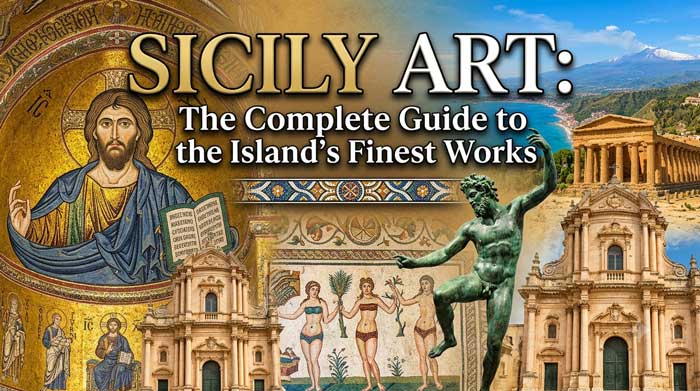
Sicily’s visual art tradition spans 3,000 years from the prehistoric rock engravings of the Aeolian Islands and the painted Siculan pottery of the Bronze Age to the Norman mosaic programme of the 12th century, the Renaissance master Antonello da Messina, Caravaggio’s three Sicilian paintings of 1608 to 1609, the Baroque stucco programme of Giacomo Serpotta and the contemporary street art of the Palermo ZEN. The specific quality of Sicilian art is the quality of accumulation and encounter each period producing its most ambitious work in response to the specific landscape, the specific social conditions and the specific cultural influences available on the most culturally intersected island in the Mediterranean. This guide covers the essential Sicilian art programme with the specific works and the specific places where they can be encountered.
In this guide
- Antonello da Messina the Sicilian Renaissance
- Caravaggio in Sicily
- The Norman mosaics
- Giacomo Serpotta and the Palermo oratories
- The Triumph of Death Palazzo Abatellis
- The best art museums in Sicily
- Contemporary art in Sicily
- Where to see the finest Sicilian art
- FAQ
Antonello da Messina the Sicilian Renaissance
Antonello da Messina (approximately 1430 to 1479) is the only Sicilian artist in the Italian Renaissance canon the painter from Messina whose specific technical achievement (the introduction of the Flemish oil painting technique to the Italian painting tradition, allowing the transparency and the colour depth unavailable in the earlier egg tempera medium) changed the course of Italian Renaissance painting as decisively as any single technical development of the century. Antonello’s specific contribution: he travelled to Flanders (or learned the Flemish technique from the Flemish paintings that passed through the Neapolitan and Sicilian markets) and returned to Italy with the oil medium that the Flemish painters had developed applied the new technique to the Italian tradition and produced paintings of a specific luminous quality that the tempera tradition could not achieve.
The most celebrated single Antonello painting available in Sicily is the Vergine Annunziata (Virgin Annunciate, approximately 1476) at the Palazzo Abatellis in Palermo the three-quarter portrait of the Virgin at the moment of the Annunciation, her right hand raised to hold the mantle that covers her head, her gaze directed slightly downward and inward in the specific gesture of reception and contemplation that has made this the most widely reproduced single image in Sicilian art history. The painting is small (45 by 34 centimetres) and entirely without the narrative apparatus that the standard Annunciation scene deploys no angel, no lilies, no architectural setting, only the Virgin in the three-quarter view that Antonello learned from the Flemish portrait tradition. The specific quality of the painting is the specific quality of the gaze the interior contemplative focus, the slight downward angle, the specific combination of awareness and withdrawal that no other Italian Renaissance painter achieved at this scale in this format.
The other significant Antonello works in Sicily: the San Gregorio Polyptych at the Museo Regionale di Messina (the most important altarpiece by the artist still in his home city) and the fragments of the San Cassiano Altarpiece reconstruction in the Kunsthistorisches Museum of Vienna (the most significant Antonello work outside Italy, the original commission that changed the Venetian painting tradition when Antonello brought it to Venice in 1475 to 1476). Read our complete Palermo guide.
👉 SICILY ART TOUR ANTONELLO, CARAVAGGIO AND THE FINEST WORKS ON THE ISLAND
A guided art tour of Sicily the Antonello Vergine Annunziata at Palazzo Abatellis, the Caravaggio paintings in Syracuse and Messina and the Norman mosaic masterworks at the Cappella Palatina. The most art-historically significant single tour programme available in Sicily. Expert guides, small groups.
👉SEE THE BEST SICILY ART TOUR HERE
Caravaggio in Sicily
Michelangelo Merisi da Caravaggio (1571 to 1610) arrived in Sicily in October 1608, fleeing Malta after his escape from the Knights of Malta prison following a violent assault. He spent approximately eight months in Sicily six in Messina and Syracuse, two in Palermo before departing for Naples, and during this period he produced three paintings that represent the darkest and the most technically radical phase of his entire career. The Sicilian Caravaggio paintings are the most specifically atmospheric works in the Sicilian art programme and the most historically specific encounter with a great artist in the most desperate period of his life.
Seppellimento di Santa Lucia (Burial of Saint Lucy, 1608). Painted for the Church of Santa Lucia alla Badia in Ortigia, Syracuse, where it remains today. The painting is the most spatially radical work of Caravaggio’s career the scene of the saint’s burial occupies the lower quarter of the canvas, with the two grave-diggers dominating the foreground; the vast darkness of the upper three-quarters of the canvas is occupied almost entirely by shadow, with the mourning figures barely visible in the background. The specific quality of the Burial: the immense empty darkness above the human scene communicates the specific weight of grief in a way that no more conventionally composed painting could. The work is viewable in the original church in Ortigia; the church is open for visits. Read our complete Ortigia guide.
Resurrezione di Lazzaro (Raising of Lazarus, 1609). Painted for the Church of Padri Crociferi in Messina, now in the Museo Regionale di Messina. The largest of the three Sicilian Caravaggio paintings, at 380 by 275 centimetres, and the most compositionally ambitious the specific moment of Lazarus’s resurrection depicted with the violent foreshortening and the extreme tenebrism that characterises Caravaggio’s final period. Read our complete Messina guide.
Adorazione dei Pastori (Adoration of the Shepherds, 1609). Also painted for a Messina church, now in the Museo Regionale di Messina alongside the Raising of Lazarus. The most tenderly intimate of the three Sicilian works the Madonna lying exhausted on the stable floor with the infant, the shepherds gathered in the specific darkness of the Caravaggesque stable, the specific quality of a painting made by a man who was tired and who understood exhaustion.
The Norman Mosaics
The 12th-century Norman mosaic programme the gold Byzantine mosaics of the Cappella Palatina in Palermo, the Monreale Cathedral and the Chiesa della Martorana constitutes the most significant single body of medieval art in Italy and the most ambitious mosaic programme of the medieval Mediterranean world. The mosaics were executed by Byzantine craftsmen from Constantinople and the Greek world, working under the patronage of the Norman kings of Sicily in the specific combination of Norman architectural forms, Arab decorative programme and Byzantine mosaic technique that defines the Arab-Norman synthesis.
The specific art historical achievement of the Norman mosaics: the Monreale Cathedral mosaic programme (6,340 square metres of mosaic covering the nave, the transept, the choir and the apse) is the largest Byzantine mosaic programme in the world more extensive than Hagia Sophia in Constantinople, more complete than the mosaics of Ravenna, more concentrated than any other single Byzantine mosaic commission in the medieval period. The specific quality of the Monreale programme is the quality of the narrative the Old and New Testament narrative programme of the nave, read from the entrance to the altar as a continuous theological argument, is the most complete single biblical narrative programme available in mosaic in the Christian world. Read our complete Monreale Cathedral guide and Cappella Palatina guide.
Giacomo Serpotta and the Palermo Oratories
Giacomo Serpotta (1656 to 1732) is the most specifically Palermitan artist in the Sicilian art tradition the stucco sculptor whose decorative programme in the confraternity oratories of the Palermo historic centre constitutes the most technically accomplished and the most visually extraordinary baroque decorative ensemble in Sicily and one of the finest in Italy. Serpotta worked exclusively in stucco (plaster reinforced with marble dust, applied in the wet state and modelled with extraordinary precision before setting) a medium that the baroque tradition considered decorative rather than sculptural, but that Serpotta deployed with the technical ambition and the compositional confidence of a sculptor working in marble.
The three principal Serpotta oratories in Palermo: the Oratorio del Rosario di Santa Cita (Via Valverde the most elaborate single Serpotta programme, with the allegorical female figures representing the Christian virtues in poses of extraordinary anatomical virtuosity along the walls), the Oratorio di San Lorenzo (Piazza San Francesco the oratorio from which Caravaggio’s Nativity was stolen in 1969 in the most significant art theft in Sicilian history, the empty space where the painting hung now marked), and the Oratorio del Rosario di San Domenico (Via dei Bambinai the most restrained and the most classically balanced of the three, with the altarpiece by Anthony van Dyck providing the most unexpected single art historical encounter in Palermo). The Serpotta oratories are open for visits; entrance is modest and the visitor numbers are almost always minimal. Read our complete Palermo guide.
The Triumph of Death Palazzo Abatellis
The most dramatic single work of art in Sicily and one of the most dramatically conceived paintings of the 15th century is the Trionfo della Morte (Triumph of Death) at the Palazzo Abatellis in Palermo. The fresco (detached and displayed on the wall of the former chapel of the Palazzo Abatellis, painted approximately 1446 by an unknown artist the specific attribution has been disputed between a Flemish master, a Catalan painter and a locally trained Sicilian artist without definitive resolution) depicts a skeleton riding a skeletal horse through a crowd of humanity the rich and powerful trampled under the horse’s hooves, the poor and suffering below apparently untouched.
The painting is 6 metres wide and 6 metres high a scale of fresco painting unusual in the Sicilian context and the quality of the individual figures (the specific postures of the dying rich, the skeleton horse’s movement, the specific visual argument for the democratic power of death) is the most specifically medieval art historical argument available in any Sicilian museum. The Trionfo della Morte hangs in the same room as the Antonello Vergine Annunziata the most art historically concentrated single gallery space in Sicily, where the most dramatic and the most intimate works of the Sicilian 15th century occupy the same walls.
The Best Art Museums in Sicily
Palazzo Abatellis, Palermo (Via Alloro 4). The finest art museum in Sicily the collection of Sicilian medieval and Renaissance art in the Catalan-Gothic palazzo, with the Antonello Vergine Annunziata and the Triumph of Death as the centrepieces. Open Tuesday to Saturday 9am to 6.30pm, Sunday 9am to 1pm. Entry approximately €8.
Museo Regionale di Messina (Viale della Libertà). The finest regional museum in eastern Sicily the Antonello San Gregorio Polyptych, the two Caravaggio Sicilian paintings (Raising of Lazarus and Adoration of the Shepherds) and the most significant collection of Messina artistic heritage. Read our complete Messina guide.
Museo Archeologico Regionale Antonio Salinas, Palermo (Piazza Olivella). The finest archaeological art collection in Sicily the metopes of Selinunte (the carved marble frieze panels from the Selinunte temples, the finest surviving examples of archaic Greek sculptural relief in the western Mediterranean), the bronzes and the ceramics of the Sicilian Greek world. Read our complete Palermo guide.
Museo Paolo Orsi, Syracuse (Viale Teocrito 66). The finest archaeological museum in southeastern Sicily the Landolina Venus (the most celebrated ancient sculpture in the Syracuse collection), the prehistoric and Greek colonial material from the southeastern Sicily excavations and the specific collection of Siculan and Greek colonial art that provides the most complete single-museum survey of the pre-Roman artistic tradition in eastern Sicily. Read our complete Syracuse guide.
Farm Cultural Park, Favara (Agrigento province). The most internationally celebrated contemporary art destination in Sicily the 7-courtyard complex of galleries, street art and installation art in the abandoned historic centre of Favara. Read our complete Sicily street art guide.
Contemporary Art in Sicily
The contemporary Sicilian art scene is concentrated in Palermo the city’s specific combination of the international art fair circuit (the Palermo arts programme under the former mayor Leoluca Orlando invested significantly in contemporary art events from 2012 to 2022), the street art programme of the ZEN neighbourhood and the Ballarò Buskers festival, and the specific quality of the historic centre as a context for contemporary work (the baroque palazzo as the site for installation art, the Norman church as the backdrop for performance) produces the most active and the most specifically Sicilian contemporary art programme available on the island.
The Manifesta biennial (the European nomadic contemporary art biennial, held in Palermo in 2018) produced the most significant single concentration of international contemporary art in Sicilian history the specific choice of Palermo as a host city for a major contemporary art event reflected the international recognition of the city’s specific qualities as an art context. Several of the Manifesta 12 installations remain accessible in the historic centre; the legacy of the biennial in the Palermitan contemporary art scene continues in the gallery and museum programme that developed around it.
Where to See the Finest Sicilian Art
The concentrated Sicilian art programme requires 4 to 5 days and a car the key stops: Palazzo Abatellis (Antonello and Triumph of Death, Palermo), Cappella Palatina (Norman mosaics, Palermo), Serpotta oratories (Palermo historic centre, 3 oratories within walking distance), Monreale Cathedral (Norman mosaics, 8 km from Palermo), Museo Regionale di Messina (Antonello and Caravaggio), Church of Santa Lucia alla Badia (Caravaggio Burial of Saint Lucy, Ortigia), Museo Paolo Orsi (archaeological art, Syracuse) and Farm Cultural Park (contemporary art, Favara/Agrigento).
FAQ about Sicily Art
What is the most famous painting in Sicily?
Antonello da Messina’s Vergine Annunziata (Virgin Annunciate, approximately 1476) at the Palazzo Abatellis in Palermo is the most reproduced and the most celebrated Sicilian painting. Caravaggio’s Burial of Saint Lucy (1608) in the Church of Santa Lucia alla Badia in Ortigia is the most historically dramatic painted by the most significant artist of the Italian Baroque in the most troubled year of his life in the city where the saint was martyred.
Which Sicilian museums have the best art?
The Palazzo Abatellis in Palermo for medieval and Renaissance Sicilian painting. The Museo Regionale di Messina for Antonello and Caravaggio. The Museo Paolo Orsi in Syracuse for ancient art. The Museo Archeologico Salinas in Palermo for the Selinunte metopes. The Farm Cultural Park at Favara for contemporary art.
Did Caravaggio paint in Sicily?
Yes Caravaggio spent approximately eight months in Sicily in 1608 to 1609, producing three paintings: the Burial of Saint Lucy (now in the Church of Santa Lucia alla Badia, Ortigia, Syracuse), the Raising of Lazarus and the Adoration of the Shepherds (both now in the Museo Regionale di Messina). The three Sicilian works are the darkest and the most technically radical of his career.
The Island That Attracted the Finest
Sicily attracted the finest because it was the right place for what the finest needed to do. Antonello came from it and took what he learned in Flanders back to Venice, changing Italian painting in the process. Caravaggio came to it in flight and produced the three most emotionally desolate works of his career, which are also among the finest. The Byzantine mosaic craftsmen came to it at the invitation of a Norman king who understood that the finest available visual expression of the divine was in their tradition. Serpotta was born in it and never left, producing in the oratories of his own city the most technically accomplished stucco programme in the baroque world. Each of them found in Sicily what they needed the landscape, the commission, the specific cultural intersection, the extremity of condition and each produced in Sicily work that they could not have produced anywhere else. The island attracted the finest because it was, for each of them, in their specific moment, the right place.
For the complete Sicily culture programme, read our Sicily literature guide, our Sicily architecture guide and our Sicily for history lovers guide.
Did this guide help you discover Sicilian art? Save it to Pinterest or share it with someone who wants to see the finest visual art on the most layered island in the Mediterranean.