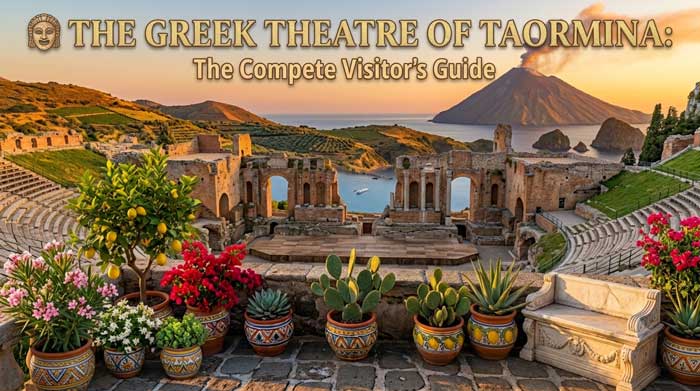
The Teatro Antico di Taormina the Greek theatre built on the clifftop ridge above the Ionian Sea in the 3rd century BC and substantially rebuilt by the Romans in the 2nd century AD is the most visited single monument in Sicily and one of the most extraordinary ancient performance spaces in the world. The combination of the Greek theatrical tradition (the cavea carved into the natural rock of the Taormina hillside, the acoustic design that allows an unamplified voice to reach the upper tiers), the Roman engineering ambition (the elaborate stage building, the scaenae frons, that transformed the Greek orchestra into a Roman performance stage) and the specific geographical coincidence that places the theatre on the only clifftop position in Sicily where both Etna (to the north, its summit at 3,357 metres on a clear day apparently at the same horizon level as the stage) and the Ionian Sea (to the east, extending to the Calabrian coast 50 kilometres away) are simultaneously visible from the cavea produces a monument of entirely specific visual quality. The view from the upper tiers of the Taormina theatre is the most cited reason to visit Sicily that has nothing to do with archaeology.
In this guide
- History Greek theatre to Roman arena
- The architecture
- The view Etna and the Ionian
- Taormina Arte performances in the theatre
- Visiting the theatre practical information
- Best time to visit
- What to see nearby
- Photography tips
- FAQ
History Greek Theatre to Roman Arena
The Taormina theatre was originally built by the Greek colonists of Tauromenion (the Greek name of the city) in the 3rd century BC a period of significant theatrical building across the Sicilian Greek colonies, contemporary with the expansion of the Syracusan theatrical tradition under the influence of the Athenian dramatic programme. The original Greek theatre was built in the standard Greek format: the cavea (the semicircular seating area) carved into the natural rock of the hillside, the orchestra (the circular performance area at the base of the cavea) and the skene (the backstage structure) providing the primary architectural elements.
The Romans, who controlled Tauromenion from the 2nd century BC, substantially rebuilt and expanded the theatre in the 2nd century AD transforming it from a Greek theatrical space into a Roman entertainment venue. The Roman programme: the stage building (the scaenae frons) was erected in the elaborate multi-storey Roman architectural vocabulary of columns, niches and decorative programme that the surviving fragments still display; the orchestra was lowered and modified to allow gladiatorial combat and venationes (wild animal hunts) the specific Roman entertainment forms that required a different spatial configuration than the Greek dramatic tradition. The theatre’s current appearance reflects primarily the Roman intervention, with the earlier Greek elements visible in the cavea’s rock-cut seating and the overall semicircular plan.
The theatre fell out of use with the decline of the Roman empire and was partially quarried for building material in the medieval period. The systematic archaeological excavation began in the 19th century, and the theatre has been used for modern performances since the early 20th century the Taormina Arte festival formalised the performance programme in 1983. Read our complete Taormina guide.
The Architecture
The theatre measures approximately 109 metres in diameter one of the largest ancient theatres in Sicily, exceeded in scale only by the theatre at Syracuse with the cavea capable of seating approximately 5,000 to 10,000 spectators in the ancient configuration. The seating tiers are divided by the two main horizontal walkways (the diazoma) into the lower, middle and upper zones; the upper tiers, where the cheapest ancient seats were located, now provide the most sought-after positions for the panoramic view rather than the performance.
The scaenae frons the Roman stage building survives in fragmentary but substantial form: the three surviving columns of the central section, the brick backing wall with its niches for statue decoration and the partial entablature give sufficient evidence for the reconstruction drawings that dominate the archaeological literature. The surviving fragments of the Roman mosaic flooring in the orchestra are the most precisely detailed ancient material remaining at ground level; the acoustic cavea surface has been reinforced and partly repaved for the modern performance use.
The specific architectural detail most consistently noted by visitors: the stage building’s central opening (the porta regia, the central doorway of the Roman scaenae frons) frames the Etna summit in a near-perfect compositional relationship the volcanic cone centred in the architectural aperture, the sea visible on either side. This is not a coincidence of modern viewing but the deliberate exploitation of the specific topography by the Roman architects who positioned the stage building to maximise the dramatic effect of the backdrop visible through the performance space.
The View Etna and the Ionian
The view from the upper tiers of the Taormina Greek Theatre is the most reproduced single image in Sicilian tourism photography and, in person, it consistently exceeds the expectations of visitors who have seen the photographs. The specific elements: the Etna summit at 3,357 metres visible to the northwest, the snow-capped cone (in winter) or the summit steam (year-round) providing the geological drama; the Ionian Sea extending to the east and south, the Calabrian coast 50 kilometres away visible on clear days and the Giardini Naxos bay immediately below; the theatre itself in the foreground with the Roman columns framing the view. The combination of human achievement (the 2,300-year-old theatre), geological scale (the active volcano) and marine beauty (the Ionian at its most expansive) in a single visual field is the specific quality that no other ancient site in Sicily or Italy provides.
The morning view (9 to 11am) is the finest for photography the light is from the east, illuminating the Ionian and the volcanic landscape with the specific warmth of the morning Mediterranean sun. The late afternoon view (4 to 6pm) is the finest for the atmospheric quality the Etna profile against the western sky at sunset, the theatre in the golden light, the Ionian fading to silver below. The midday view in summer (11am to 3pm) is the least favourable the vertical sun eliminates the shadow detail that gives the theatre its sculptural depth. Read our complete Sicily photography guide.
👉 GREEK THEATRE TAORMINA GUIDED TOUR THE HISTORY, THE ARCHITECTURE AND THE VIEW
A guided visit to the Greek Theatre of Taormina the architectural history from the Greek original to the Roman transformation, the scaenae frons programme, the acoustic design and the specific story of the theatre that has been performing for 2,300 years. Expert English-speaking guides available. The essential Taormina cultural experience.
👉SEE THE BEST GREEK THEATRE TAORMINA GUIDED TOUR HERE
Taormina Arte Performances in the Theatre
The Taormina Arte festival has been presenting performances in the Greek Theatre since 1983, making it one of the longest-running ancient theatre festival programmes in Italy. The programme runs from late June through August, with opera, theatre, dance, music concerts and film screenings programmed across the summer season. The specific quality of the Taormina Arte performance in the Greek Theatre: the experience of watching a live performance in a 2,300-year-old space with the Etna profile visible above the stage and the Ionian sea in the peripheral vision is specific to this theatre and unavailable at any other ancient performance venue in Sicily or Italy.
The opera programme at Taormina Arte typically including 2 to 4 major opera productions per season draws from the standard Italian repertoire (Verdi, Puccini) alongside occasional less frequently performed works. The summer concert programme (jazz, classical, contemporary) provides the most varied single-evening programme. The Taormina Film Festival, held in late June as part of the Taormina Arte programme, is the most prestigious film event in Sicily, with premieres and award ceremonies conducted in the theatre.
Tickets for Taormina Arte performances range from approximately €15 (upper tiers, restricted view) to €120 (premium orchestra stalls) for opera; concert tickets range from €25 to €80. Book 4 to 6 weeks in advance for the major July and August opera productions; the peak productions sell out by June. The theatre box office is in the Via del Teatro Greco, adjacent to the entrance.
Visiting the Theatre Practical Information
Address: Via del Teatro Greco, 98039 Taormina. On the eastern side of the historic centre, 5 minutes’ walk from the Corso Umberto along the Via del Teatro Greco.
Opening hours: Daily 9am to 7pm (summer, April to October), 9am to 5pm (winter). Last entry one hour before closing. The theatre closes on performance days during the Taormina Arte season from approximately 3pm onward to allow production setup; check the Taormina Arte website for performance dates when planning afternoon visits.
Entry fee: Approximately €10 for adults, reduced rates for EU citizens under 18 and over 65, free for under-6. Audio guide available at the entrance for approximately €5. The combined ticket with the Palazzo Corvaja museum provides a marginal saving.
Pre-booking: Pre-booking is strongly recommended for July and August when the daily visitor numbers can produce queues of 30 to 45 minutes at the entrance. Book online through the Sicilian Parks and Monuments system (the Parks.it platform) or through GetYourGuide. In the shoulder season (April to June, September to October), walk-in entry is generally available without significant waiting.
Accessibility: The theatre cavea is on a slope and involves significant steps between the seating tiers. The main viewing terrace (the first level above the orchestra) is accessible without steps from the entrance path; the upper tiers require stair climbing. Wheelchair access to the lower level is available; the upper tiers are not wheelchair accessible.
Best Time to Visit
The early morning (9 to 10am, immediately at opening) provides the finest visiting conditions the light is directional from the east, illuminating the theatre architecture and the Etna backdrop with the specific quality of morning Mediterranean light, and the visitor numbers in the first hour are a fraction of the midday peak. By 10.30am in July and August, the tour groups from the coastal hotels and the cruise ships at Catania begin arriving; the quality of the experience at the upper tiers (the panoramic viewpoint) declines proportionally with the crowd density.
The late afternoon visit (4.30 to 6.30pm) provides the second-best conditions the golden hour light, the reduced crowd after the afternoon tour group traffic and the specific atmospheric quality of the theatre in the late Mediterranean sun. On performance days during Taormina Arte, the late afternoon visit ends when the production setup begins (typically 3 to 4pm); on non-performance days the 4.30pm visit provides the finest light of the afternoon programme.
The visit in shoulder season (April to June, September to October) provides a fundamentally better experience than the July-August peak at any hour the visitor numbers are 30 to 50 percent of the summer maximum and the quality of the upper tier view without the crowd is notably better than the summer equivalent. Read our complete Sicily in September guide.
What to See Nearby
The Villa Comunale (the public gardens on the Corso Umberto) provide the second finest view in Taormina after the theatre cavea the terrace gardens designed by Lady Florence Trevelyan in the 1890s, with the Etna profile visible above the bougainvillea and the Ionian below. Free entry; open daily.
The Palazzo Corvaja (13th century, the finest medieval building in Taormina and the site of the first Sicilian Parliament under Roger II in 1097) is a 5-minute walk from the theatre entrance and provides the most historically significant single building programme in the town. The Corso Umberto itself the main baroque street of the historic centre connects the theatre entrance to the Piazza del Duomo and the Palazzo Corvaja in a 10-minute walk. Read our complete Taormina guide.
Photography Tips
The classic Taormina theatre photograph the Roman columns of the scaenae frons in the foreground, the Etna summit centred in the central arch and the Ionian Sea visible on either side is taken from the orchestra level or the lower cavea. The specific composition requires a wide angle (16 to 24mm equivalent) to include all three elements simultaneously. The morning light (9 to 10am from March to October) is directional and warm; the afternoon light (3 to 5pm) is warmer but flatter. The overcast day provides even light that eliminates the harsh shadows of the noon sun and produces the most detail in the stone textures.
The upper tier photograph the full Ionian panorama with the theatre below and Etna above requires a wider angle still (12 to 16mm equivalent) or a panoramic stitching programme. The best upper tier position is the central axis of the cavea at the diazoma level, which provides the most compositionally balanced view of the theatre bowl with the sea and volcano behind. Read our complete Sicily photography guide.
Frequently Asked Questions
Is the Greek Theatre Taormina worth visiting?
Yes, unambiguously the Greek Theatre of Taormina provides the combination of significant ancient architecture and one of the most extraordinary views in the Mediterranean in a single site. The experience of standing at the upper tiers with Etna above and the Ionian below is one of the most specifically memorable available in Sicily or Italy. The entry fee is among the best-value monument admissions in the island.
How long do you need at the Greek Theatre Taormina?
A minimum of 45 to 60 minutes for the complete theatre circuit (orchestra, lower cavea, upper tiers, the view) without a guide. A guided visit (90 minutes) provides the architectural and historical context that transforms the experience from a visual spectacle into a historically grounded encounter with the Greek and Roman theatrical tradition. Allow 2 hours total for the guided visit with time for the view at the upper tier.
Can you see performances at the Greek Theatre Taormina?
Yes the Taormina Arte festival presents opera, theatre, concerts and film screenings in the theatre from late June through August. Tickets from approximately €15 to €120 depending on the performance and the seating tier. Book 4 to 6 weeks in advance for the major summer productions. The experience of a live performance in this specific ancient space with Etna above and the Ionian below is the most specific single evening available in Sicily.
The Stage at the Edge of the World
The Greek Theatre of Taormina has been performing in one form or another, for one purpose or another for 2,300 years. The Greek dramatists who wrote for it, the Roman gladiators who fought in it, the 19th-century Grand Tour visitors who sketched it and the Taormina Arte audiences who watch Verdi performed in it with the same Etna and the same Ionian behind the same stage are connected by the specific geological coincidence that placed this theatre on this ridge above this sea. No architect chose the setting. The setting chose the theatre. Everything that has happened in it since the tragedies, the gladiatorial combat, the operas, the photographs has been a response to the specific quality of a place that had already decided what it was before the first stone was laid.
For the complete Taormina programme, read our Taormina guide, our where to stay in Taormina guide and our day trips from Taormina guide.
Did this guide help you plan your Greek Theatre visit? Save it to Pinterest or share it with someone who wants to stand where Aeschylus was performed and see Etna above the stage.