The name Marzamemi comes from the Arabic Marsà al-hamām harbour of the doves a reference to the migratory birds that used this sheltered southeastern coast as a resting point on their crossings between Africa and Europe. The Arabs arrived here around the year 1000 and built the first tuna fishery, recognising that the coastline’s configuration the way it funnelled the migrating bluefin tuna close to shore made it one of the most productive fishing grounds in the eastern Mediterranean.
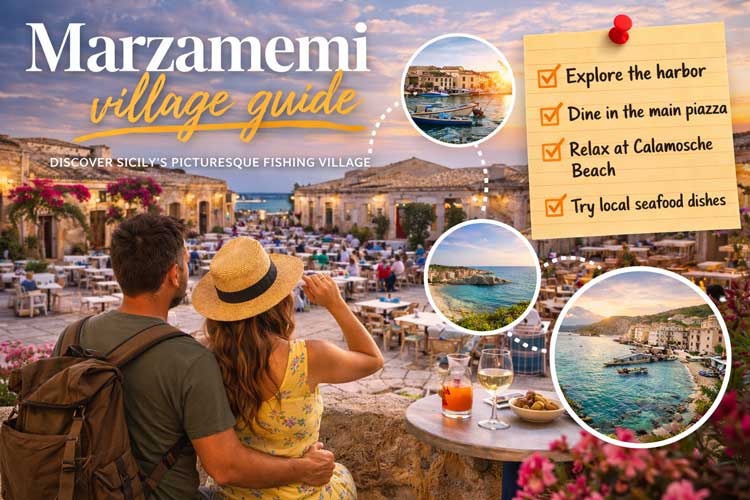
The village that grew around the tonnara over the following centuries is one of the most photogenic small places in Sicily: a central piazza of golden limestone fishermen’s houses arranged around the historic tonnara buildings and the aristocratic Palazzo di Villadorata, two churches facing each other across the square, coloured wooden boats in the twin harbours below, and the burgundy-red silhouette of the private Isolotto Brancati visible offshore. It is very small you can walk through the entire village in twenty minutes. The reason to come is not to cover distance but to stop, eat fresh tuna, sit in the piazza at sunset, and understand what a Sicilian coastal village feels like when it has not been overwhelmed by its own attractiveness.
In this guide
- Piazza Regina Margherita
- The Tonnara di Marzamemi
- Isolotto Brancati
- The beaches
- What to eat in Marzamemi
- The International Film Festival
- How to get there
- What to combine with Marzamemi
- Practical tips
- Frequently asked questions
Marzamemi quick facts
- Location: Province of Syracuse, southeastern Sicily, 15 minutes south of Vendicari, 25 minutes from Noto
- Best for: Piazza Regina Margherita at sunset, fresh tuna, the tonnara, the Film Festival (July), Vendicari day trip
- From Noto: 25 minutes by car (22 km south via SP19)
- From Syracuse: approximately 1 hour by car
- From Ragusa: approximately 45 minutes by car
- How long to visit: Half a day is comfortable; a full day with a beach afternoon and evening in the piazza is ideal
- Best months: May, June, September, October avoid August weekends for the piazza
Piazza Regina Margherita
The central piazza is the village everything else radiates from it. Piazza Regina Margherita is a compact, intimate square of golden limestone built in the 18th century as the social and economic centre of the tonnara operation: fishermen gathered here after returning from the sea, merchants negotiated the sale of tuna, and the warehouses surrounding the piazza stored equipment and processed fish. Unlike the grand baroque piazzas of nearby Noto or Modica, this square is small and human in scale, the buildings low and functional, the architecture of labour rather than ceremony.
Today the piazza functions as the social centre of the village’s summer season. The low stone houses that once sheltered fishermen now house small restaurants, boutiques and bars with outdoor tables that spill into the square. The Palazzo di Villadorata anchors one side, the deconsecrated Church of the Tonnara and the active Church of San Francesco di Paola face each other across the space, and the whole ensemble catches the late afternoon light in a way that explains the tens of thousands of photographs taken here every summer.
The finest moment in the piazza is the hour before sunset, when the golden limestone walls turn amber and the tables fill gradually with the mixture of local families and visitors that constitutes the Marzamemi summer evening. Order a Sicilian aperitivo, find a table on the piazza edge and let the hour pass slowly. This is exactly what Marzamemi is for.
The Tonnara di Marzamemi
The tonnara the tuna fishery is the reason Marzamemi exists. The first fishery was established here by Arab settlers around the year 1000, who recognised the specific coastal geography that concentrated the migrating bluefin tuna close to shore. For the following nine centuries, the tonnara defined the village’s economy, its social structure and its physical form.
The substantial buildings visible today date from 1752, when the noble Nicolaci family Princes of Villadorata, whose baroque palace in Noto is one of the most celebrated in Sicily commissioned a major reconstruction and expansion of the tonnara complex, adding the Palazzo del Principe, the warehouses, the processing facilities and the fishermen’s houses around the central piazza. At its height, the tonnara employed dozens of fishermen organised in a hierarchical structure led by the rais the head fisherman, a position of considerable social prestige and a supporting cast of net workers, processors and shore workers.
The tonnara closed definitively in 1969, when declining Mediterranean bluefin tuna populations made the traditional mattanza economically unviable. The buildings were subsequently converted to other uses: the central loggia, a covered space of approximately 750 square metres originally used as a shelter for the tonnara’s large boats, now hosts concerts, exhibitions and private events. The exterior and the courtyard are accessible; the interior is used for events and is not open for independent visits. Walking along the base of the tonnara buildings from the piazza to the harbour, reading the stone and imagining the scale of the operation, is one of the most specific historical experiences in the southeastern corner of Sicily.
Isolotto Brancati
Visible from the La Fossa harbour on the southern side of the village, the Isolotto Brancati is a small private islet immediately offshore, its most distinctive feature being the deep burgundy-red villa that occupies most of its surface. The building was originally constructed by a nobleman from Noto; the island subsequently passed to the family of the Sicilian writer Vitaliano Brancati, whose novels of Sicilian provincial life in the fascist period (Don Giovanni in Sicilia, Il bell’Antonio) are among the most celebrated works of 20th-century Italian literature. The island is private and inaccessible, but its silhouette the dark red building against the turquoise sea, the Sicilian sky above is one of the most reproduced images in the southeastern Sicily photography canon.
The larger Isola Grande, connected to the mainland by a small land bridge, can be walked to from the village and provides a different perspective on the harbour and the coast. The swimming around both islands is excellent.
The beaches
Spiaggia della Spinazza, 12 minutes’ walk north of the piazza, is the most accessible beach from the village centre. A mix of sand and fine gravel, with both free sections and a small beach club, it is the standard choice for a morning swim before lunch in the village. The water is clear and the beach is reliably uncrowded on weekday mornings.
Spiaggia Cavettone, 1.5 kilometres from the village, is a finer beach with golden sand enclosed by low rocky walls. Better for snorkelling than Spinazza and quieter for most of the season. A 20-minute walk or 5-minute drive from the piazza.
San Lorenzo beach, at the southern edge of the Vendicari Nature Reserve immediately north of Marzamemi, is the most beautiful beach in the immediate area and accessible from the reserve’s southern entrance. Fine sand, exceptional water quality and the proximity to the Cittadella Maccari Byzantine ruins give it a character that the village beaches cannot match. See our complete Vendicari Nature Reserve guide for details.
What to eat in Marzamemi
The Marzamemi food culture is entirely organised around the sea, and specifically around the tuna that the tonnara produced for nine centuries. The Mediterranean bluefin tuna remains the central ingredient of the local kitchen, even now that the traditional mattanza has ended and the tuna is sourced from regulated catches rather than the village’s own fishery.
Tuna in all its forms fresh grilled tuna steak, pasta with tuna ragù, tuna bottarga (salted and dried roe, grated over pasta with olive oil and black pepper), smoked tuna and marinated anchovies. The Campisi company, whose processing facility is located a few kilometres from the village, operates a shop on the road between the centre and Isola Grande selling the full range of preserved and canned products. It is the finest souvenir shop in Marzamemi and the tuna with pepperoncino in olive oil is a non-negotiable purchase.
Pomodori di Pachino the small sweet cherry tomatoes from nearby Pachino, protected by IGP status and among the finest cherry tomatoes in Italy, appear in everything: raw with olive oil and oregano as an antipasto, in pasta, with fish. Their specific sweetness and the thin skin that bursts under pressure are qualities that large commercial tomatoes cannot replicate.
Fish arancini the Marzamemi version of the Sicilian arancina uses tuna or mixed fish as the filling rather than the mainland meat ragù, a coastal adaptation specific to the southeastern coast.
The restaurants in and around Piazza Regina Margherita range from tourist-facing (higher prices, acceptable food, great location) to genuinely excellent seafood kitchens. La Cialoma, with its distinctive blue and white wooden tables, is the most historically established restaurant in the piazza and maintains a good standard. The restaurants along the harbour south of the piazza, with views of the Isolotto Brancati, are generally more focused on local clientele and worth seeking out.
The International Film Festival
Each July, Piazza Regina Margherita hosts the Festival Internazionale Cinema di Frontiera the International Frontier Film Festival, one of the more unusual and genuinely atmospheric film events in Sicily. Films are screened outdoors in the piazza, projected against the walls of the historic buildings, with the audience seated on the square and the warm Sicilian night above. The festival focuses specifically on films from border regions and minority cultures cinema from places and peoples on the margins of dominant cultural narratives which gives it a distinctive editorial character quite different from standard regional film festivals.
The combination of the piazza setting, the artistic programme and the Marzamemi summer atmosphere makes the Film Festival one of the best reasons to time a southeastern Sicily visit to July. Check the official festival website for the current programme and dates.
👉 VAL DI NOTO AND SOUTHEASTERN SICILY DAY TOUR FROM CATANIA OR SYRACUSE
A guided day tour of the southeastern Sicilian coast Noto, Marzamemi, Vendicari and the baroque villages of the Val di Noto. The finest natural and cultural experiences of this corner of Sicily in a single day, with transport included from Catania or Syracuse.
👉SEE THE BEST VAL DI NOTO AND SOUTHEASTERN SICILY DAY TOUR HERE
How to get there
A car is the practical choice. Marzamemi is in the rural southeastern tip of Sicily, 22 kilometres south of Noto via the SP19 road (approximately 25 minutes). From Syracuse, approximately 1 hour via the SS115. From Ragusa, approximately 45 minutes via the SP25 and SS115. Parking is available in a large car park at the entrance to the village (free or paid depending on the season); the village centre itself is pedestrian.
Public transport to Marzamemi is limited. Some bus services connect the village to Noto and Pachino, but services are infrequent and not recommended for day-trip timing. From Syracuse, organised day tours that include Marzamemi as part of a southeastern Sicily circuit are available.
👉 RENT A CAR
Marzamemi is most enjoyable as part of a southeastern Sicily road trip combining Noto, Vendicari and Ragusa Ibla. Compare rental prices at Catania and Palermo airports on DiscoverCars and book in advance.
👉 COMPARE THE BEST RENTAL CARS HERE
What to combine with Marzamemi
Marzamemi is 15 minutes from the southern entrance of the Vendicari Nature Reserve the two destinations are natural partners for a single day: morning at the reserve’s beaches and birdwatching lagoons, lunch in Marzamemi, afternoon in the piazza. This is the finest single-day combination in the southeastern corner of Sicily.
Noto, 25 minutes north, provides the baroque cultural complement to Marzamemi’s coastal character. An afternoon in Noto’s Corso Vittorio Emanuele followed by an evening dinner in Marzamemi is one of the finest one-two days in the Val di Noto.
The village of Porto Palo di Capo Passero, 10 kilometres south of Marzamemi, sits at the southernmost tip of Sicily the narrowest crossing point between Europe and Africa, where on a clear day the African coast is theoretically visible on the horizon. A short detour for those who want to stand at the geographic end of Italy.
For the full southeastern Sicily circuit, read our guides to Noto, Ragusa, Modica and Ortigia.
Practical tips
Marzamemi is tiny all the sights are within a 10-minute walk of each other. Arrive by 10am on summer days to find parking and to walk the village before the main wave of visitors arrives. The piazza is at its best in the late afternoon and evening; if your primary reason for visiting is the aperitivo atmosphere of the square at sunset, timing your arrival for 4pm gives you time to walk the village and the harbours before the evening fills the tables.
August weekends bring considerable crowds to the piazza. The village is genuinely beautiful under these conditions but the experience is different louder, more commercial, less intimate than the same piazza on a weekday morning in September. September is the finest month for Marzamemi: the village at its most atmospheric, the water still warm, the flamingos beginning to arrive at Vendicari just 15 minutes away.
Frequently asked questions about Marzamemi
Is Marzamemi worth visiting?
Yes, strongly especially if combined with the Vendicari Nature Reserve and Noto. Marzamemi alone can be covered in half a day; its value increases significantly when positioned as the coastal anchor of a southeastern Sicily circuit that also includes the baroque towns and the nature reserve. The piazza at sunset with fresh tuna and a Sicilian white wine is one of the finest uncomplicated pleasures that this corner of Sicily offers.
What is Marzamemi known for?
Marzamemi is known for three things: its historic tonnara (tuna fishery), which functioned from the Arab period until 1969 and physically defines the village’s architecture; Piazza Regina Margherita, one of the most photographed small piazzas in Sicily; and its fresh tuna and preserved tuna products, which remain the centre of the local food culture despite the end of the traditional mattanza.
What does Marzamemi mean?
Marzamemi derives from the Arabic Marsà al-hamām harbour of the doves (or turtledoves). The name was given by the Arab settlers who arrived here around the year 1000, and refers to the migratory birds that used this sheltered coastal bay as a resting point on their crossings between Africa and Europe. The Arab presence and the natural geography of the bay for intercepting migrating tuna are both referenced in the name this is a place defined by migration, both avian and marine.
How far is Marzamemi from Noto?
Approximately 22 kilometres south of Noto via the SP19 road approximately 25 minutes by car. The two are the natural pairing for a southeastern Sicily day: Noto for the baroque, Marzamemi for the sea.
The harbour of the doves
Marzamemi works because it has not tried to be more than it is. The piazza is small. The restaurants serve what the sea provides. The history is in the buildings rather than in a museum. The film festival brings unusual cinema to an unusual setting for a few weeks in July and then the village returns to its own rhythm. It is a place defined by the tuna that no longer comes and the birds that still do, by the Arabic name and the 18th-century stone and the Isolotto Brancati red against the Sicilian sea. For a few hours on an afternoon in September, there are worse places to be.
Did this guide help you plan your Marzamemi visit? Save it to Pinterest or share it with someone planning a southeastern Sicily trip.