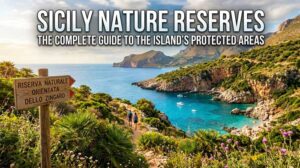
The Vendicari Nature Reserve occupies 1,512 hectares of the southeastern Sicilian coast between Noto and Marzamemi. It is everything that has been squeezed out of the rest of the Sicilian coastline by tourism development: unspoiled beaches of fine sand, three brackish lagoons that function as one of the most important migratory bird staging points in the central Mediterranean, salt marshes, sand dunes, Mediterranean scrubland and a shoreline of alternating sandy and rocky stretches that has never had a sun umbrella planted in it. It is protected under the Ramsar Convention on Wetlands as a site of international ecological significance.
More than 200 species of birds visit the reserve each year. Pink flamingos arrive in late summer and early autumn. Grey herons, black-winged stilts, spoonbills, avocets and marsh harriers are visible year-round. The beaches are some of the finest in Sicily. The 15th-century Aragonese tower, the ruined 18th-century tuna fishery, the Byzantine necropolis and the Greek ruins in the northern sector add layers of human history to what would already be a remarkable natural landscape. And it is 13 kilometres from Noto, one of the greatest baroque towns in Europe, making the combination of a morning at the reserve and an afternoon in the town one of the finest single days available in southeastern Sicily.
In this guide
- The beaches
- Birdwatching and the flamingos
- The Tonnara di Vendicari
- Torre Sveva
- Byzantine ruins and the necropolis
- The hiking trails
- How to get to Vendicari
- Practical information
- Frequently asked questions
Vendicari Nature Reserve quick facts
- Location: Province of Syracuse, southeastern Sicily, between Noto and Marzamemi
- Protected status: Regional Nature Reserve; Ramsar Convention wetland site
- Size: 1,512 hectares
- Entry fee (2025): €3.50 per person; €7 family pass; €5 parking per vehicle
- Opening hours: Daily from sunrise to sunset (year-round)
- Entrances: Four Eloro (north), Calamosche, Torre Sveva/Vendicari (central), San Lorenzo (south)
- From Noto: 13 km south via the SP19 road (approximately 20 minutes)
- From Syracuse/Ortigia: approximately 50 minutes by car
- From Ragusa: approximately 1 hour by car
- Best for flamingos: September to November and March to April
The beaches
The beaches of the Vendicari reserve are among the finest in southeastern Sicily and among the most consistently praised in the entire island for water quality. They have been awarded four blue sails by Legambiente (the highest environmental quality rating in the Italian system) repeatedly. No beach clubs operate within the reserve there are no sun loungers, no umbrellas for hire, no beach bar services inside the reserve boundaries. Bring everything you need for the day.
Calamosche
The most celebrated beach in the reserve and one of the most celebrated beaches in Sicily. Calamosche is a sheltered sandy cove framed by low dunes and Mediterranean scrubland, with exceptionally clear shallow water of the pale turquoise shade that the Sicilian southeast coast produces at its best. It is reached from the Calamosche entrance car park via a 30-minute walk through pine forest on a wooden boardwalk, which means it requires effort to access and retains some natural calm even in peak season. The walk through the pine forest in the early morning, with the light filtering through the canopy, is one of the finer short walks in the reserve. Calamosche has been repeatedly cited in national and international rankings of Italy’s finest beaches. This is entirely deserved.
Marianelli
Located between the Eloro and Calamosche beaches in the northern section of the reserve, Marianelli is wilder and less visited than Calamosche. The beach sits between almond trees, lemon groves and sand dunes enriched by the endemic coastal flora the approach through agricultural Sicilian landscape gives it a character entirely different from the pine forest path to Calamosche. The water is shallow and clear. No facilities of any kind.
Eloro
The northernmost beach in the reserve, near the ancient Greek ruins of Eloro, is the most accessible from the Noto direction and the most easily reached without a long walk. The water quality matches the reserve’s standard throughout. The proximity to the Greek ruins adds a specific historical dimension to swimming at this beach that the other reserve beaches do not provide.
San Lorenzo
The southernmost beach in the reserve, near the Cittadella Maccari Byzantine ruins, has the finest sand of any beach in the reserve and is the most family-friendly the approach is easier than Calamosche and some minimal tourist facilities (a small bar and farmhouse restaurant) exist near the car park, outside the reserve boundary. The crystal-clear water and fine sand make it one of the most genuinely beautiful beaches in southeastern Sicily.
Birdwatching and the flamingos
Vendicari is one of the most important birdwatching destinations in the central Mediterranean. Its three salt lagoons (Pantano Piccolo, Pantano Grande and Pantano Roveto) function as critical staging points for migratory birds crossing between Africa and northern Europe the reserve sits directly on the principal migratory flyway and provides food, fresh water and shelter at the narrowest crossing point of the central Mediterranean.
More than 200 species have been recorded in the reserve. The seasonal pattern is:
Winter (December to February): Royal swans, wild geese, mallards and various duck species use the lagoons. The reserve is quieter in terms of visitor numbers but consistently active for birdwatching.
Spring (March to May): The arrival of northbound migrants from Africa hoopoes, rollers, bee-eaters, black-winged stilts, avocets, various warblers and the early returning flamingos. Spring is the finest season for the botanical interest of the reserve as well, with the endemic coastal flora in flower.
Summer (June to August): Grey herons, little egrets, terns and large colonies of gulls. The nesting season for resident species. The reserve is at its most visited by beach tourists during this period; the birding is productive but less dramatic than in spring and autumn.
Autumn (September to November): The finest season for flamingos. Pink flamingos are rare in the wild in Europe they breed in the Camargue (France), the Doñana (Spain) and Sardinia, and Vendicari is one of the very few places on the Italian coast where they can be observed reliably in their natural habitat. The flamingo presence at Vendicari typically begins in late August and reaches its peak in October and November, when the lagoons hold significant flocks. Seeing flamingos in the wild in Sicily, against the backdrop of the 15th-century tower and the ruined tonnara, is one of the most specific wildlife experiences the island offers.
Wooden birdwatching hides are positioned at intervals around the lagoons and are open to all visitors. Binoculars are strongly recommended; a telephoto lens for photography is worthwhile in autumn. The reserve attracts professional ornithologists from across Europe as well as amateur birdwatchers, and the observation cabins are reliably occupied during peak migration periods.
The Tonnara di Vendicari
The ruined tuna fishery at the heart of the reserve is one of the finest examples of maritime industrial archaeology in Sicily and one of the most atmospheric structures in the entire southeastern coast. The Tonnara di Vendicari was established in the 18th century, though fishing in this location is documented from medieval times the coastal configuration, with the lagoons creating the right water conditions for intercepting migrating tuna schools, made Vendicari one of the most productive tuna grounds on the southeastern coast.
The tonnara was what Sicilian fishing culture called a “return tonnara” it intercepted Atlantic bluefin tuna returning westward from their Mediterranean spawning grounds, unlike the “departure tonnare” on the Tyrrhenian coast that caught the fish heading east. This distinction influenced the season (late summer and autumn) and the net-positioning technique specific to this fishery. At its height, the tonnara employed more than 40 fishermen, led by two rais (head fishermen) and a team of land-based workers who processed the catch using traditional salting methods. The tuna was exported to Malta and Tunisia.
The tonnara closed permanently in 1943 during the Second World War, a combination of wartime disruption and the beginning of the long decline in Mediterranean bluefin tuna populations that eventually made the traditional mattanza economically unviable across all of Sicily. The buildings the processing rooms, the net storage warehouses, the fishermen’s houses stand in various states of ruin within the reserve, the stone and plaster bleached by decades of Sicilian sun and sea wind. They are not restored and are not presented as a museum; they are simply there, available to walk through, their history documented by panels along the adjacent trail.
Torre Sveva
Standing above the tonnara ruins on the coastal promontory, the Torre Sveva is a 15th-century defensive tower built by the Aragonese (the Spanish rulers of Sicily at that period the name reflects the earlier Swabian presence on the site) as protection against Saracen and Barbary pirate raids. The tower was an active military installation until 1867, when the newly unified Italian state decommissioned it along with dozens of similar towers along the Sicilian coast. It was most recently restored in 2007.
The tower provides the finest viewpoint in the central section of the reserve the lagoons to the north and south, the tonnara ruins below, the beach extending in both directions and the island of Vendicari (a small offshore islet, now a nesting site for migratory birds and inaccessible to visitors) visible offshore. The view from the tower base at sunset, with the lagoon catching the last light and the silhouettes of the flamingos wading in the shallows, is one of the finest in the reserve.
Byzantine ruins and the necropolis
The southern section of the reserve, reached from the Cittadella Maccari entrance, contains the remains of a Byzantine settlement of the 6th century AD a small village of stone buildings, an early Christian church and a necropolis of Byzantine catacombs carved into the coastal rock. The settlement was part of the Byzantine administrative reorganisation of Sicily after the collapse of Roman authority, and represents the period between Roman and Arab rule that is one of the least well-documented phases of Sicilian history.
The Byzantine ruins are accessible on foot from the Cittadella Maccari entrance and are not formally excavated or presented they sit within the natural landscape of the reserve, the stone walls emerging from the Mediterranean scrubland in a way that gives them an atmosphere of gradual discovery rather than organised heritage display. Greek ruins in the northern part of the reserve, near the Eloro entrance, date to an even earlier period of settlement on this coast.
The hiking trails
The reserve has three marked trail sections running north to south along the coastline, colour-coded by difficulty and distance:
Blue Trail (northern section, 3 km) connects the Eloro entrance to the Calamosche area. The shortest and easiest section, relatively flat with good views of the northern lagoon. Suitable for all fitness levels including families with children.
Orange Trail (central section, 4.5 km) the most popular section, connecting the Calamosche entrance to the Torre Sveva/Vendicari area. Passes the tonnara ruins, the Torre Sveva viewpoint, the main birdwatching hides on Pantano Grande and the central beach. The finest single section of the reserve for combining history, wildlife and beach access. Allow 2 to 3 hours with stops.
Green Trail (southern section, 5 km) the longest and most demanding section, connecting the Torre Sveva area to the Cittadella Maccari entrance in the south, passing San Lorenzo beach and the Byzantine ruins. The terrain is more varied here, with some rocky sections and more dramatic coastal cliff views.
A full north-to-south traverse of the reserve covers approximately 12 to 13 kilometres one-way and requires arranging transport at the far end, as the four entrances are not connected by road within the reserve. Most visitors walk an out-and-back section of 3 to 5 kilometres from one entrance. The Orange Trail from the central entrance is the recommended single-section visit for those with half a day.
How to get to Vendicari
A car is strongly recommended. The reserve is in the rural southeastern interior of Sicily, between Noto and Marzamemi, and is poorly served by public transport. From Noto, drive south on the SP19 road toward Pachino and follow the signs to the appropriate entrance (13 kilometres, approximately 20 minutes). From Syracuse/Ortigia, approximately 50 minutes via the SS115 south. From Ragusa, approximately 1 hour via the SP47 and SP19.
There are four separate entrances with their own car parks, each charging approximately €5 per vehicle. The entrances are not connected to each other by road within the reserve, so choose your entrance based on which section you plan to visit. The Calamosche entrance for Calamosche beach and the Orange Trail; the Torre Sveva entrance for the central section, tonnara and birdwatching hides; the San Lorenzo entrance for the southern beach and Byzantine ruins; the Eloro entrance for the northern beaches and Greek ruins.
👉 RENT A CAR
Vendicari is most easily reached by car and pairs perfectly with Noto, Ragusa Ibla and Ortigia on a southeastern Sicily road trip. Compare rental prices at Catania and Palermo airports and book in advance.
👉 COMPARE THE BEST RENTAL CARS HERE
Practical information
Tickets and opening hours
Entry costs €3.50 per person (2025) or €7 for a family pass. Parking costs an additional €5 per vehicle at each entrance car park. The reserve is open daily from sunrise to sunset year-round. There are no facilities inside the reserve (no bars, no restaurants, no rubbish bins). The only services are near the car parks at the entrances, outside the reserve boundary.
What to bring
Water a minimum of 1.5 litres per person; 2 to 3 litres in summer. Sun protection: sunscreen, hat and lightweight layers the trails have minimal shade in the central and southern sections. Hiking shoes or trail runners (flip flops are not recommended on the uneven terrain). Water shoes for the rocky beach entries. Snacks and lunch nothing is available inside the reserve. Binoculars for the birdwatching hides. A dry bag for electronics at the beach. Leave no rubbish the reserve has no bins.
When to visit
For beaches: May to October, with June and September as the finest months. For flamingos: September to November and March to April. For the botanical interest of the Mediterranean scrubland: March to May, when the endemic coastal flora is in flower. The reserve is accessible and interesting year-round; winter offers the quietest conditions and the most reliably productive birdwatching. Read our complete best time to visit Sicily guide.
Combining Vendicari with the Val di Noto
The reserve is 13 kilometres from Noto and naturally combines with a morning visit to the baroque town or an afternoon there after a day at the beach. The circuit of Noto, Vendicari and Modica or Ragusa Ibla covers the finest natural and cultural destinations of the southeastern corner of Sicily in two to three days. The village of Marzamemi, 15 minutes south of the reserve, is one of the most beautiful fishing villages in Sicily with an excellent tuna-based restaurant tradition. Read our complete Sicily road trip guide for how to build this southeastern circuit.
👉 VAL DI NOTO AND VENDICARI GUIDED DAY TOUR FROM SYRACUSE
A guided day tour combining the baroque towns of the Val di Noto with the Vendicari Nature Reserve beaches and birdwatching lagoons the finest natural and cultural experience in southeastern Sicily in a single day, with transport from Syracuse or Catania.
👉SEE THE BEST VAL DI NOTO AND VENDICARI GUIDED DAY TOUR HERE
👉 NOTO BAROQUE TOWN AND VENDICARI BEACH DAY TRIP
A guided day trip combining the UNESCO baroque streets of Noto with a beach afternoon at Vendicari’s Calamosche Sicily’s most beautiful baroque town and its most beautiful nature reserve beach in a single day. Available from Catania and Syracuse.
👉SEE THE BEST NOTO BAROQUE TOWN AND VENDICARI BEACH DAY TRIP HERE
Frequently asked questions about Vendicari
Is Vendicari Nature Reserve worth visiting?
Yes, strongly. Vendicari offers a combination unavailable elsewhere in southeastern Sicily: the finest unspoiled beaches in the region, reliable flamingo sightings in autumn, an 18th-century tuna fishery ruin, a 15th-century Aragonese tower, Byzantine catacombs and over 200 species of migratory birds. For those visiting the Val di Noto baroque towns, adding a half-day at Vendicari is one of the most straightforward improvements to any southeastern Sicily itinerary.
Can you see flamingos at Vendicari?
Yes, reliably in the right season. Pink flamingos arrive at Vendicari from late August and are typically present in significant numbers through October and November. Spring (March to April) also brings flamingo sightings. Vendicari is one of the very few locations in Italy where flamingos can be observed in the wild in a natural habitat, making it a specific destination for wildlife-oriented visitors.
What is the best beach in Vendicari?
Calamosche is the finest and most celebrated fine sand, turquoise shallow water, framed by dunes and Mediterranean scrubland, reached by a 30-minute walk through pine forest. San Lorenzo is the most accessible and family-friendly. Marianelli is the most secluded. All three are among the finest beaches in southeastern Sicily.
How do you get to Vendicari?
By car from Noto (13 km south via the SP19, approximately 20 minutes). Public transport to the reserve is impractical multiple connections are required and services are infrequent. A rental car or taxi from Noto are the realistic options without a car. Guided day tours from Syracuse and Catania that include transport are available via GetYourGuide.
What is the Tonnara di Vendicari?
An 18th-century tuna fishery that operated from a coastal site within the reserve until its permanent closure in 1943. At its peak it employed more than 40 fishermen and exported preserved tuna to Malta and Tunisia. The ruins of the processing buildings, net warehouses and fishermen’s houses are accessible within the reserve and are among the finest examples of maritime industrial archaeology in southeastern Sicily.
The southeastern corner of Sicily at its wildest
Vendicari is the reserve that completes the Val di Noto circuit. Noto gives you the finest baroque street in Sicily; Ragusa Ibla gives you the most cinematic hilltop skyline; Ortigia gives you the island city and the Ionian seafood. And Vendicari gives you the flamingos at dusk on the lagoon, the Byzantine catacombs carved into the coastal rock, the tuna fishery abandoned by the sea and the long walk through the pine forest to the best beach in the southeast. These four together form one of the most specific and most rewarding regional itineraries in the island.
For help planning the rest of the southeastern Sicily circuit, read our guides to Noto, Ragusa, Modica and Ortigia, and our complete Sicily road trip guide.
Did this guide help you plan your Vendicari visit? Save it to Pinterest or share it with someone planning a trip to southeastern Sicily.