

Sicily’s famous destinations are famous for reasons that justify the crowds: the Cappella Palatina, the Greek theatre at Taormina, the Valley of the Temples, Etna at dawn. But the Sicily that most visitors carry home in their memories is often found somewhere else in a village they stopped at on the way to somewhere else, where the bar was the only bar and the owner knew every person who came through the door. These ten villages are the places where that other Sicily is most consistently present: slower, quieter, less managed for tourists and more genuinely itself.
Some are in the lists of the Most Beautiful Villages in Italy (Borghi più Belli d’Italia). Some are obscure even to Sicilians from the other side of the island.
1. Gangi

Gangi sits on Monte Marone at 1,011 metres, near the heart of the Madonie Regional Park, in the territory that the medieval geographer Al-Idrisi who mapped Sicily for King Roger II in 1154 described as one of the most fertile and well-populated parts of the island. The town’s origins are ancient: the site is identified by many historians with the Greek settlement of Engyon, known for its cult of the Mothers, the maternal deities worshipped across the Greek colonisation of Sicily.
What you find today is a medieval and baroque hill town of exceptional spatial quality narrow lanes that spiral upward toward the Church of San Nicolò, whose 15th-century campanile (the tallest medieval tower in Sicily) provides a panoramic view over the Madonie mountains and, on clear days, as far as Etna. The Ventimiglia Palace, the Church of Sant’Andrea and the Palazzo Bongiorno are the principal architectural monuments; the overall quality of the historic centre as a coherent ensemble is what earned Gangi the Borgo dei Borghi title in 2014 and recognition in the Borghi più Belli d’Italia list.
Gangi is reached by car from Palermo in approximately 1 hour 30 minutes via the A19 and the SP54. It combines naturally with Petralia Soprana, Castelbuono and the Madonie mountain circuit.
2. Erice
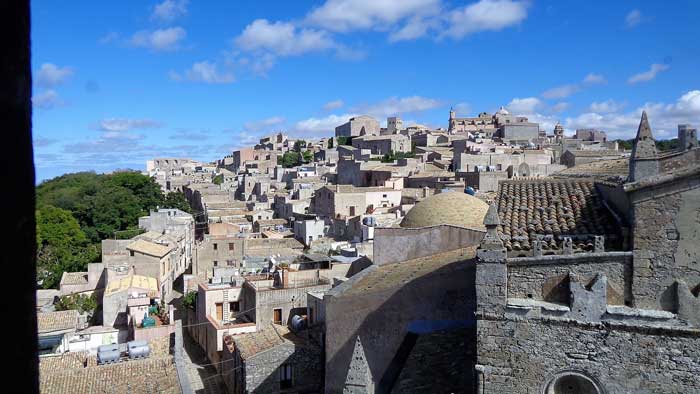
Erice is the most consistently atmospheric village in western Sicily and one of the most historically layered in the entire island. It sits at 750 metres on the summit of Monte Erice above Trapani, and the experience of arriving in the village is significantly determined by the weather: on clear days the view extends across the Tyrrhenian coast, the salt pans below the town, the Egadi Islands and on exceptional days to Cape Bon in Tunisia. When the clouds come in, which they do frequently and without warning, the village becomes entirely enclosed in mist and acquires a quality of isolation that its medieval streets seem designed to produce.
The site was sacred long before the Greeks arrived. The Elymian people maintained the Temple of Venus Erycina here a sanctuary whose goddess was considered an aspect of Astarte, Aphrodite and the general Mediterranean tradition of the sacred feminine and the temple was known across the ancient world. The Romans maintained it as the Venus Erycina, and the wealth of offerings accumulated over centuries made the sanctuary one of the richest in the western Mediterranean. The Norman Castello di Venere, built on the ruins of the ancient temple in the 12th century, is the most visible monument on the summit.
The pastry shop of Maria Grammatico on the Corso Vittorio Emanuele is the finest example anywhere in Sicily of the convent pastry tradition Grammatico learned her craft as a novice in the convent of San Carlo and has maintained the production of the almond paste confections, the genovesi ericine and the frutta di martorana that were the speciality of the enclosed nuns of western Sicily. A visit to her shop is as historically specific a food experience as Sicily offers. Read our complete Erice guide.
3. Savoca

Savoca is in the Ionian hills above Taormina, 30 minutes by car from the coast, and has been known to international visitors since 1971 when Francis Ford Coppola chose it as one of the locations for The Godfather. The Bar Vitelli on the main street was the bar where Michael Corleone asked for Apollonia’s hand in marriage; the medieval streets and stone arches above the bar were the alleys through which Michael and Apollonia walked in the courtship scenes. The village’s medieval character preserved largely because the town was too remote and too depopulated to attract development pressure through the 20th century made it the most credible available location for Coppola’s vision of the Sicilian interior.
Beyond the film connection, Savoca has its own specific historical attraction: the Capuchin Convent above the village, where the bodies of noble citizens from the 17th to 19th centuries were preserved by the naturally desiccating conditions of the convent crypt and are now displayed in various states of mummification in their original clothing. The Catacombe dei Cappuccini of Palermo are more famous, but the Savoca version is more intimate and more accessible. The climb to the Pentefur Castle above the convent provides the finest view over the Ionian coast between Messina and Taormina.
4. Sambuca di Sicilia

Sambuca di Sicilia was founded by an Arab emir around 830 AD and named Zabut a name that survives in the local dialect’s Zabuth for the oldest quarter of the town, where the Arab-derived street layout (narrow, irregular lanes converging at small squares) survives intact beneath the later baroque facades. The combination of Arab spatial structure and Sicilian baroque architectural decoration is specific to a handful of Sicilian towns, and Sambuca is the clearest surviving example outside of Palermo itself.
Sambuca gained international attention in 2016 when it won the television competition Borgo dei Borghi (Italy’s Most Beautiful Village), and then again several years later when its €1 house initiative selling abandoned historic properties at symbolic prices to buyers who committed to restoring them attracted international media coverage and a wave of international buyers. The initiative has brought a certain self-consciousness to the village’s presentation, but the underlying quality of the place the wine culture (Sambuca is in the Sambuca di Sicilia DOC zone), the views over Lake Arancio, the Saracen Quarter pre-dates and outlasts the publicity cycle.
5. Marzamemi

Marzamemi is technically a fraction of the municipality of Pachino rather than an independent village, which is why it appears on very few tourist maps and why many visitors to the Val di Noto baroque circuit miss it entirely. This is a significant oversight: Piazza Regina Margherita in Marzamemi is among the most beautiful small piazzas on the Sicilian coast, and the combination of the former tonnara (tuna fishery), the fishermen’s houses around the central square and the two natural harbours below gives the village a specific character of living maritime history that more polished coastal destinations cannot replicate.
The tonnara functioned from the Arab period until 1969, when declining bluefin tuna populations ended the traditional mattanza (the ritual tuna hunt) that had been the economic foundation of the village for a thousand years. The buildings are still present; the courtyard hosts the Festival Internazionale del Cinema di Frontiera each July; the Campisi shop nearby sells the preserved and canned tuna products that continue the processing tradition in industrial form. Read our complete Marzamemi guide for full details.
6. Castiglione di Sicilia

Castiglione di Sicilia perches on a ridge above the Alcantara Valley on the northern slope of Etna, at an altitude where the volcanic basalt stone of the buildings turns the village a specific dark grey-black that is unlike the honey limestone of the Val di Noto towns or the golden tufa of the Palermo region. The origins are Byzantine the village was a Byzantine administrative centre before the Norman conquest and several Byzantine-era churches, most notably the Santi Pietro e Paolo in the valley below, survive as evidence of the religious infrastructure of that period.
Today Castiglione is known primarily as an Etna wine village the volcanic soil of the surrounding territory produces some of the finest Nerello Mascalese in the Etna DOC, and several of the most celebrated producers (including small-scale growers who cultivate pre-phylloxera centenarian vines in the ancient terraced vineyards around the village) work from here. The Lauria Castle above the town, the medieval lanes around the main square and the views from the ridge over the Alcantara valley and toward the sea combine naturally with a morning wine tasting at one of the local cantinas. Read our complete Etna wine guide for the broader wine circuit.
7. Montalbano Elicona

Montalbano Elicona in the Nebrodi mountains holds a specific distinction that most Sicilian villages cannot claim: it was personally chosen by the Holy Roman Emperor Frederick II as a royal summer residence. The Swabian Castle above the village one of the best-preserved Norman-Swabian castles in Sicily was expanded and used by Frederick II during his long tenure in the island, and the village’s elevated position in the Nebrodi mountains, its clean air and its distance from the coastal heat made it a preferred destination for the court’s summer months.
The village is also the gateway to the Argimusco Plateau, a high ridge of the Nebrodi where natural rock formations have been eroded into shapes that the imagination inevitably anthropomorphises figures with raised arms, seated forms, animal profiles. The plateau has been called the Sicilian Stonehenge by some, and while the megalithic comparison is imprecise (the formations are natural rather than constructed), the landscape at dawn, with the volcanic rocks silhouetted against the eastern sky and the coastal plain visible far below, has an atmosphere that is genuinely extraordinary and almost unknown to visitors outside of Sicily.
8. Cefalù
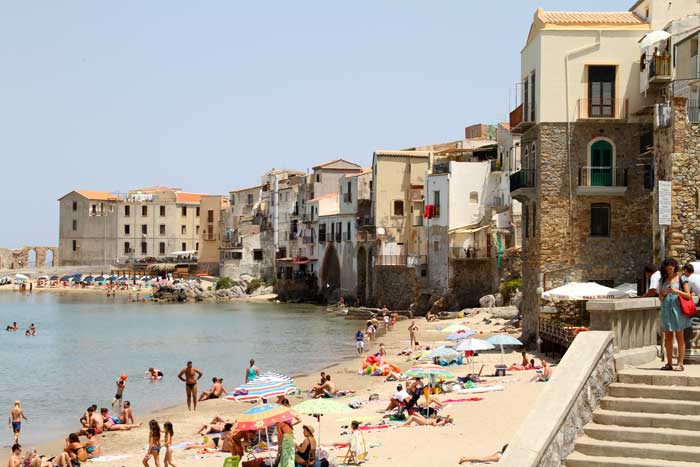
Cefalù is the most visited village on this list and the least in need of advocacy, but its inclusion is justified by the quality that distinguishes it from the larger Sicilian cities: it is still genuinely a place, with a resident population, a working fishing harbour and a daily market, rather than a destination constructed primarily for the convenience of tourists. The combination of the Norman cathedral (built by Roger II in 1131 as an act of thanksgiving for surviving a storm, and containing one of the finest Christ Pantocrator mosaics in the Byzantine tradition), the medieval Arab-Norman street layout of the old town and the golden sand beach immediately below the historic centre is unmatched among the small coastal towns of the northern Sicilian coast.
La Rocca, the enormous limestone crag above the town, carries the ruins of the Tempio di Diana (a 5th-century BC Sicilian-Greek sanctuary, long predating the Norman town below) and provides the finest aerial view of the Cefalù beach and coastline available from any land-based position. The climb takes approximately 45 minutes; the view from the summit justifies every step of it. Read our complete guides to things to do in Cefalù and the Cefalù beach guide.
9. Sutera
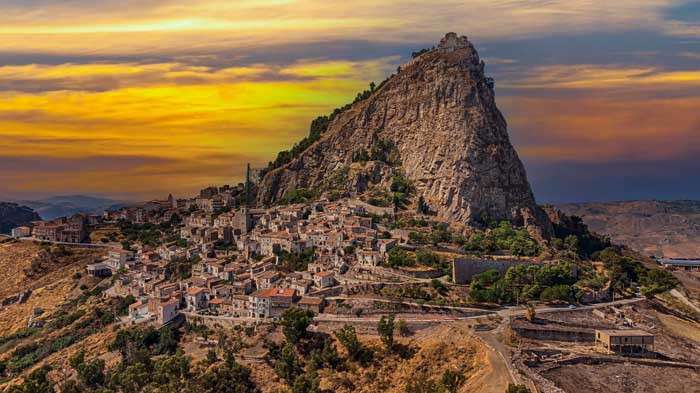
Sutera is in the centre of the island, in the province of Caltanissetta, on a rocky spur that rises abruptly from the agricultural plain with the houses of the village cascading down its slopes in a visual composition that photographs with the dramatic quality of something constructed rather than accumulated. The Santuario di San Paolino at the summit has been a pilgrimage destination for the surrounding agricultural communities for centuries; the Arab quarter at the base of the rock, known locally as the Rabato, preserves the narrow irregular lanes of the Islamic town that preceded the Norman settlement above.
Sutera is known within Sicily primarily for the living nativity (Presepe Vivente) held each Christmas, when the village stages an elaborate reenactment of traditional Sicilian trades and biblical scenes in the medieval streets bakers, blacksmiths, shepherds and fishermen in period costume occupying the alleys and stairways of the Arab quarter in a production that has been running for decades and attracts visitors from across the island. Outside the Christmas season, Sutera is one of the quietest and most genuinely unchanged villages in the Sicilian interior.
10. Ferla

Ferla is a small baroque town in the Val di Noto, rebuilt after the earthquake of 1693 in the same golden limestone that gives all the towns of the southeastern baroque circuit their specific visual quality in the afternoon light. It is smaller and less visited than Noto, Ragusa Ibla and Modica, but it has the same architectural quality and a specific practical advantage: it is the nearest inhabited settlement to the Pantalica Necropolis, the most significant prehistoric site in Sicily and one of the most remarkable natural and archaeological landscapes in the Mediterranean.
Pantalica is a limestone canyon carved by the Anapo and Calcinara rivers over millennia, its rock faces excavated with more than 5,000 chamber tombs of the Sicel culture between approximately 1200 and 700 BC the largest Bronze Age necropolis in Sicily and a UNESCO World Heritage Site. The walk through the canyon, with the tombs visible in the cliff faces above the river and the vegetation of the gorge providing shade and birdsong, is one of the most specific archaeological walking experiences on the island. Read our complete Noto guide for the broader Val di Noto baroque circuit.
Off the circuit, on the island
The ten villages in this guide are not alternatives to Sicily’s main destinations they are complements. The Cappella Palatina and the Valley of the Temples and the Greek theatre at Taormina deserve the visits they receive. But the villages are where the island reveals a different kind of quality: slower, more domestic, less aware of being observed. The bar in Montalbano Elicona where the same four men have been playing cards every afternoon for thirty years. The Maria Grammatico pastry shop in Erice where the genovese have been made from the same recipe since the convent. The Savoca alley where Coppola found something unchanged enough to stand in for 1940s Sicily and where, fifty years later, it still does.
For the complete Sicily planning picture, read our Sicily road trip guide, our day trips from Palermo guide and our best time to visit Sicily guide.
Did this guide help you discover a new corner of Sicily? Save it to Pinterest or share it with someone planning a trip to the island.


