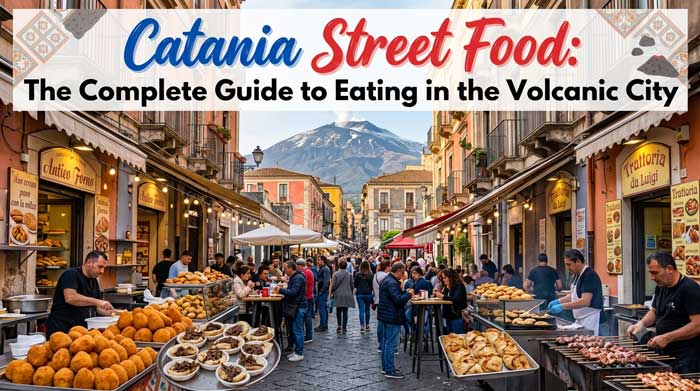
Catania has a street food culture that is distinct from Palermo’s and that, by several measures, surpasses it. Where Palermo’s street food is Arab in its origins and anarchic in its organisation the sfincione vendor on the back of a three-wheeled Ape, the stigghiola cart in the Vucciria at night Catania’s eating culture is more concentrated, more theatrical and more directly volcanic in its ingredients. The arancino (Catanese, masculine, with the pointed shape of Etna) is the finest version in Sicily. The granita al caffè at 7am at a Catanese bar counter is the finest breakfast in Italy. The Pescheria fish market behind the Duomo, with the swordfish laid out in full scale on the ice counters and the vendors performing for the crowd, is the most theatrical single food environment in eastern Sicily. This guide covers all of it.
In this guide
- The Pescheria the morning fish market
- The arancino Catania’s great contribution
- Granita and brioche the Catanese breakfast
- Pasta alla Norma the city’s signature pasta
- The horse meat sandwiches of Via Plebiscito
- Sciampanata and the Catanese fried programme
- The Bronte pistachio in the Catanese pastry
- Wine and aperitivo
- Where to eat street food in Catania
- Practical tips
The Pescheria the Morning Fish Market
The Pescheria di Catania the fish market in the sunken square behind the Fontana dell’Amenano, below the level of the Piazza del Duomo is the most dramatic single food market in eastern Sicily and the experience that most consistently produces the “best thing we did in Catania” comment from visitors who make it there before 10am. The market runs from approximately 6am to 1pm daily except Sunday; the peak hour is 7 to 9am, when the catch from the previous night arrives and the vendors are at their most theatrically active.
The specific Catanian character of the Pescheria: the swordfish (pesce spada) from the Strait of Messina, laid out in full scale on the ice counters with their characteristic long swords intact; the tuna (tonno) from the Sicilian Channel, the red flesh visible in the cross-sections displayed for the buyers; the sea urchin (ricci di mare) vendors who split the ricci at the stall and sell them to be eaten directly from the shell with a squeeze of lemon. The riccio at the Pescheria counter the fresh Ionian sea urchin eaten standing at a market stall at 8am is one of the most specifically Catanian food experiences available and the one most worth seeking out on the first morning in the city.
The vendors’ approach to selling at the Catanian Pescheria is performance as much as commerce the theatrical presentation of the fish, the invitation to touch and smell the product, the specific Catanese market patter that mixes salesmanship with genuine pride in the quality of the catch. Arrive at 7.30am for the finest version of the market before the tourist photography traffic begins at 9am. Read our complete Catania guide.
The Arancino Catania’s Great Contribution
The arancino (masculine in Catania, feminine arancina in Palermo a distinction that Sicilians take seriously and that visitors are advised to respect according to geography) is the single most important street food in eastern Sicily and the item most associated with the Catanese food identity. The Catanese arancino is conical rather than round the pointed shape allegedly evoking the profile of Mount Etna and traditionally larger than the Palermitan version, with a more firmly structured rice body and a thicker crust from the double breading and frying process.
The canonical Catanese fillings: al ragù (the classic a slow-cooked meat ragù of beef and pork with peas and tomato, enclosed in the saffron-scented rice), al burro (butter actually prosciutto cotto, mozzarella and béchamel, the “white” alternative to the ragù) and al pistacchio (Bronte pistachio cream with mozzarella and ham the most specifically Catanese of the three, using the pistachio grown on the Etna slopes above the city). The quality range is enormous the finest arancino in Catania (the rice perfectly cooked al dente, the ragù slowly made, the crust thin and crisp) is a fundamentally different product from the tourist-zone versions. The reference addresses: Savia on Via Etnea (the most celebrated Catanese pasticceria, their arancino is the city’s reference standard), Spinella in Piazza Stesicoro and the bars around the Pescheria market that serve them fresh from the fryer.
The correct Catanese arancino experience: ordered at the bar counter, eaten standing, at 8 or 9am before the queue builds, with a coffee or granita alongside. Not at a table, not with cutlery, not at noon. Read our complete arancini guide.
👉 CATANIA STREET FOOD TOUR PESCHERIA, ARANCINI AND THE VOLCANIC FOOD TRADITION
A guided street food tour of Catania the Pescheria fish market at opening, sea urchin from the shell, arancini from the finest bar in the city, granita al pistacchio and the specific Catanese food tradition rooted in the volcanic landscape of Etna. Morning tours only the best food is gone by noon.
👉SEE THE BEST CATANIA STREET FOOD TOUR HERE
Granita and Brioche the Catanese Breakfast
The Catanese granita is the finest version in Sicily smoother, colder and more intensely flavoured than the mainland Sicilian standard, with the specific texture of a granita that has been frozen and stirred at precise intervals rather than simply left to crystallise. The flavours that define the Catanese granita programme: caffè (the most traditional the intensely bitter coffee granita that provides the same caffeine hit as the espresso in a more pleasurable temperature and texture package), mandorla (almond the floral, sweet granita from the local almonds that is the most specifically Sicilian of the flavours), pistacchio (Bronte pistachio green, intensely nutty, the most immediately popular with visitors), gelsi (mulberry available in the late spring and early summer when the mulberry trees of the Etna slope are in fruit, the most specifically seasonal of the Catanese granita flavours) and limone (lemon the most refreshing in summer, from the Sicilian lemons of the Conca d’Oro).
The canonical Catanese granita breakfast: a granita al caffè or alle mandorle, served in a wide glass, with a fresh brioscia (the Catanese version of the brioche bun slightly larger and more egg-rich than the Palermitan version) for dipping into the granita as it softens. This is not a tourist affectation it is the standard Catanese breakfast eaten at bar counters across the city every morning from June through September, and increasingly year-round. The granita for breakfast in Catania is as normal and as specific as the croissant for breakfast in Paris, and considerably better. Read our complete granita guide.
Pasta alla Norma the City’s Signature Pasta
Pasta alla Norma is the most celebrated single pasta preparation in the Catanese kitchen and the dish most directly connected to the city’s cultural identity named after the opera by Catanese composer Vincenzo Bellini (1801 to 1835), whose Teatro Massimo Bellini on Via Perrotta is still the principal opera house of the city. The pasta (typically rigatoni or spaghetti) is served with a tomato sauce reduced with aubergine fried in olive oil, topped with salted ricotta (ricotta salata, the aged and salted version that crumbles rather than spreads) and fresh basil. The specific quality indicator: the aubergine must be genuinely fried (not sautéed or roasted) in good olive oil, the ricotta salata must be local and properly aged, and the tomato must be the Sicilian San Marzano equivalent rather than an industrial product.
The story of the name: the opera Norma premiered at La Scala in Milan in 1831 and was immediately recognised as a masterpiece; a Catanese actor is credited with the exclamation “È una Norma!” (It’s a Norma!) on tasting the pasta for the first time, meaning it was as magnificent as Bellini’s greatest work. The attribution is probably apocryphal; the pasta predates the opera in the Catanese kitchen. But the story is so specifically Catanese the pride in the local composer, the identification of food excellence with cultural excellence that it tells more about the city’s character than any factual account.
👉SEE THE BEST CATANIA COOKING CLASS HERE
The Horse Meat Sandwiches of Via Plebiscito
Horse meat (carne di cavallo) is a specific Catanese street food tradition that is entirely absent from the Palermitan programme and that surprises visitors who encounter it. The rosticcerie and street food vendors around Via Plebiscito and the Piazza Carlo Alberto (the Fera ‘o Luni, the Monday market area) serve horse meat in several formats: the sandwich (panino con cavallo, the slow-roasted horse meat shredded and served in a roll with salt and oregano), the grilled slice (fettina di cavallo alla griglia) and the stigghiola equivalent made from horse intestines. The horse meat tradition in Catania dates from the period of Spanish rule when the city’s poor had access to the horses of the cavalry as a protein source; the tradition has survived as a specific Catanese street food identity that the rest of Italy does not share.
For visitors unfamiliar with horse meat: the flavour is slightly sweeter and less fatty than beef, with a specific mineral note from the higher iron content. The Catanese preparation (slow-roasted, shredded, in a soft roll with olive oil and oregano) is the most accessible format for those trying it for the first time. The Via Plebiscito vendors are the reference address; the food is eaten standing at the vendor’s cart. Read our complete Catania restaurant guide.
Sciampanata and the Catanese Fried Programme
The Catanese fried food programme extends well beyond the arancino. The sciampanata (the local name for a mixed fried street food plate) includes: crocchette di patate (potato croquettes), olive fritte (fried olives stuffed with anchovy and breadcrumb), frittelle di baccalà (salt cod fritters), frittura di pesce (small mixed fried fish the sardines, anchovies and calamari from the Ionian catch), and the panelle (chickpea fritters, more associated with Palermo but present in the Catanese fried programme in a slightly different form).
The fried food vendors of the Catanese street food programme operate primarily in the morning and early afternoon the best products are available from 8am to 1pm, the same window as the Pescheria. The vendors around the Piazza Carlo Alberto and the Fera ‘o Luni market are the most concentrated street food zone outside the Pescheria.
The Bronte Pistachio in the Catanese Pastry
The proximity of Catania to Bronte the Etna foothill town 45 kilometres northwest where the finest pistachio in the world grows on volcanic basalt soil means that the Bronte pistachio is present in the Catanese pastry and bar programme at a quality and a price that is unavailable outside eastern Sicily. The pistachio in Catania is not a luxury addition it is an ingredient of ordinary daily use, available in granita, in arancino, in the paste di mandorla (the pistachio version alongside the almond), in the pistachio cannolo, in the pistachio pesto sold at the deli counters.
The reference pistachio pastry addresses in Catania: Savia on Via Etnea (the pistachio brioscia and the pistachio granita are both reference quality), Pasticceria Russo on Via Etnea and the specialist pistachio shops on and around Via Etnea that sell the full range of pistachio products (pesto, cream, raw shelled nuts, pistachio flour) from the Bronte cooperative production. Read our complete Bronte pistachio guide.
Wine and Aperitivo
The Catanese aperitivo culture is less famous than the Palermitan or the Milanese versions but produces a specific experience the spritz or the Etna Bianco with the cicchetti (small snacks) on the terrace of a bar on Via Etnea or around the Piazza Bellini in the early evening, the Etna profile visible above the baroque city at the moment when the light is golden. The Etna DOC wines the Nerello Mascalese red and the Carricante white are available by the glass at the better Catanese bars and enotece at prices significantly below the mainland Italian retail equivalent. This is the specific Catanese aperitivo programme that rewards the visitor who books a table on Via Etnea at 6.30pm and orders a glass of the local wine alongside the street food platter. Read our complete Etna wine guide.
Where to Eat Street Food in Catania
The Pescheria area (Piazza Alonzo di Benedetto). The core of the Catanese street food morning the fish market from 6am, the adjacent bars for arancino and granita from 7am, the ricci vendor at the market counter. The essential first stop of any Catania food programme.
Via Etnea. The main corso of the city, running north from the Duomo toward Piazza Stesicoro the reference addresses for the finest Catanese bars and pasticcerie (Savia, Spinella, Pasticceria Russo). The granita al pistacchio at Savia on Via Etnea is the reference standard for the Catanese granita programme.
Piazza Carlo Alberto (Fera ‘o Luni). The Monday market and daily street food zone in the northern part of the historic centre the horse meat vendors, the fried food carts, the produce market. The most specifically local version of the Catanese street food experience, less visited by international tourists than the Pescheria.
Via Plebiscito. The horse meat and stigghiola zone the specific Catanese street food that has no equivalent in Palermo or anywhere else in Sicily.
Practical Tips for Catania Street Food
The street food programme in Catania is a morning activity. The finest products (arancini fresh from the fryer, ricci direct from the morning’s catch, granita made with the day’s production) are available from 7am to noon. By 1pm the best arancini are sold out at the finest bars, the Pescheria has thinned significantly and the fried food vendors are beginning to close. Plan the Catania food programme for the morning: Pescheria at 7.30am, arancino and granita at 9am, Fera ‘o Luni at 10.30am. Read our complete day trips from Catania guide.
The standing bar counter culture is important in Catania. Eating at the counter (al banco) is cheaper than sitting at a table (al tavolo) and is the correct way to eat the breakfast food programme granita, brioscia, arancino. The price difference is typically 20 to 30 percent; more importantly, eating at the counter is the local way and produces the specific experience of standing alongside Catanesi eating the same food in the same way at the same time of morning.
For the full Catania food context, read our complete Catania restaurant guide and Sicilian food guide.
The Volcanic Kitchen
The Catanese food tradition is volcanic in the most literal sense the Bronte pistachio from the basalt soil, the Etna DOC wine from the volcanic terraces, the San Marzano-style tomatoes of the Ionian coastal plain fed by the volcanic ash deposits, the specific flavour of everything grown within 50 kilometres of an active volcano that has been enriching the soil for 500,000 years. When you eat the pistachio granita at Savia on Via Etnea, you are eating the specific expression of a geological system that began before any of the history the city is famous for and that will continue after all of it. The food of Catania is as specific to its landscape as the landscape is specific to the island. Eat it at the counter, at 8am, before the queue builds.
For the complete Catania picture, read our Catania guide, our best restaurants in Catania and our day trips from Catania guide.
Did this guide help you plan your Catania food programme? Save it to Pinterest or share it with someone who thinks Palermo has the only street food worth talking about in Sicily.