Sicily is Italy’s largest wine region by vineyard area 98,000 hectares, larger than the entire wine production of several European countries and for most of the 20th century it was one of the least respected. The island was known primarily as a source of high-alcohol bulk wine shipped north to strengthen the thin reds of Burgundy and Bordeaux after poor harvests. The transformation that has taken place since the 1980s, and accelerated dramatically after 2010, is one of the most significant quality revolutions in Italian wine: a shift from anonymous bulk production to individual estate wines of genuine character, driven by a renewed focus on the island’s own grape varieties and the extraordinary diversity of its terroir.
Today Sicily produces some of the most exciting wines in Italy. The volcanic wines of Etna have attracted international investment and critical attention at a level that places them among the most discussed wine zones in Europe. The Nero d’Avola of the southeast provides some of the finest value in Italian red wine at any price point. The Cerasuolo di Vittoria DOCG Sicily’s only DOCG combines Nero d’Avola and Frappato in a wine of genuine elegance. And the dessert wine traditions of Marsala and Pantelleria represent a historical legacy that is being rehabilitated after decades of commercial debasement.
This guide covers the essential Sicilian wines by region, grape and occasion organised to help you understand what you are drinking and what to order with the food of the island.
In this guide
- Etna DOC the volcanic wines
- Nero d’Avola Sicily’s flagship red
- Cerasuolo di Vittoria DOCG
- Sicilian white wines Grillo, Carricante and Catarratto
- Marsala DOC the historic fortified wine
- Passito di Pantelleria and the sweet wine tradition
- Key producers to know
- Sicilian wine and food pairing
- Wine tours and tastings
- FAQ
Sicilian wines at a glance
- Flagship red: Nero d’Avola (southeast Sicily) full-bodied, dark fruit, excellent value
- Most exciting zone: Etna DOC Nerello Mascalese reds, Carricante whites, volcanic terroir
- Only DOCG: Cerasuolo di Vittoria (Nero d’Avola + Frappato blend, southeastern Sicily)
- Best whites: Etna Bianco (Carricante), Grillo (western Sicily), Catarratto (island-wide)
- Historic fortified: Marsala DOC (western Sicily, est. 1796)
- Finest dessert wine: Passito di Pantelleria DOC (Zibibbo/Muscat of Alexandria)
- Best season for wine tourism: September to October (harvest, cellar visits, tastings)
Etna DOC the Volcanic Wines
The Etna DOC is the most internationally discussed wine zone in Sicily and one of the most dynamic in all of Italy. Established in 1968 as one of the earliest DOCs in southern Italy, it remained obscure for decades before a combination of critical attention, international investment and the discovery that its old-vine Nerello Mascalese could produce wines of extraordinary complexity transformed it into one of the wine world’s reference points for terroir-driven, age-worthy Italian reds.
The vineyards occupy the slopes of Europe’s highest active volcano at altitudes ranging from approximately 400 to over 1,000 metres above sea level. The volcanic basalt soil black, porous, mineral, low in organic matter and nutrients forces the vines to work deep for water and produces grapes of concentrated flavour and high acidity. The altitude provides cool nights that preserve the aromatic complexity and freshness that low-elevation Sicilian reds often lack. The result is a wine that bears almost no resemblance to the image of “Sicilian red” that the outside world still sometimes maintains.
The dominant red grape is Nerello Mascalese thin-skinned, high in acid, prone to elegant rather than powerful expression, closer in temperament to Pinot Noir or Nebbiolo than to the full-bodied Nero d’Avola of the southeast. The comparison to Burgundy is made constantly in wine writing about Etna, and it is not as imprecise as it might seem: the best Etna Rosso from old vines in the finest contrade (the named vineyard sites of the northern slope) has the mineral tension, the aromatic complexity and the aging potential of a serious Côte de Nuits. The price has followed accordingly single-contrada wines from the top producers now command €40 to €80 or more per bottle, with collector examples significantly higher.
The northern slope of the volcano the Contrada zone is considered the finest source of Etna Rosso, with the named vineyards of Calderara Sottana, Caselle, Guardiola, Santo Spirito and Rampante among the most respected. The white wines of the eastern slope around Milo, made primarily from Carricante and designated Etna Bianco Superiore DOC, are structured, saline and mineral the finest Sicilian whites available and among the most serious white wines produced in Italy.
Read our complete Etna wine guide for the full vineyard circuit, the best producers and how to combine a wine tour with a visit to the volcano.
👉 ETNA DOC WINE TASTING AND VINEYARD TOUR
A guided wine tasting tour of the Etna DOC vineyards on the slopes of the volcano Nerello Mascalese reds from old alberello vines, Carricante whites and the volcanic terroir that makes these wines unique in Italy. Available from Taormina and Catania. Best timed for the September harvest season.
👉SEE THE BEST ETNA DOC WINE TASTING HERE
Nero d’Avola Sicily’s Flagship Red
Nero d’Avola is the most widely planted red grape in Sicily and the one most commonly associated with the island outside Italy. Named after the town of Avola in the southeastern province of Syracuse, it is documented in the island’s viticulture from at least the 15th century. For most of the 20th century it was used primarily as a blending grape to add colour and body to lighter northern Italian and French wines. The rehabilitation of Nero d’Avola as a serious varietal wine began in the 1980s and has produced, over four decades of work, some of the finest value in Italian red wine.
A well-made Nero d’Avola is full-bodied and deeply coloured, with flavours of ripe plum, black cherry, chocolate and a characteristic note of dried herbs and spice. The tannins are firm but not aggressive; the acidity is moderate, which makes careful winemaking and harvest timing important for balance. At its best from the finest sites around Avola, Pachino and Noto in the southeastern corner of the island it is a wine of genuine depth and distinctiveness, comparable to a good Syrah in weight and complexity but with a specifically Mediterranean character of its own.
The most celebrated single-varietal Nero d’Avola expressions come from producers including Cos (whose Cerasuolo di Vittoria blends Nero d’Avola with Frappato), Planeta, Tasca d’Almerita and Arianna Occhipinti, whose organic and biodynamic approach to southeastern Sicilian viticulture has attracted significant international critical attention. Entry-level Nero d’Avola from the Sicilia DOC appellation represents some of the best value in Italian wine retail, consistently delivering character at €12 to €18 per bottle.
Cerasuolo di Vittoria DOCG
Cerasuolo di Vittoria is Sicily’s only DOCG the highest quality designation in the Italian appellation system and one of the most distinctive wines produced on the island. Made from a blend of Nero d’Avola (50 to 70 percent) and Frappato (30 to 50 percent), it combines the colour, structure and depth of the first grape with the aromatics, freshness and lighter touch of the second. The result is a wine of genuine elegance red fruit, herbs, a hint of liquorice, moderate tannins and an acidity that gives it unusual versatility at the table.
Frappato on its own increasingly available as a varietal wine from producers in the Vittoria area is worth seeking out for those who prefer lighter reds. The grape produces wines closer in weight to a Beaujolais or a light Pinot Noir than to the full-bodied reds of the Sicilian interior, with a specific floral and strawberry character and a freshness that makes it one of the finest warm-weather red wines available from any Italian region. Cos, the Vittoria estate founded in 1980 and producing wine from amphora-fermented indigenous varieties, is the reference producer for both the DOCG blend and the varietal Frappato.
Sicilian White Wines Grillo, Carricante and Catarratto
Sicilian white wine has been transformed by the quality revolution of the past two decades. Catarratto the most planted white grape on the island, covering more vineyard area than any other variety was for decades treated as a bulk variety, processed in volume for the northern blending market. The finest Catarratto, particularly from the high-altitude sites of western Sicily and from the volcanic soils of Etna, produces wines of genuine character: citrus, floral, mineral, with a freshness that belies the grape’s reputation as a workhorse variety.
Grillo is the white grape with the most consistent personality across the island. Medium-bodied, dry, with a characteristic note of white peach, citrus zest and a saline finish that reflects the maritime influence of the western Sicilian coast it is the white wine most naturally suited to Sicilian seafood and one of the most reliable choices at any restaurant on the island. The producers of the “Salt West” project in the Marsala area three Italian Masters of Wine working to establish Grillo as a serious quality benchmark are producing some of the finest examples currently available.
Carricante, the primary white grape of Etna, is in a different category entirely from the other Sicilian whites. Grown on the eastern slope of the volcano around Milo and Zafferana Etnea at altitudes of 600 to 900 metres, it produces wines of striking mineral intensity, high acidity and genuine aging potential. The Etna Bianco Superiore DOC designation applies specifically to wines from the Milo commune; the finest examples develop complexity over five to ten years in bottle and represent the most serious white wine produced in Sicily.
Marsala DOC the Historic Fortified Wine
Marsala is the most historically significant wine produced in Sicily and the one whose reputation has suffered most in the 20th century. The English merchant John Woodhouse arrived in Marsala in 1796 and, finding a local wine of quality that could not survive the sea voyage to England without spoilage, added grape spirit to stabilise it for export creating, in the process, one of the great fortified wine traditions of the Mediterranean world. The Florio family, the dominant commercial dynasty of 19th-century Sicily, subsequently built the production into an international luxury product. The debasement of Marsala into a cheap cooking wine during the 20th century obscured a wine of genuine complexity and historical interest that serious producers have been working to rehabilitate for the past two decades.
A fine Marsala Superiore Riserva, aged for a minimum of four years in the solera system (the same blending system used for Sherry and Port, with wines from different vintages progressively mixed through older barrels), develops flavours of dried fruit, caramel, roasted almonds, fig and oxidative complexity that are entirely different from the industrial cooking product. The Vergine classification Marsala aged for a minimum of five years without added mistella (sweetened grape must) produces the driest and most complex category, with a character closer to a dry Amontillado Sherry than to the sweetened versions more commonly available.
The Florio and Pellegrino cellars in Marsala offer guided tastings of the full range of production styles and are among the most atmospheric cellar visits available in western Sicily. Read our complete guide to Marsala for the full picture of the town and its wine tradition.
Passito di Pantelleria and the Sweet Wine Tradition
Pantelleria is a small volcanic island 70 kilometres southwest of Sicily, closer to the coast of Tunisia than to the Sicilian mainland, and the source of the finest dessert wine in the Sicilian tradition. The Passito di Pantelleria DOC is made from Zibibbo the Sicilian name for Muscat of Alexandria grown on the island’s volcanic black lava soil and dried in the sun after harvest to concentrate the sugars and aromatic intensity before fermentation. The resulting wine is amber-golden, intensely aromatic (apricot, dried fig, orange peel, honey, jasmine) and naturally sweet without the heaviness of fortified wines.
The island’s Zibibbo can also produce dry whites of remarkable fragrance and complexity the Ben Ryé of Donnafugata is the most internationally celebrated example of the Passito style, while the dry Zibibbo expressions from producers including COS (fermented in terracotta amphora) represent the less-known but equally rewarding dry application of the grape.
The Malvasia delle Lipari DOC, from the Aeolian Islands northeast of Sicily, is the other significant sweet wine in the Sicilian tradition lighter and more delicate than the Pantelleria Passito, with a specific apricot and peach character from the Malvasia Bianca grape. Read our complete Aeolian Islands guide for the broader context of the volcanic island chain.
Key producers to know
In the Etna DOC zone, the producers who established the modern reputation of the appellation are Benanti (the family estate that began serious Nerello Mascalese production in the 1980s), Frank Cornelissen (a Belgian producer who arrived in 2001 and whose natural wine approach has attracted international attention), Passopisaro (now part-owned by the Frescobaldi family of Tuscany following a 2025 investment), Terre Nere and Terre di Trente. For visitors, the contrade of the northern slope Calderara, Caselle, Guardiola and Santo Spirito are the sites worth visiting for cellar tours and tastings in September and October.
In the southeastern zone, Cos in Vittoria is the reference estate for both Cerasuolo di Vittoria DOCG and biodynamic indigenous variety production. Arianna Occhipinti in Vittoria produces organic Frappato and Nero d’Avola of exceptional quality and has become one of the most internationally recognised names in Sicilian wine. Planeta, the island’s largest quality estate with vineyards across several zones, provides reliable quality across a wide range of varieties and styles.
In western Sicily, Tasca d’Almerita at Regaleali produces the most consistent range of wines from the Sicilian interior, with the red Rosso del Conte (a Nero d’Avola-based blend from 50-year-old vines) the flagship. Donnafugata produces excellent wines across multiple zones including the Ben Ryé Passito di Pantelleria and serious Nero d’Avola from the Contessa Entellina estate.
Sicilian wine and food pairing
Nero d’Avola pairs naturally with the richest dishes of the Sicilian table: pasta alla Norma, parmigiana di melanzane, grilled lamb, slow-cooked beef, aged pecorino. Its deep colour and firm tannins need the fat and protein of substantial food to balance. At the lighter end of the Nero d’Avola spectrum, a fresher style works well with pasta al ragù and grilled swordfish.
Etna Rosso is one of the most food-versatile red wines in Italy, a quality that comes directly from its high acidity and moderate tannin. It handles grilled tuna and swordfish better than most reds, matches well with pasta con le sarde (the saffron, pine nuts and sardines responding to the mineral freshness of the Nerello Mascalese) and is the natural companion to any of the mushroom and truffle preparations from the Etna foothills. For more on the Sicilian dishes that call for these pairings, read our complete Sicilian food guide.
Grillo and Carricante whites pair best with the seafood of the Sicilian coast grilled branzino, pasta alle vongole, crudo di gamberi, fried anchovies, the mixed seafood antipasto that opens most coastal restaurant meals. The Etna Bianco Superiore has enough structure and mineral complexity to handle the more assertively flavoured seafood dishes (swordfish, tuna, even pasta con le sarde) where a lighter white would be overwhelmed.
Marsala Superiore Riserva served as an aperitivo or alongside aged cheeses and almond biscuits is the experience that most changes a visitor’s understanding of what Marsala is and can be. The dry Vergine style alongside a plate of hand-sliced Sicilian salumi is the finest expression of the wine’s savory complexity.
Wine tours and tastings in Sicily
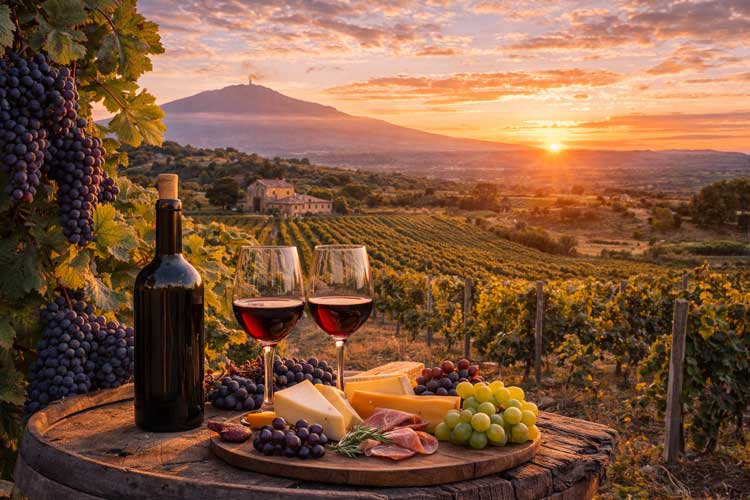
The Etna DOC zone offers the most developed wine tourism infrastructure in Sicily, with cellar visits, vineyard tours and harvest experiences available from September through November at most of the major estates. The September harvest when the Nerello Mascalese comes off the vine at altitude in the cool volcanic air, with the sea visible on three sides of the volcano and the smoke from the summit craters overhead is one of the most specific wine tourism experiences available in Italy. Booking cellar visits in advance is essential during the harvest season.
The Marsala cellars Florio and Pellegrino both offer excellent guided tastings in the historic bagli (farmhouse cellars) of the Marsala production zone provide the most atmospherically impressive cellar visit in western Sicily, with the solera barrels of different vintages and the history of the John Woodhouse enterprise providing a narrative that the Etna zone, for all its current excitement, cannot match in historical depth.
👉 MARSALA WINE TASTING AND SALT PANS TOUR
A guided wine tasting at one of the historic Marsala cellars combined with a tour of the Trapani salt pans and a visit to the town of Marsala the full picture of the western Sicilian wine and landscape tradition. Available from Palermo and Trapani.
👉SEE THE BEST MARSALA WINE TASTING HERE
👉 RENT A CAR
Exploring the Sicilian wine regions requires a car the Etna vineyards, the Marsala cellars and the Vittoria estates are all off the main public transport routes. Compare rental car prices at Palermo and Catania airports and book in advance for the September harvest season.
👉 COMPARE THE BEST RENTAL CARS HERE
Frequently asked questions about Sicilian wines
What is the most famous Sicilian wine?
Marsala is historically the most internationally famous Sicilian wine, known worldwide for two centuries. Among current table wines, Nero d’Avola is the most widely available and most commonly recognised Sicilian red outside Italy. Among wine critics and serious collectors, the Etna DOC particularly single-contrada Etna Rosso from the northern slope of the volcano has attracted the most sustained international attention in the past decade and commands the highest prices.
What does Nero d’Avola taste like?
A well-made Nero d’Avola has deep colour and full body, with flavours of ripe plum, black cherry, chocolate and dried herbs, with firm tannins and moderate acidity. It is often compared to Syrah in weight and style. The finest examples from the Avola and Noto area develop complexity with age, adding leather, tobacco and earthy notes over five to ten years in bottle.
Is Etna wine worth trying?
Yes, without qualification. The best Etna Rosso from old-vine Nerello Mascalese vineyards on the northern slope of the volcano is among the most distinctive and age-worthy red wine produced in Italy. Even at entry level, Etna Rosso offers a combination of mineral freshness, aromatic complexity and food versatility that few other Italian reds provide at the same price point. Read our complete Etna wine guide.
What food pairs with Sicilian wine?
Nero d’Avola with pasta alla Norma, parmigiana, grilled lamb and aged pecorino. Etna Rosso with grilled tuna, swordfish, pasta con le sarde and mushroom dishes. Grillo and Catarratto whites with grilled fish, seafood antipasto and light pasta dishes. Marsala Superiore with aged cheese and almond biscuits. Passito di Pantelleria with almond pastries, ricotta desserts and blue cheese.
An island at its best in a glass
The transformation of Sicilian wine over the past four decades is the story of an island rediscovering the value of what it already had. The indigenous grape varieties that were dismissed as bulk material Nero d’Avola, Nerello Mascalese, Frappato, Carricante, Grillo are now the wines that wine professionals fly to the island to taste. The volcanic soils of Etna, the limestone plateaus of the southeast, the maritime hillsides of western Sicily and the black sand of Pantelleria produce wines that could not come from anywhere else. This specificity the direct expression of a particular place, climate and tradition in a glass is what the best Sicilian wine has always had. It took the rest of the world several decades to notice.
For the full wine tourism circuit, read our Etna wine guide, our Marsala guide, our Bronte pistachio guide and our complete Sicily road trip guide.
Did this guide help you plan your Sicilian wine journey? Save it to Pinterest or share it with someone who still thinks Marsala is only for cooking.