There is a moment that every visitor to Noto experiences sooner or later, usually in the late afternoon when the sun is low and the light turns warm. You are walking along the Corso Vittorio Emanuele, the main street of this perfectly planned baroque city, and the honey-coloured limestone of the buildings around you begins to glow. The Cathedral of San Nicolò, at the top of its broad staircase, turns amber. The palaces along the Corso catch the light and seem to radiate it back. The street fills with the sound of Sicilian Italian, the smell of almond pastry from the best bar in Italy, and the particular quality of evening in southeastern Sicily that no photograph has ever quite managed to capture.
Noto is the capital of Sicilian baroque. It was built almost entirely in the first half of the 18th century, after the catastrophic earthquake of 11 January 1693 obliterated the original medieval city and gave the architects of the age a blank canvas on which to paint their ambitions. What they built Vincenzo Sinatra, Paolo Labisi, Rosario Gagliardi is a perfectly proportioned urban masterpiece: three east-to-west avenues, three piazzas, each anchored by a church, the whole ensemble executed in the soft golden limestone of the Iblean plateau that gives the city its characteristic warmth and its UNESCO World Heritage status.
This guide covers everything you need to plan your visit: the monuments, the hidden streets, the Infiorata festival, the beaches, the day trips and the food. Noto is small enough to cross on foot in twenty minutes and rich enough to hold you for days.
In this guide
- Noto Cathedral and Piazza del Duomo
- Walking the Corso Vittorio Emanuele
- Palazzo Nicolaci di Villadorata
- The Infiorata di Noto festival
- Noto Antica the ghost city on the hill
- What to eat in Noto and Caffè Sicilia
- Beaches near Noto
- Day trips from Noto
- Guided tours in Noto
- Practical information
- Frequently asked questions
Quick facts about Noto
- UNESCO status: Late Baroque Towns of the Val di Noto (2002)
- Location: Southeastern Sicily, province of Syracuse, 30 km from Siracusa
- From Catania: 80 km, approximately 1 hour 15 minutes by car
- From Syracuse: 30 km, approximately 35 minutes by car or train
- Best time to visit: May (Infiorata festival), April to June, September to October
- How many days: Half day for the city centre alone; 2 nights to include beaches and day trips
- Famous for: Baroque architecture, Caffè Sicilia granita, the Infiorata flower festival, Vendicari beaches
Noto Cathedral and Piazza del Duomo
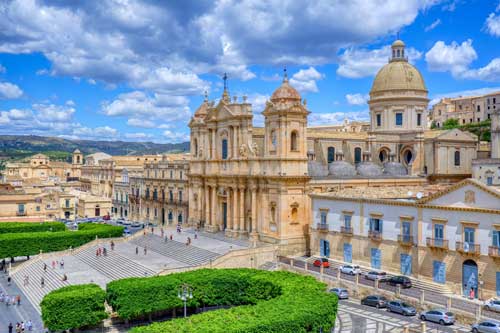
The Cattedrale di San Nicolò is the visual and symbolic centre of Noto, and it is one of the most theatrical baroque buildings in Sicily. It stands at the top of a broad, sweeping staircase that functions simultaneously as an architectural approach, a public gathering place and a stage set exactly as its designers intended. The facade rises in three tiers, each set of columns narrower and more vertical than the one below, drawing the eye upward to the dome that was rebuilt after it famously collapsed in 1996 and restored to its original form by 2007.
The best way to experience the cathedral is from the foot of the staircase, where the full composition is visible: the steps in the foreground, the church behind, and directly opposite across the piazza, the Palazzo Ducezio (Noto’s town hall), inspired by the palaces of 17th-century France, its columned loggia providing a formal counterpart to the cathedral’s vertical energy. Climb the steps of one building and you are at eye level with the facade of the other one of the great urban views in southern Italy.
Entry to the cathedral is free. The interior, bright and relatively austere compared to the drama of the facade, is worth entering for the quality of the light at certain times of day, but the exterior and the piazza are the primary experience. The Palazzo Ducezio charges approximately €3 for entry to its upper floor and the Sala degli Specchi, its mirrored reception hall decorated with frescoes a combination ticket also covers the Teatro Tina di Lorenzo nearby.
Walking the Corso Vittorio Emanuele
The Corso Vittorio Emanuele is the spine of Noto and the finest baroque street in Sicily. It runs east to west through the historic centre, beginning at the Porta Reale, the 19th-century triumphal arch that marks the formal entrance to the city, and ending at the western gardens. Along its length it passes through three piazzas, each anchored by a church, each a set-piece of the baroque urban vocabulary: the Piazza del Duomo with the cathedral, the Piazza dell’Immacolata with the Church of San Francesco, and the Piazza XVI Maggio with the Church of San Domenico and the public gardens.
Walking the full length of the Corso, from the Porta Reale to the western end, takes approximately twenty minutes at a tourist pace with stops for photographs. The buildings on either side palaces, convents, churches, aristocratic residences are all built in the same golden limestone and to a consistent scale and height, giving the street a visual coherence that is unusual even by baroque standards. The afternoon light, particularly in the hour before sunset, turns the limestone from pale gold to deep amber in a transformation that happens gradually enough to be worth pausing for.
One detail worth noticing as you walk the Corso: the three lateral streets that run perpendicular to it divide the city into its three sections (for the nobility, the clergy and the people), a social hierarchy literally inscribed into the urban plan. Via Cavour, running parallel to the Corso to the north, was the street of the nobility and has the most elaborately carved palace portals on the island it is less visited than the Corso and more rewarding for slow exploration.
Palazzo Nicolaci di Villadorata
The Palazzo Nicolaci di Villadorata on Via Corrado Nicolaci is the finest and most exuberant example of Sicilian baroque civil architecture in Noto and arguably in the entire Val di Noto. Built for the Nicolaci family from 1737 onwards and comprising 90 rooms decorated with frescoes and furnished with objects accumulated over centuries, the palace is above all famous for its exterior facade and specifically its six elaborately carved balconies supported by figures that represent the baroque imagination at its most uninhibited: horses, lions, sphinxes, mermaids, cherubs and grotesque faces project from the building as if trying to escape it, each one different, each one executed with extraordinary skill and specificity.
The balconies alone are worth the detour to Via Nicolaci. They are not decorative in the passive sense they are a statement, an expression of the Nicolaci family’s wealth, ambition and theatrical sensibility in stone. The family lived in the palace until 1989, and the building has since been partially opened to the public, with rotating exhibitions in the former state rooms. The exterior and the street itself are freely accessible at any hour.
Via Corrado Nicolaci is also the street of the Infiorata, the annual flower festival that is Noto’s most celebrated event see the section below for full details.
The Infiorata di Noto festival
On the third weekend of May each year, Via Corrado Nicolaci is transformed into one of the most extraordinary spectacles in Sicily. The Infiorata di Noto is a festival of flower art: flower artists from across Italy and the Mediterranean spend three days creating elaborate pictorial compositions mythological scenes, symbolic images, abstract patterns from flower petals, leaves, seeds and other plant materials laid directly on the stone pavement of the street. The results are carpets of colour that fill the full length of Via Nicolaci with a precision and a density of detail that seems impossible for a medium this fragile and this temporary.
The festival has been held since 1980 and has become one of the most important outdoor art events in southern Italy. The theme changes each year. In 2025 the theme was peace. The compositions are viewable from the street level and from the balconies of Palazzo Nicolaci above the view from the palace balconies, looking down along the full length of the flower carpet, is the most celebrated visual experience of the festival.
If you are planning a visit to Sicily in May, timing it to coincide with the Infiorata is one of the best decisions you can make. Noto is busy during the festival weekend but not impossibly so, and the combination of the flower carpet, the baroque setting and the Sicilian May light is genuinely unforgettable. Book accommodation well in advance the town fills up quickly for this weekend.
Noto Antica the ghost city on the hill
Most visitors to Noto know only the 18th-century baroque city. Very few know that approximately 10 kilometres to the northwest, on the summit of Monte Alveria, the ruins of the original medieval city of Noto still exist, largely unvisited and largely unremarked by the guides and itineraries that focus on the spectacular rebuilt town below.
Noto Antica was the original settlement, inhabited continuously from at least the 9th century BC through to the 1693 earthquake. After the earthquake, the population relocated entirely to the new site, leaving the hilltop ruins to be slowly reclaimed by the vegetation of the Iblean plateau. What remains is extraordinary in its desolation: collapsed Norman churches, the outline of streets, fragments of walls, ancient rock-cut tombs and caves carved directly into the limestone, and the complete absence of other tourists.
The ruins are accessible by car via a mountain road from modern Noto, approximately 20 minutes’ drive. There is no entry charge and no organised visitor facilities. The site rewards the traveller who arrives with a spirit of exploration rather than expecting signage and information panels. The views from Monte Alveria across the Iblean plateau and towards the distant sea are among the finest in southeastern Sicily, and the contrast between the ghost city on the hill and the golden baroque spectacle below is a striking meditation on what the 1693 earthquake actually meant for this part of Sicily.
What to eat in Noto and Caffè Sicilia
Noto has the finest gelateria and bar in Sicily, possibly in Italy. Caffè Sicilia on Corso Vittorio Emanuele 125 has been operating since 1892 and was voted the best bar in Italy by Gambero Rosso a recognition that reflects not just the quality of its granita, gelato and pastries but the philosophy behind them: everything made from scratch, from the best local ingredients, to recipes that have been refined over more than a century. The almond granita, made from Avola almonds ground fresh each morning, is the standard by which all other Sicilian granita is judged. The Bronte pistachio gelato is extraordinary. The cassata is one of the finest in Sicily. If you visit Noto and do not go to Caffè Sicilia, you have made a significant error.
Beyond Caffè Sicilia, Noto’s food scene reflects the broader southeastern Sicilian tradition: fresh seafood from the nearby coast, almonds from Avola (the Mandorla di Noto IGP is one of the finest almonds in the world), local olive oil, Nero d’Avola wine from the surrounding vineyards, and the full range of Sicilian pastry. The wine estate Planeta has one of its cantinas in the Noto DOC zone, producing a celebrated Nero d’Avola that pairs naturally with the lamb and aged cheese dishes of the Iblean countryside.
For lunch and dinner, the trattorias around Piazza Municipio and along the side streets off the Corso offer good value and honest Sicilian cooking. The restaurant Ristorante Crocifisso on Via Principi Landolina is the most consistently praised in the city for its creative Sicilian menu using local seasonal ingredients advance booking is recommended in summer.
Beaches near Noto
Noto is positioned approximately 8 kilometres from the sea, which makes it unusually convenient as a base for combining baroque sightseeing with beach days a combination that few other towns in the Val di Noto can offer as easily.
Lido di Noto, 8 kilometres south, is the closest beach: a long strip of golden sand with clear, shallow water and adequate facilities, including beach clubs, restaurants and free access sections. It is popular with families and with Notese locals and has a pleasant, genuinely local atmosphere rather than the resort character of more touristy beaches elsewhere on the island.
Calamosche, within the Vendicari Nature Reserve approximately 20 kilometres south of Noto, is consistently ranked among the most beautiful beaches in Italy: a perfectly sheltered cove of white sand and turquoise water protected on both sides by rocky headlands, accessible only on foot through the nature reserve (approximately 15 minutes’ walk from the car park). No facilities, no beach clubs, no vendors just the beach, the sea and the protected coastal scrubland of the reserve. Arrive early in July and August as it fills quickly.
San Lorenzo and Eloro are two further beaches south of Noto with fine white sand and clear water, both considerably less visited than Calamosche and both excellent for a quieter day by the sea. The Vendicari Reserve between them contains walking trails, archaeological ruins of ancient Greek and Byzantine settlements, and a large lagoon that is an important bird sanctuary on the Mediterranean migration routes.
Day trips from Noto
Noto’s central position in the Val di Noto makes it one of the best bases in southeastern Sicily for day trips to the other baroque towns. All three of the UNESCO-listed destinations within easy reach can be done as day trips, though spending a night in each is recommended for the full experience.
Modica (30 kilometres, 40 minutes): The most dramatic of the Val di Noto towns, built in two levels up a steep ravine with baroque churches rising from the valley floor to the ridgeline. Essential for the cold-process Modica chocolate, the Churches of San Giorgio and San Pietro, and the extraordinary setting. A full half-day minimum.
Ragusa (50 kilometres, 1 hour): The most architecturally complex of the baroque towns, split between Ragusa Ibla below and Ragusa Superiore above, connected by 242 steps and a degree of urban drama that is unique in Sicily. Plan a full day if combining with the Donnafugata Castle excursion. Read our complete guide to things to do in Ragusa for the full picture.
Syracuse and Ortigia (30 kilometres, 35 minutes): The ancient Greek city whose island old town of Ortigia is the finest urban environment in southeastern Sicily, with the Duomo built around a 5th-century BC Doric temple, the Fonte Aretusa freshwater spring at the sea’s edge, and one of the richest archaeological museums in Italy. Read our complete guide to things to do in Syracuse for what to prioritise.
Marzamemi (25 kilometres, 30 minutes): The small fishing village south of Noto with a photogenic piazza, excellent raw seafood restaurants and a lingering atmosphere of the traditional tuna fishing culture that defined this coastline for centuries. An excellent half-day excursion combined with a stop at the Vendicari Reserve.
Guided tours in Noto
Noto is a city that reveals considerably more to those who understand what they are looking at. A knowledgeable guide decodes the social hierarchy embedded in the urban plan, explains the symbolic language of the baroque decoration, and opens access to buildings and palaces not freely accessible to independent visitors.
Noto baroque walking tour
A guided walk through the historic centre with a local expert the cathedral, Palazzo Nicolaci, Via Cavour and the stories behind the architecture. Available in English, 2 hours, small group.
👉see the best Noto baroque walking tour here
Beyond the city itself, several excellent guided experiences are available in the surrounding area.
Val di Noto baroque towns day tour
A full-day guided circuit of Noto, Modica and Ragusa from Syracuse or Catania the most efficient way to see all three UNESCO baroque towns in a single day with expert commentary.
👉see the best Val di Noto baroque towns day tour here
Noto wine tasting and vineyard tour
Visit one of the Noto DOC estates for a guided tasting of Nero d’Avola and local whites, with a tour of the vineyards and an insight into the volcanic and limestone terroir that gives Noto wines their distinctive character.
👉see the best Noto wine tasting and vineyard tour here
Book your Sicily rental car
Compare prices across all major car hire companies in Sicily, including Palermo and Catania airports, and book in advance to get the best rates. Always select full coverage (zero excess) when booking in Sicily.
👉compare the best rental cars here
Practical information for visiting Noto
How to get there
From Catania, the drive via the A18 and SS115 takes approximately 1 hour 15 minutes (80 km). From Syracuse, the drive takes 35 minutes (30 km). The train from Syracuse to Noto runs several times daily and takes approximately 30 minutes a practical option for those without a car, as Noto’s historic centre is entirely walkable on arrival. From Palermo, the drive is approximately 3 hours via the A19 and SS115.
Parking is available on the outskirts of the historic centre. The centre itself is a pedestrian zone park at the Parcheggio Porta Reale near the triumphal arch and walk in. For getting around the wider province and reaching the beaches, a rental car is strongly recommended. Read our complete Sicily road trip guide for driving advice across the island.
When to visit
Noto is best in April, May, June, September and October. The Infiorata festival in the third weekend of May is the single most spectacular event in the city’s calendar and is worth planning a visit around specifically. July and August are hot (temperatures regularly above 35°C in the city centre), very busy and the light is harsh for the kind of photography the city rewards. Winter visits are quiet and mild and the city is seen at its most local, though some restaurants and beach facilities close in November and December. Read our complete guide to the best time to visit Sicily for the full seasonal picture.
How many days do you need
The historic centre of Noto can be seen thoroughly in half a day at a comfortable pace. A full day adds time for Caffè Sicilia, Noto Antica and an evening in the city at its most beautiful. Two nights is the ideal length for combining the city with a beach day at Calamosche and a day trip to Modica or Ragusa. Three nights makes Noto a genuine base for the entire Val di Noto, allowing visits to Syracuse, Marzamemi and the Vendicari Reserve as well.
Frequently asked questions about Noto
Is Noto worth visiting?
Yes, without qualification. Noto is the finest example of baroque urban planning in Sicily and one of the most beautiful small cities in Italy. Even visitors who are not particularly interested in architecture find the combination of the golden limestone city, the food, the surrounding beaches and the general atmosphere of southeastern Sicily compelling. A half-day visit is the minimum; two nights is the ideal.
How far is Noto from Syracuse?
Noto is 30 kilometres from Syracuse, approximately 35 minutes by car or 30 minutes by train. The two cities are easily combined in a single day, or Noto can be used as a base for day trips to Syracuse. Both are among the finest destinations in southeastern Sicily and both should be visited on any serious trip to this part of the island.
What is the Infiorata di Noto?
The Infiorata is Noto’s annual flower festival, held on the third weekend of May. Flower artists from across Italy and the Mediterranean create elaborate compositions from flower petals, leaves and seeds laid on the pavement of Via Corrado Nicolaci, transforming the street into a carpet of colour and imagery. It is one of the most extraordinary outdoor art events in southern Italy and one of the best reasons to visit Sicily in May.
What is Noto famous for?
Noto is famous for its baroque architecture (UNESCO World Heritage Site since 2002), for Caffè Sicilia (voted best bar in Italy), for the Infiorata flower festival, for the nearby Calamosche beach at the Vendicari Nature Reserve, and for its position as the finest base in the Val di Noto for day trips to Modica, Ragusa and Syracuse.
Can you visit Noto as a day trip?
Yes. Noto’s historic centre is small and walkable and can be seen thoroughly in 3 to 4 hours. The city is a natural day trip destination from Syracuse (35 minutes), Ragusa (1 hour) and Catania (1 hour 15 minutes). However, arriving in the late afternoon and staying for dinner and the evening when the limestone turns golden and the city comes alive with its own life reveals a side of Noto that a morning day trip cannot provide.
Plan your visit to Noto
Noto is best experienced slowly: arriving in the afternoon, walking the Corso at sunset, having dinner at a table on a side street, waking to almond granita at Caffè Sicilia, spending the morning at Calamosche and the evening back in Piazza del Duomo. The city is small enough to hold everything it needs to hold and confident enough not to need anything more.
For the rest of your southeastern Sicily circuit, read our complete guides to Ragusa, Syracuse and Agrigento, and our complete Sicily 7-day itinerary and Sicily road trip guide for the full island.
Did this guide help you plan your Noto visit? Save it to Pinterest or share it with someone planning a trip to Sicily.