
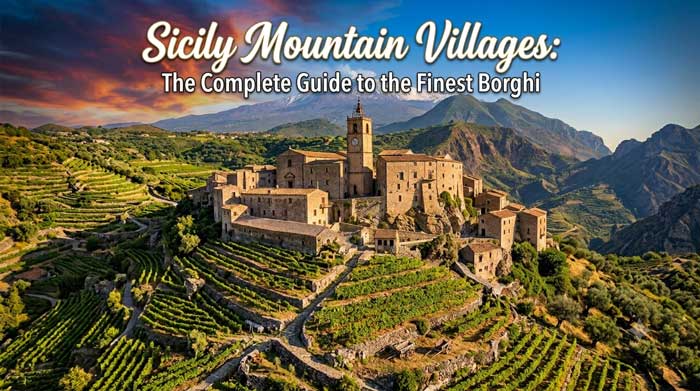
The mountain villages of the Sicilian interior are the island’s least visited and most specifically Sicilian destinations the medieval borghi of the Madonie and Nebrodi ranges where the daily life has changed less in the past century than in any coastal or urban zone, where the food traditions (the mountain cheese, the mushroom, the wild boar, the autumn chestnut) are specific to this altitude and these soils, and where the relationship between the village and its landscape the castle visible from 30 kilometres, the Norman church integrated into the limestone cliff, the cemetery gardens of wild flowers below the walls provides a visual and historical depth that the more celebrated coastal destinations cannot match. These are the places that most visitors to Sicily miss entirely, driving past them on the autostrada below on the way between Palermo and Catania.
In this guide
- Castelbuono the finest mountain village in Sicily
- Gangi medieval perfection on the ridge
- Petralia Soprana and Petralia Sottana
- Geraci Siculo the Ventimiglia lords
- Polizzi Generosa
- The Nebrodi villages
- Sperlinga the cave village
- Mountain food the interior tradition
- Best season for the mountain villages
- Practical tips
Castelbuono the Finest Mountain Village in Sicily
Castelbuono is the finest mountain village in Sicily the most complete combination of medieval architecture, food culture, natural landscape access and cultural programme available in the Sicilian interior. The village of approximately 9,000 residents occupies a limestone ridge in the Madonie mountains 70 kilometres east of Palermo, its 14th-century Ventimiglia castle visible from the valley below and its medieval centre the Piazza Margherita with the baroque church of Sant’Anna, the narrow lanes of the historic quarter, the Cappella Palatina inside the castle with its extraordinary baroque stucco programme by Giacomo Serpotta providing a monument programme of surprising quality for a village of this size.
The specific Castelbuono food identity is the most developed of any Sicilian mountain village. The Fiasconaro pasticceria, founded in 1953 and now the producer of what is considered by many to be the finest panettone in Italy (the Castelbuono panettone is sold internationally and has won every major Italian artisan food award), is the most internationally known food product of the village. The mushroom tradition (the Castelbuono funghi festival in October is the most important autumn food event in the Madonie) produces the finest porcini and chiodini mushroom preparations in the province; the mountain pork and the wild boar of the Madonie forest provide the charcuterie programme that is the most specifically interior-Sicilian food available in the village. Read our complete Cefalù guide for the coastal approach to the Madonie.
Gangi Medieval Perfection on the Ridge
Gangi, named the Most Beautiful Village in Italy (Borgo più Bello d’Italia) in 2014, occupies a dramatic limestone ridge in the central Madonie the entire village visible from the valley below as a single dense mass of stone houses descending from the Norman tower at the summit to the valley walls, with no suburb or modern development breaking the medieval profile. The view of Gangi from the approach road on the SP54 is the most specific medieval village silhouette in Sicily and one of the most dramatic in southern Italy the tower, the church campanile and the concentric rings of terraced houses from summit to valley all visible simultaneously.
The Gangi historic centre is entirely walkable in 45 minutes the main street from the lower gate to the upper piazza, the 14th-century Church of San Nicolo’ with its extraordinary wooden ceiling and the paintings attributed to Zoppo di Gangi, and the specific atmosphere of a village of 6,000 residents that has not significantly changed its physical structure in 600 years. The Gangi programme works best as a full afternoon and evening visit from a Castelbuono or Cefalù base arrive at 4pm when the afternoon light catches the summit tower, dinner at one of the village’s trattatorie, depart the following morning. The Agriturismo Bergi outside the village provides the finest accommodation in the Gangi area.
Petralia Soprana and Petralia Sottana
The twin Petralias Petralia Soprana (1,147 metres, the highest village in the Madonie) and Petralia Sottana (1,000 metres) occupy adjacent ridges in the central Madonie at altitudes that produce the specific mountain climate of cool summers, cold winters and the finest panoramic views available from any accessible point in the Sicilian interior. Petralia Soprana in particular has a position of extraordinary quality the village terrace at the edge of the ridge provides a 360-degree view of the Madonie mountains, the Tyrrhenian coast visible to the north and the volcanic cone of Etna visible to the east on clear days.
The Petralia Soprana programme: the main street from the lower entrance to the terraced viewpoint at the north end, the baroque Church of Santi Pietro e Paolo (the finest baroque church facade in the Madonie mountains), the specific atmosphere of the highest inhabited village in the Sicilian mountain interior. The Piano Battaglia ski resort (8 kilometres above Petralia Sottana, accessible by the mountain road from the village) provides the finest winter mountain programme in Sicily from December through March in snow years. Read our complete Sicily hiking guide.
Geraci Siculo the Ventimiglia Lords
Geraci Siculo on the eastern edge of the Madonie, 20 kilometres from Castelbuono on the SP54 ridge road, is the most dramatically ruined of the Madonie medieval villages the Ventimiglia castle at the summit reduced to a limestone ruin of considerable dramatic quality, the village descending below it in the specific layered character of a place that has been inhabited and rebuilt and partially abandoned across seven centuries. The Ventimiglia family the Norman dynasty that controlled the Madonie from the 12th to the 15th century, with their principal seat at Geraci produced the most significant medieval power base in the Sicilian interior, and the ruins of their castle, the surviving Gothic portal of the cathedral and the specific atmosphere of a village whose population has declined from 5,000 to fewer than 2,000 in the past century, provide the most melancholic and the most atmospherically specific medieval experience in the Madonie circuit.
The Geraci Siculo programme works best combined with the Gangi visit on the same ridge road circuit from Castelbuono the morning at Castelbuono, the midday drive along the SP54 ridge road (one of the finest mountain roads in Sicily, with views of both coasts on clear days), Gangi in the afternoon and Geraci for the sunset from the castle ruin.
Polizzi Generosa
Polizzi Generosa, at the western edge of the Madonie, is the most historically literary of the mountain villages the town where Agostino Inveges (the 17th-century Sicilian historian) was born, where the 13th-century Mother Church contains one of the finest triptychs in Sicily (attributed to the Flemish master Jan Gossaert, the Madonna and Child with Saints of 1500 to 1510), and where the specific combination of the Norman-Arabic street pattern and the 15th-century noble palaces provides a historic centre of considerable quality that the tourist infrastructure does not yet adequately serve.
The Polizzi Generosa medicinal herb tradition is the most specific food product of the village the wild herbs of the Madonie (wild fennel, oregano, thyme, calamint) gathered and dried by the local producers are used in the village’s restaurant and agriturismo kitchens in a way that adds a specific aromatic dimension to the standard Sicilian interior food programme. The Targa Florio historic race route the legendary Sicilian road race that used the Madonie mountain roads from 1906 to 1977 passes through Polizzi Generosa, providing a motorsport heritage dimension to the village visit.
The Nebrodi Villages
The villages of the Nebrodi mountains the range running from the Messina province to the Enna province in northeastern Sicily provide the most specifically remote and most authentically agricultural mountain village experience in the island. The Nebrodi are less visited than the Madonie (further from Palermo, less accessible from the main tourist circuit) and have a more distinctly pastoral character the pigs, the cattle and the Sanfratellano horses of the Nebrodi park are as much a presence in the landscape as the medieval villages.
San Fratello. The most historically specific Nebrodi village the home of the Sanfratellano horse breed (the indigenous Sicilian mountain horse), the site of the Festa di San Filippo e Giacomo (April 30 to May 1, the most spectacular equestrian festival in Sicily) and a village with the distinctive Gallo-Italic dialect spoken nowhere else in Sicily (the specific language brought by the Lombard settlers whom the Norman king Roger II established in the village in the 12th century). Read our complete horse riding guide.
Troina. At 1,120 metres, one of the highest medieval towns in Sicily the Norman cathedral (one of the first Norman foundations on the island, 1078), the panoramic view of the Nebrodi and the specific atmosphere of a town that Roger I established as his first Sicilian seat of government in 1062, before Palermo was recaptured from the Arabs.
Sperlinga the Cave Village
Sperlinga, in the Nebrodi foothills north of Enna, is the most archaeologically specific village in the Sicilian interior a settlement built into and against the sandstone cliff face, with cave dwellings (the grotte) that have been inhabited from the prehistoric period through the 20th century integrated into the base of the medieval castle. The castle of Sperlinga (Norman, built above an earlier Arab fortification, itself built above a Bronze Age settlement in the cliff caves) provides the most complete vertical chronology of Sicilian settlement history available at a single accessible site from the Bronze Age cave to the Norman tower in a vertical sequence of 3,000 years of continuous occupation.
The famous inscription above the castle gate “Quod Siculis placuit sola Sperlinga negavit” (What the Sicilians approved, Sperlinga alone refused) refers to the Sicilian Vespers massacre of 1282, when the Sicilian population rose against the French Angevin rulers and killed every French soldier on the island; Sperlinga alone refused to join the uprising, providing refuge to the French garrison within the cave castle walls. The specific pride in this dissent from the island consensus is the most specifically Sperlinga identity available, and the inscription above the gate is the most historically loaded single phrase in the Sicilian interior. Read our complete Enna guide.
👉 MADONIE MOUNTAIN VILLAGES GUIDED TOUR CASTELBUONO, GANGI AND THE INTERIOR BORGHI
A guided day tour of the finest Madonie mountain villages from Palermo or Cefalù Castelbuono, Gangi and the medieval borghi of the interior, with local guide commentary on the Norman heritage, the food traditions and the mountain landscape that most visitors to Sicily never see. Available year-round.
👉SEE THE BEST CASTELBUONO GUIDED TOUR HERE
Mountain Food the Interior Tradition
The food of the Sicilian mountain villages is the most specifically interior in character and the least influenced by the Arab and North African traditions that shape the coastal kitchen. The mountain programme: the wild porcini and chiodini mushrooms of the Madonie and Nebrodi forests (October and November, the most atmospheric seasonal food moment in the mountain villages), the Castelbuono Fiasconaro panettone (available year-round from the laboratory, the finest version of an Italian Christmas product in Sicily), the Castelbuono manna (the dried sap of the ash tree Fraxinus ornus, collected in the mountain forests above the village and used as a natural sweetener a food product specific to Castelbuono and its environs and available nowhere else in Italy), the wild boar salami of the Nebrodi (the cinghiale sausage, intensely flavoured with the specific wild diet of the mountain forest pig), and the mountain sheep’s milk ricotta and aged pecorino of the Madonie pastoral farms.
The agriturismo restaurant in the Madonie and Nebrodi is the finest single format for eating the mountain food programme the estate’s own produce (olive oil, wine, cheese, cured meat, vegetables from the garden), the kitchen using the seasonal availability of the mountain forest (mushrooms in October, wild herbs in May, chestnuts in November) and the specific welcome of a family-run establishment that takes pride in the specific local identity of its kitchen. Read our complete Sicilian food guide.
👉 RENT A CAR
The mountain villages of the Madonie and Nebrodi are accessible only by car the mountain roads are narrow and rewarding, and the villages are too dispersed for public transport. Compare prices at Palermo airport on DiscoverCars and book in advance. A compact car is more practical than an SUV for the narrower approach roads.
👉COMPARE THE BEST RENTAL CARS HERE
Best Season for the Mountain Villages
October is the finest single month for the mountain village programme the mushroom season at its peak, the autumn colour in the Madonie chestnut and beech forest, the harvest completed in the vineyards of the lower slopes and the specific atmospheric quality of the Sicilian mountain interior in the first weeks of autumn. The tourist traffic at the coastal and baroque destinations has ended; the mountain villages are inhabited by their own communities in the most directly local version of the daily life. The Castelbuono Funghi Festival (second or third weekend of October) is the most concentrated single food event of the autumn programme.
May and June provide the spring wildflower programme the Madonie and Nebrodi meadows are at their most colourful from April through June, with the specific high-altitude orchids and the meadow flowers of the Piano Battaglia accessible on foot. The spring visit to Gangi and the Petralia villages, with the mountain meadows flowering around the medieval stone, provides the most visually varied version of the interior programme. Read our complete Sicily in spring guide.
Practical Tips for the Mountain Villages
All the major Madonie villages are connected by the SP54 ridge road the most scenic mountain road in the Sicilian interior, running along the Madonie crest from Castelbuono through Geraci Siculo, Gangi, Petralia Soprana and Petralia Sottana before descending to Polizzi Generosa. The full SP54 circuit from Cefalù on the coast to Cefalù via the ridge takes approximately 5 to 6 hours with stops at the main villages the finest single driving day in the Sicilian interior.
The mountain village accommodation is primarily agriturismo and small family-run B&Bs rather than hotels. Castelbuono has the widest range (several quality options from €60 to €120 per night for a double room); the other villages have 1 to 3 accommodation options each, most requiring advance booking particularly for October (the mushroom festival period). The agriturismo format staying on the estate, eating the estate’s produce, exploring the mountain programme from a rural base is the most specific and most rewarding accommodation format for the mountain village circuit.
The mountain road driving requires more attention than the main SS and A-road network the SP54 and the connecting mountain roads are narrow (single lane in several sections), with blind curves, occasional livestock on the road and gradients that require gear changes not normally needed on the Sicilian plain roads. Drive slowly, use the horn at blind curves and allow extra time for every mountain road journey.
The Interior Sicily
The mountain villages of the Madonie and Nebrodi are the Sicily that the coastal and archaeological tour does not include. The visitor who sees Palermo, Taormina, the Valley of the Temples and the Val di Noto baroque and believes they have understood Sicily has seen the island’s most celebrated achievements the monuments, the coastal beauty, the baroque but has missed the specific interior character that produced them: the mountain communities whose pastoral and agricultural economy was the base of the Sicilian economy for millennia, whose food and dialect and social structure are as specific to this landscape as the Nerello Mascalese grape is specific to the Etna volcanic soil. The mountain villages reward the detour from the main circuit with the most specific and the most unexpectedly beautiful version of Sicily available to any visitor willing to take the mountain road.
For the complete interior Sicily picture, read our Sicily hiking guide, our Sicily cycling guide and our Sicily for history lovers guide.
Did this guide help you discover the interior Sicily? Save it to Pinterest or share it with someone who wants the real island beyond the tourist circuit.


