
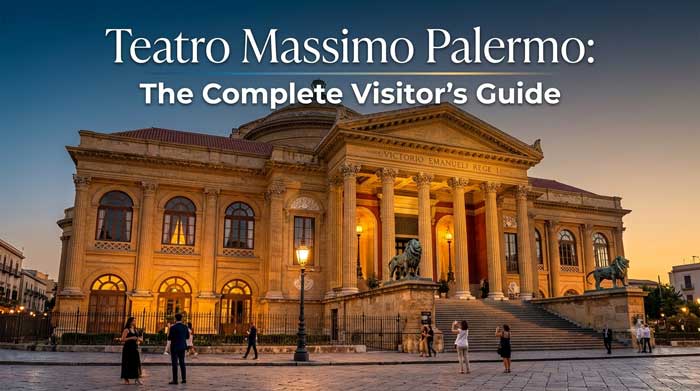
The Teatro Massimo Vittorio Emanuele is the largest opera house in Italy and the third largest in Europe larger than the Vienna State Opera, larger than the Paris Opera, surpassed only by the Paris Opera Bastille and the Opéra National de Paris in the European ranking. This is not a claim that requires qualification: the Teatro Massimo has a stage of 1,200 square metres and an auditorium that seats 1,381 a scale that the visitor encounters physically on arrival at the Piazza Verdi as a genuinely monumental presence in the city. The theatre was inaugurated in 1897 after 23 years of construction, became the cultural symbol of the Palermitan ambition at the peak of the Florio-era bourgeois prosperity and was closed for restoration in 1974 a closure that lasted, due to the specific combination of bureaucratic inertia, political dysfunction and the interventions of the Sicilian construction industry, for 23 years. The theatre reopened in 1997, exactly 100 years after its inauguration, and has since resumed its position as one of the most important opera and concert venues in Italy.
In this guide
- History the 23-year construction and the 23-year closure
- The architecture
- The Godfather III connection
- Visiting the Teatro Massimo guided tours
- The opera and concert programme
- Practical information
- What to see nearby
- FAQ
History the 23-Year Construction and the 23-Year Closure
The Teatro Massimo was conceived in 1864 as the centrepiece of the Palermo urban renewal programme the Piano di Risanamento that would transform the capital of the newly unified Italian Sicily from a medieval labyrinth into a modern European city. The architect Giovanni Battista Filippo Basile won the competition in 1864 and began construction in 1875 after a decade of administrative delay; he died in 1891 before the theatre was complete, and the completion was carried out by his son Ernesto Basile (who would become the most significant Sicilian architect of the Liberty era). The theatre was inaugurated on May 16th, 1897 with a performance of Verdi’s Falstaff the opera chosen to honour the composer in the year of his death.
The 23-year closure (1974 to 1997) is the most notorious episode in the theatre’s history and the one most directly connected to the specific pathologies of the Sicilian political economy of the postwar period. The theatre was closed for routine maintenance and restoration; the restoration contract became a vehicle for the specific corrupt interplay between the construction industry, the political class and the organised crime organisations that had colonised the Palermo public works economy since the 1950s. The restoration took 23 years instead of the projected 2 to 3, cost approximately 60 billion lire (approximately €180 million in current values) instead of the projected 8 billion and became internationally known as a symbol of Sicilian institutional dysfunction. The reopening in 1997 the exact centenary of the inauguration was a genuinely emotional moment for Palermitans who had grown up with the closed theatre as the most visible civic embarrassment of their city.
The Architecture
The Teatro Massimo is the finest example of Italian theatrical neoclassicism and the masterpiece of the Basile father-and-son architectural practice. The facade presents six Corinthian columns above a broad ceremonial staircase the most monumental theatre entrance in Italy, the proportional relationship between the column height, the staircase width and the urban space of the Piazza Verdi producing a civic presence of exceptional quality. The dome above the auditorium is visible from much of the historic centre and from the Via Maqueda approach as the commanding visual terminus of the principal axis of the Palermo street grid.
The interior is the most significant element architecturally the horseshoe plan auditorium with five tiers of boxes (palchi) in the traditional Italian opera house format, the ceiling fresco by Luigi Di Giovanni depicting the Triumph of Music, the specific acoustic quality of the horseshoe plan that gives the unamplified human voice the projection that the Teatro Massimo’s acoustic reputation is built on. The royal box at the centre of the first tier level is the most elaborately decorated single space in the theatre; the six royal portraits in the lobbies of the tiers levels are the most significant collection of formal portrait painting in any Sicilian public building. The backstage tour includes the stage machinery the 19th-century fly tower and counterweight system that is still partially operational and provides the specific theatrical dimension that the front-of-house tour cannot.
The Godfather III Connection
The Teatro Massimo provides the setting for the most celebrated sequence in The Godfather Part III (Francis Ford Coppola, 1990) the opera house finale in which Michael Corleone witnesses the performance of Cavalleria Rusticana while the assassination attempt on his life unfolds, concluding with the death of his daughter Mary on the theatre staircase. The sequence is filmed at the actual Teatro Massimo; the staircase visible in the film is the ceremonial entrance staircase of the Piazza Verdi facade. The performance visible in the film is Cavalleria Rusticana by Pietro Mascagni the opera most specifically Sicilian in its setting (the libretto is set in a Sicilian village) and its atmosphere (the violent, operatic climax of the jealousy narrative resonating with the violence of the Corleone climax). The Teatro Massimo Godfather tour available as part of the guided visit covers the specific filming locations within the theatre and provides the narrative of the production history.
The connection between The Godfather and the Teatro Massimo has made the theatre one of the most visited Coppola filming locations in Italy the staircase photograph with the memory of the final scene is the most reproduced single tourist photograph of the Palermo historic centre after the Cappella Palatina mosaics. Read our complete Sicily film locations guide.
Visiting the Teatro Massimo Guided Tours
The Teatro Massimo offers daily guided tours of the auditorium, the royal foyer, the backstage and the historical archives. The standard tour (approximately 30 minutes) covers the auditorium, the royal box, the ceiling fresco and the main lobby spaces; the extended backstage tour (approximately 60 minutes, available on specific days and requiring advance booking) covers the stage machinery, the costume and set workshops and the specific theatrical infrastructure of the 19th-century fly tower.
Tour times: daily from 9.30am to 5.30pm (last tour entry). Closed on days with daytime rehearsals or performances check the theatre website (teatromassimo.it) for the current tour availability calendar before visiting. Entry fee: approximately €10 for the standard tour, €15 for the extended backstage option (prices subject to change confirm on the theatre website). The tour is available in English, Italian, French, Spanish and German; audio guides are available for independent tours. No booking required for the standard tour in the low season; advance booking recommended for July and August when the tour capacity fills.
👉 TEATRO MASSIMO PALERMO GUIDED TOUR THE GODFATHER STAIRCASE AND ITALY’S FINEST OPERA HOUSE
A guided tour of the Teatro Massimo the auditorium, the royal box, the Godfather III filming locations and the history of the theatre that took 23 years to build and 23 years to restore. Available daily with English-speaking guides. The most historically specific single building tour in Palermo.
👉SEE THE BEST TEATRO MASSIMO PALERMO GUIDED TOUR HERE
The Opera and Concert Programme
The Teatro Massimo opera season runs from October through June, with the main opera productions (typically 6 to 8 new productions per season) concentrated in the autumn, winter and spring months. The symphony concert programme (the Orchestra del Teatro Massimo) runs year-round. The summer programme (July and August) includes open-air concerts and special events in the theatre foyer and on the exterior staircase that complement the main season programme.
The opera productions at the Teatro Massimo range from the standard Italian repertoire (Verdi, Puccini, Rossini) to less frequently performed 19th and early 20th-century Italian opera and occasional international repertoire. The specific Sicilian connection: Cavalleria Rusticana by Mascagni (the Sicilian village opera, premiered in Rome in 1890 and subsequently staged at the Teatro Massimo in its natural setting with particular atmospheric resonance) is the most frequently produced opera at the theatre, and the staging of any production with Sicilian content takes on a specific contextual weight at this venue. The Bellini connection: the Teatro Massimo Bellini in Catania is the rival great Sicilian opera house, dedicated to the Catanese composer; the programming competition between the two houses is a specific dimension of the Palermo-Catania cultural rivalry that both cities take seriously. Read our complete Palermo guide.
Tickets: available on the Teatro Massimo website (teatromassimo.it), by telephone and at the box office on Piazza Verdi. Prices range from approximately €15 (upper gallery standing or restricted view seats) to €130 (premium stalls and first-tier box seats) for opera productions. The symphony concert programme is significantly less expensive (€10 to €50 for most programmes). The box office opens 1 hour before performances for day-of tickets; in-demand productions sell out 2 to 3 weeks in advance.
Practical Information
Address: Piazza Verdi, 90138 Palermo. At the northern end of Via Maqueda, 10 minutes’ walk from the Quattro Canti.
Getting there: The theatre is in the pedestrian zone of the northern historic centre, accessible on foot from the Quattro Canti in 10 minutes along Via Maqueda. The nearest bus stops are on Via Cavour and Via Roma. There is no parking immediately adjacent; the nearest car parks are on Via Sampolo and Via Volturno at the edge of the pedestrian zone.
Tour dress code: Smart casual is appropriate for tours; for evening performances, the Teatro Massimo maintains a dress expectation aligned with the formality of a major Italian opera house formal wear is not required but elegant attire is appropriate and respected.
Photography: Photography without flash is permitted during guided tours. Photography is not permitted during performances.
Accessibility: The theatre is accessible for visitors with reduced mobility via the side entrance on Via Turati; the main staircase is not accessible by wheelchair. Confirm accessibility requirements when booking tours or performances.
What to See Nearby
The Teatro Massimo is at the northern end of the Via Maqueda axis the principal north-south street of the Palermo historic centre that connects the theatre to the Quattro Canti and the southern historic centre in a 10-minute walk. The immediate neighbourhood of the Piazza Verdi provides the finest concentration of the Palermo Liberty architecture the department store La Rinascente on Via Roma (the finest example of the Palermo commercial Liberty style), the Grand Hotel Piazza Borsa (the 19th-century stock exchange converted to a hotel) and the Politeama Garibaldi theatre (the second great Palermo theatre, on the Piazza Ruggero Settimo, 10 minutes north of the Massimo).
The Palazzo dei Normanni and the Cappella Palatina are 20 minutes south along Via Maqueda and Corso Vittorio Emanuele the natural complement to the Teatro Massimo visit for the full Palermo cultural day. The Ballarò market is 15 minutes south of the theatre and provides the food programme that the mid-morning or early afternoon visit allows before the afternoon nap and the evening performance. Read our complete Palermo 2-day itinerary and Cappella Palatina guide.
Frequently Asked Questions
Can you visit the Teatro Massimo without a ticket to a performance?
Yes guided tours of the theatre are available daily (subject to rehearsal schedules) and allow visitors to see the auditorium, the royal foyer and the backstage without attending a performance. The tour fee is approximately €10 for the standard 30-minute programme. Check the theatre website for current tour availability before visiting.
Is the Teatro Massimo in The Godfather?
Yes the Teatro Massimo provides the setting for the opera house finale of The Godfather Part III (1990), including the famous staircase sequence. The theatre was used for the actual filming and the staircase visible in the film is the real ceremonial entrance of the Piazza Verdi facade. The guided tour includes the Godfather filming location programme.
What is the dress code for an opera at the Teatro Massimo?
Formal dress is not required but elegant or smart attire is appropriate and expected. The Teatro Massimo is a major Italian opera house with a traditional audience; a jacket for men and smart dress or equivalent for women is the standard expectation for evening performances. Jeans and sportswear are technically permitted but conspicuous.
The Building That Took Two Generations
The Teatro Massimo is the building that Palermo took longest to build and longest to restore, and the building that most specifically expresses the Palermitan ambition and the Palermitan dysfunction simultaneously. The 23 years of construction (1875 to 1897) and the 23 years of closure (1974 to 1997) are the same duration a symmetry that is either cosmic coincidence or the specific signature of a city whose relationship with its own grandest projects has always been complicated by the gap between the vision and the execution. The theatre that emerged from both periods of delay is one of the finest opera houses in the world. The Sicilian capacity to build extraordinary things slowly is, in the Teatro Massimo’s case, entirely justified by the result.
For the complete Palermo cultural programme, read our Palermo guide, our Cappella Palatina guide and our Palermo 2-day itinerary.
Did this guide help you plan your Teatro Massimo visit? Save it to Pinterest or share it with someone who loves opera and doesn’t yet know that the finest stage in Italy is in Palermo.


